Scientists Solve the Mystery of Bizarre Golden Egg Found Deep Beneath Ocean Surface After Years Of Speculation
Synopsis
What was the mysterious 'golden egg' from the deep ocean? After baffling scientists, genetic tests reveal the true identity of this strange deep-sea discovery.
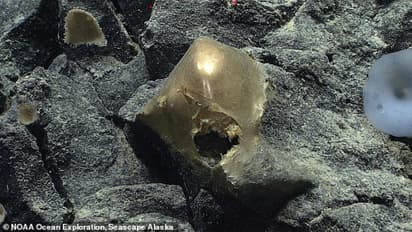
A peculiar object, known as the “golden egg,” found deep under the ocean, has finally been identified after it left scientists baffled for three years. The unusual shape, slightly over 10 centimetres across, was discovered more than 3 kilometres under the surface in the Gulf of Alaska. Its smooth and shiny look, along with a mysterious hole, sparked wild theories, including the idea that it might be from alien life.
Early Discovery
The object was first found in 2023 during a deep-sea mission by the National Oceanic and Atmospheric Administration. Scientists operating the remotely controlled vehicle Deep Discoverer saw the odd structure sitting on a rock.
Unsure of what they had found, they carefully picked it up with the vehicle’s robotic arms and took it to the research ship Okeanos Explorer. At that time, they could only say for sure that it was of biological origin.
Public Speculation
The discovery grabbed a lot of attention from the public. Many online guessed it might be an alien organism. Others thought it could be a new marine species, especially since so much of the deep sea remains unexplored. Some experts believed it might be an egg case from a sea creature, but no one knew for certain.
Also read: Meal Timing Plays Key Role in Weight Loss: Early Dinner and Breakfast Linked to Lower BMI
Detailed Analysis
The sample was eventually sent to the Smithsonian National Museum of Natural History, where a team led by Dr Steven Auscavitch and Dr Allen Collins started a thorough investigation.
Early look at the object showed it had no features typical of animals, such as a mouth or muscles, and it did not look like an egg either.
Key Clues
Closer inspection with a microscope showed that the material was fibrous and covered in specialised stinging cells known as cnidocytes.
This suggested scientists were looking at the cnidarian group, which includes corals and sea anemones. Further testing narrowed the possibilities down to a subgroup called Hexacorallia.
Genetic Match
To confirm their findings, researchers performed advanced genetic tests, including whole-genome analysis. The results showed strong similarities with a large deep-sea anemone called Relicanthus daphneae. DNA sequencing of the mitochondrial material provided final proof that the “golden egg” was not an egg but a leftover part linked to this species.
True Identity
Scientists now think the object is a pile of dead cells that once formed the base of the anemone, anchoring it to a rock. At some point, the animal either moved away or died, leaving this part behind. These anemones can grow as long as two metres and live near deep-sea vents, where they use long, stinging tentacles to feed.
Ongoing Mystery
Co-author Charlotte Benedict said some questions are still unanswered. It is unclear exactly how the structure became separate from the rest of the animal. One possibility is that it was left behind during a process of asexual reproduction, where part of the organism breaks off. Despite the mystery, the discovery shows how much we still don’t know about life in the deep ocean.
Source: Daily Mail - Science & Tech
Also read: Ultra-Processed Foods May Harm Cognitive Abilities and Raise Dementia Risks: Study