Punch the Monkey’s Heartbreaking Story: Experts Explain Why Some Mothers Abandon Their Babies
Synopsis
Discover the moving story of Punch, a baby Japanese macaque abandoned by his mother. Learn why he clings to a stuffed toy and the expert reasons for this behaviour.
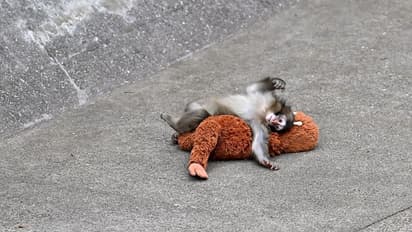
A tiny monkey in Japan has touched hearts worldwide after viral videos showed him being left by his mother and bullied by other monkeys. Punch, a Japanese macaque born last July at Ichikawa Zoo, has attracted global attention because zoo workers gave him a stuffed orangutan toy after his mother abandoned him.
Without his mother’s support, Punch has found comfort in the toy, which he clings to constantly. The videos show him being chased and roughly handled by older macaques, wandering alone with the toy, and holding it tightly as he is teased. In one instance, another monkey was seen grooming him, but shortly after, he was forced to hide behind a rock, clutching his toy for comfort.
Punch the Monkey: Why Mothers Abandon Their Offspring
This leads to an important question: why would a mother leave her baby? Alison Behie, a primatologist at Australian National University, explained to The Guardian that while it is uncommon, mothers might abandon infants under certain conditions.
She said, “In Punch’s case, their mother was a first-time mother, indicating inexperience. Zookeepers also suggest Punch was born during a heatwave, which would be a high stress environment. In environments where survival is threatened from outside stress, mothers may prioritise their own health and future reproduction rather than continue to care for an infant whose health may be compromised by those environmental conditions.”
After attempts to calm Punch with rolled towels failed, zookeepers introduced the stuffed orangutan.
Kosuke Shikano, a zookeeper, shared with The Guardian, “Baby Japanese macaques immediately cling on to their mother’s body after birth to build muscle strength. They also get a sense of security through holding on to something. However, because he had been abandoned, Punch had nothing to grip on to. We thought that the toy looking like a monkey might help Punch integrate back into the troop later on.”
Behie added that the toy might serve as an attachment figure, especially since Punch is six months old and likely still needs nursing. She also noted that the behaviour of the other monkeys isn’t bullying, but rather typical social interactions. Japanese macaques live in tightly structured matrilineal groups, and without his mother, Punch may struggle to learn proper submissive behaviours, which could affect his ability to fit in as he grows.
Punch’s story has led to increased visitor numbers at the zoo, prompting new visitor regulations.
Carla Litchfield, a conservation psychologist at Adelaide University, said, “This story about Punch highlights the impacts of habitat loss, climate change, zoo animal welfare, and the power of social media to connect people to animals… Monkeys belong with other monkeys. They are social beings and need to be with their own species to thrive mentally and physically.”
Like Punch, other young animals in zoos, such as Moo Deng the pygmy hippo in Thailand, have also received global attention in recent years.