Meet the 'Cosmic Owl': A rare galactic collision spotted by James Webb telescope
Synopsis
James Webb Space Telescope has spotted a rare double-ring galaxy collision 11 billion light-years away, forming an owl-like face. Known as the 'Cosmic Owl', it offers valuable insights into star formation and galaxy evolution.
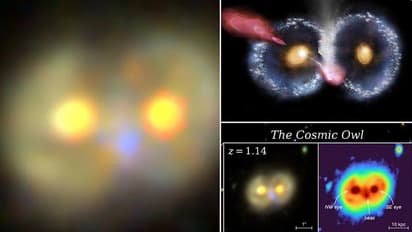
Scientists using the James Webb Space Telescope (JWST) have discovered a strange, owl-faced object deep in space. Nicknamed the 'Cosmic Owl', this object is the result of a rare collision between two unusual galaxies. These galaxies are known as ring galaxies, and their encounter has created a structure that looks like the face of an owl, with two glowing eyes and a sharp beak.
What are ring galaxies?
Most galaxies are either spirals, like the Milky Way, or have other regular shapes. But ring galaxies are very rare. They are formed when a smaller galaxy crashes through a larger one. This violent meeting pushes gas and stars into a ring around a central core. Only 0.01% of all known galaxies are ring galaxies. Even rarer is the collision of two ring galaxies and that is exactly what created the Cosmic Owl.
A lucky find
Mingyu Li, a PhD student at Tsinghua University in China, found the owl-like object by chance. He and his team were studying public data from a part of the sky called the COSMOS field, reports Live Science. This area has been observed in great detail. Thanks to JWST’s powerful cameras, the team spotted the unique double-ring shape of the colliding galaxies.
The owl's features
Each galaxy in the collision is about 26,000 light-years across, about a quarter the size of the Milky Way. Each has a bright, dense centre filled with old stars and a supermassive black hole. These bright centres look like the owl's eyes, the Live Science report said. Both black holes are more than 10 million times the mass of our Sun and are actively pulling in nearby material. This makes them active galactic nuclei.
The owl's 'beak'
The spot where the galaxies are crashing into each other forms the owl’s beak. This area is full of thick gas and is very active. Observations from the ALMA telescope in Chile found a massive cloud of molecular gas there. This gas is the raw material for new stars. A shock wave caused by the collision is squeezing the gas and causing new stars to form rapidly.
Extra pressure from a black hole jet
One of the galaxies is also blasting a jet of charged particles from its black hole. This jet is hitting the gas cloud and compressing it even more. This mix of pressure and gas is creating what scientists call a stellar nursery, a place where many new stars are being born.
How far is it?
The Cosmic Owl is about 11 billion light-years away. That means the light we see from it started its journey when the universe was much younger.
A natural lab for scientists
The Cosmic Owl is not just beautiful! It is very useful for science. It shows many important things about how galaxies change over time. Li and his team believe that the burst of star formation in the owl’s beak could reveal new ways that galaxies grow quickly in the early universe.
The team wants to study the Cosmic Owl more closely. By using simulations, they hope to learn how the galaxies crashed into each other and why they formed such a perfect twin-ring shape. This will help scientists understand more about galaxy shapes and behaviour.
Not the first odd shape from JWST
This is not the first strange space object spotted by the JWST. In the past, it has found galaxies shaped like a question mark and a baby star's gas trail that looked like a cat’s tail. The Cosmic Owl now joins this list of curious and amazing cosmic sights.