Mars rover finds strongest signs yet of possible ancient microbial life
Synopsis
Perseverance rover uncovers minerals in Jezero Crater resembling microbial activity on Earth, offering the strongest evidence yet of ancient life on Mars.
NASA’s Perseverance rover has uncovered minerals in Jezero Crater that resemble by-products of microbial activity on Earth. The discovery, backed by Imperial College London scientists, is the strongest evidence yet that Mars may once have supported microbial life. While only Earth-based labs can confirm, samples already collected could hold the long-awaited answer to the question: Are we alone?
Ancient Mars May Have Been Habitable
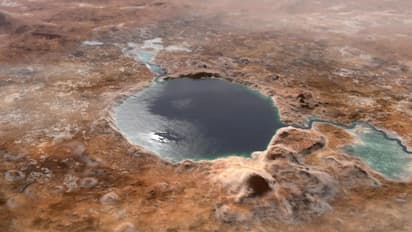
Billions of years ago, Jezero Crater on Mars wasn’t the barren dust bowl we see today. It was a calm lake, fed by rivers, rich in minerals like clay and silica — exactly the kind of environment where life could flourish.
Now, researchers have found the strongest hints yet that this Martian lake may have nurtured microbial life. Perseverance rover’s instruments detected mudstones containing iron-phosphate and iron-sulfide nodules — minerals often linked with biological activity on Earth.
Professor Sanjeev Gupta of Imperial College London explains:
“This is a very exciting discovery of a potential biosignature. But it doesn’t mean we’ve discovered life on Mars yet. Only when these samples are studied on Earth will we know for sure.”
What Perseverance Found
Since 2021, NASA’s Perseverance rover has been exploring Jezero Crater, searching for evidence of past habitability. Its recent focus was a light-toned rock formation called Bright Angel, located in an ancient river valley.
Instead of just river deposits, researchers were surprised to find lake sediments — fine-grained mudstones that suggest a period when the valley itself was flooded, forming a still-water environment ideal for microbial life.
Within these rocks, Perseverance identified millimeter-sized nodules enriched with iron and phosphorus. On Earth, these minerals are typically formed through redox reactions involving organic carbon — the same processes microbes use to survive.
Why This Matters
If confirmed, these minerals could represent the closest thing to a Martian “fossil signature” ever discovered. While non-biological processes can also create them, the similarities to microbial activity on Earth are too strong to ignore.
“This is unusual but very intriguing,” says Alex Jones, a PhD researcher at Imperial and part of the Perseverance team. “It points to a past low-energy lake — precisely the type of environment where we’d expect life to thrive.”
The Next Big Step: Bringing Mars Rocks to Earth
Perseverance has already drilled and stored a core sample from Bright Angel, named Sapphire Canyon. That sample, along with others, is waiting for the upcoming NASA–ESA Mars Sample Return mission, scheduled for the 2030s.
Once these rocks reach Earth, scientists will analyze them with advanced instruments far beyond the rover’s capabilities. Only then can we know for sure whether the minerals are products of chemistry alone — or traces of ancient Martian microbes.
A Turning Point in the Search for Life
Experts are cautiously optimistic. Matthew Cook, Head of Space Exploration at the UK Space Agency, calls it:
“The most promising evidence yet that Mars may once have hosted the conditions for microbial life.”
The discovery also underscores the importance of international collaboration and future missions like the Rosalind Franklin rover, which will dig deeper beneath the Martian surface in search of biosignatures.
For now, the question remains unanswered — but humanity may finally be closing in on proof that life once existed beyond Earth.