Deep-sea volcano off Oregon that once triggered 8,000 earthquakes could erupt 'any day' - Should we be worried?
Synopsis
An underwater volcano off the Oregon coast, Axial Seamount, is showing signs of imminent eruption, but scientists say it poses no threat to humans.
A massive underwater volcano off the coast of Oregon, United States, could erupt any day now, according to top scientists closely monitoring the area. The Axial Seamount, a mile-wide submarine volcano located 300 miles off Oregon’s coast and nearly 5,000 feet below the Pacific Ocean surface, is showing signs of another eruption nearly a decade after its last.
Seafloor Swelling Signals Magma Build-Up
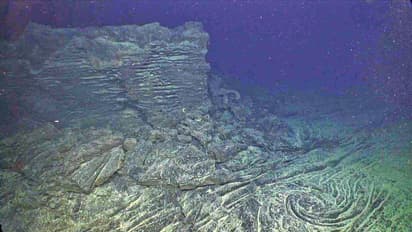
The last eruption in 2015 triggered about 8,000 earthquakes, created lava flows up to 400 feet thick, and caused the ocean floor to sink by nearly eight feet. Now, scientists have again detected a key precursor to eruption: inflation of the seafloor, indicating magma accumulation beneath the surface.
According to William Wilcock, a professor and marine geophysicist at the University of Washington, “The seafloor has already inflated to the level that it reached before the 2015 eruption.”
“Some researchers have hypothesized that the amount of inflation can predict when the volcano will erupt,” he said in a statement. “That means it could really erupt any day now, if the hypothesis is correct.”
No Threat to Humans Despite Imminent Activity
Despite the alarming signs, scientists assure that the volcano poses no threat to human populations. Due to its deep and remote location, any eruption would go unnoticed by people on land and wouldn’t affect seismic activity onshore.
Mike Poland, a scientist at the Yellowstone Volcano Observatory, emphasized the scientific value of the event. “This particular volcano is probably the best-monitored submarine volcano in the world,” he told Cowboy State Daily. “It’s fascinating and doesn’t really pose a hazard.”
A Calm, Hawaiian-Style Eruption Expected
Located along the Juan de Fuca Ridge—a chain of underwater volcanoes stretching from Oregon to Alaska—Axial Seamount is a young shield volcano, characterized by broad, low-profile structures.
“When Axial Seamount erupts, it’ll look a lot like a Hawaiian lava flow eruption,” said Poland. “It’s not an explosive eruption, but calm effusions of lava flowing out of the caldera and across the seafloor.”
Forecast Window Open Until End of 2025
Eruptions were previously recorded in 1998, 2011, and 2015. Oregon State University geophysicist William Chadwick and his team began closely monitoring the volcano again in November 2024 after noticing similar patterns of surface swelling seen before the 2015 eruption.
“Because it's had these three eruptions in the last 30 years, that's why we call it the most active volcano in the Pacific Northwest,” Chadwick told KOIN 6 News. “Most of the ones on land aren't active that frequently, and they spend a lot of their time slumbering, whereas Axial has a pretty active magma supply. So, if it's not erupting, it's inflating and getting ready for the next one. And so that's why we're kind of monitoring what's happening to it all the time.”
Based on recent trends, scientists predict the eruption window is between now and the end of 2025.
Earthquake Swarms Increasing Around the Volcano
The team has recorded a sharp uptick in seismic activity, with hundreds of small quakes occurring daily and swarms exceeding 500 per day.
Frequent, low-magnitude earthquakes often indicate magma movement beneath the ocean floor. According to Wilcock, the clearest sign that an eruption is imminent will be a spike in earthquake frequency.
“That period lasts about an hour, and then the magma reaches the surface,” he said. “The seismic activity dies down pretty quickly over the next few days, but the eruption will continue slowly for about a month.”
“Based on the current trends, and the assumption that Axial will be primed to erupt when it reaches the 2015 inflation threshold, our current eruption forecast window is between now (July 2024) and the end of 2025,” the researchers reported.
A Rare Research Opportunity for Scientists
Researchers plan to use an array of sophisticated instruments to monitor the eruption in real time. The University of Washington’s College of the Environment operates one of the world’s largest underwater observatories, which includes a network of sensors across the seafloor and throughout the ocean.
When Axial Seamount erupts, Wilcock and his team will use the observatory to capture data and imagery of the event as it unfolds.
Helping Forecast More Dangerous Eruptions in the Future
While Axial Seamount is not a danger to the public, the insights it provides could help forecast more hazardous eruptions elsewhere.
In 2022, the Hunga underwater volcano in Tonga erupted violently, generating a tsunami that caused approximately $90 billion in damages across multiple countries including the US, Canada, Japan, and others.
The West Coast won’t face such consequences from Axial, but scientists hope its eruption will bring valuable lessons in submarine volcanic behavior.