Earth's Orbit Getting Too Crowded? 1.5L Collision Alerts For Indian Satellites In 2025
Synopsis
According to the Indian Space Situational Assessment Report 2025, more than 1.5 lakh alerts were issued for Indian space assets alone, out of nearly 1.6 lakh warnings generated globally, many flagged by the US Space Command’s Combined Space Operations Center.
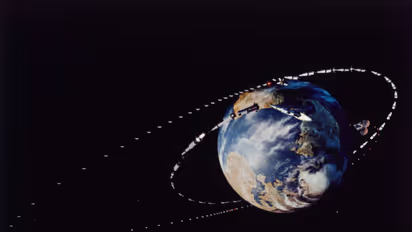
Earth’s orbit is fast turning into a chaotic superhighway, and India’s satellites are being forced into evasive action to dodge danger in real time. A surge in close-approach alerts has exposed the growing threat of mid-space collisions, as orbital lanes become dangerously congested.
According to the Indian Space Situational Assessment Report 2025, more than 1.5 lakh alerts were issued for Indian space assets alone, out of nearly 1.6 lakh warnings generated globally - many flagged by the US Space Command’s Combined Space Operations Center. Each alert signals a potential near miss, underscoring how tightly packed Earth’s orbital environment has become amid a boom in satellite launches.
The rapid deployment of massive satellite constellations - often exceeding 100 satellites in a single day—has drastically shrunk response windows and made tracking far more complex. For Indian Space Research Organisation (ISRO), this has translated into relentless vigilance and frequent course corrections.
Indian missions executed 18 collision avoidance manoeuvres (CAM) in 2025 - 14 in low Earth orbit and four in geosynchronous orbit—to steer clear of potential disasters. “All manoeuvre plans, including CAMs, were subjected to close-approach risk analysis to rule out potential close approach with neighbouring space objects within a few days of the manoeuvres; 82 manoeuvre plans were revised to avoid post-manoeuvre close approaches with other space objects for LEO satellites, and two were revised to avoid post-manoeuvre conjunctions for GEO satellites,” the report found.
The Chandrayaan-2 orbiter had to perform 16 orbit adjustments, with plans altered twice to avoid collision risks.
Meanwhile, the global space race is accelerating at an unprecedented pace. In 2025 alone, 315 successful launches injected 4,651 objects into orbit—far surpassing 254 launches in 2024 and 212 in 2023. Of these, 4,198 remain operational satellites. Although 1,911 objects reentered Earth’s atmosphere, the overall population in orbit continues to swell rapidly.
Experts warn that a critical tipping point is approaching. Within this decade, active satellites could outnumber space debris, raising the stakes for coordination as thousands of objects hurtle through increasingly narrow orbital corridors at speeds.