World’s Oceans Face New Crisis as Sea Urchins Die in Massive Numbers
Synopsis
A silent global pandemic is causing a mass die-off of sea urchins. Discover the mystery pathogen threatening marine ecosystems and what it means for our oceans.
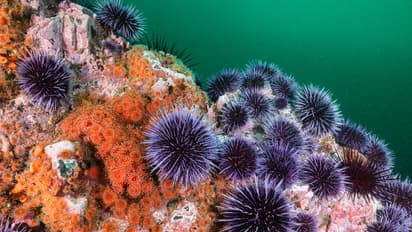
Sea urchins are not just curious sea creatures with spikes, they are essential for maintaining healthy ocean environments. They feed on seaweed and seagrass, which helps control algae growth and allows slower-growing species like corals to survive. These urchins also serve as food for many marine animals, including fish, crustaceans, sea stars, and sea mammals.
However, when there are too many sea urchins, especially if their natural predators are overfished, the ecosystem can become unbalanced. Large groups of urchins can strip the seafloor of vegetation, leading to areas known as “urchin barrens,” where most life cannot survive.
A Global Sea Urchin Pandemic
A recent study published in Frontiers in Marine Science has identified a previously unknown disease that is killing sea urchins in various parts of the world and has now reached the Canary Islands. Scientists are concerned about the potential damage this could cause to the environment.
Iván Cano, a doctoral student at the University of La Laguna in Tenerife, shared these findings: “Here we show the spread and impacts of a 'mass mortality event' which severely hit populations of the sea urchin Diadema africanum in the Canary Islands and Madeira through 2022 and 2023.”
At the same time, other Diadema species were dying in the Caribbean, Mediterranean, Red Sea, Sea of Oman, and western Indian Ocean.
From Overabundant Grazers to Sudden Collapse
The genus Diadema includes eight species that live in warm waters across the globe. Diadema africanum was commonly found along rocky coasts in western Africa and the Azores, typically at depths of 5 to 20 metres.
In the Canary Islands, the population of D africanum has been increasing since the 1960s, possibly due to overfishing of predators and warmer ocean temperatures. By the 2000s, urchin numbers had grown so much that large areas of the seafloor became bare. Efforts to balance their population naturally between 2005 and 2019 were not successful.
Rapid Die-Off Across the Islands
In February 2022, Cano and his team noticed that D africanum were dying in large numbers near La Palma and Gomera. Over the course of the year, the disease spread eastward across the islands. Affected urchins became slow, moved unpredictably, ignored signals, and eventually lost their spines and flesh before dying.
This is not the first time these urchins have faced such a crisis. Similar die-offs happened in 2008 and 2018, causing the loss of about 90-93% of local populations. After those events, the numbers recovered, but this time, recovery did not occur. A second wave of deaths happened in 2023.
Historic Lows and Reproduction Collapse
To understand the scale of the die-off, Cano and his team studied 76 sites across the seven main islands from 2022 to 2025. They also worked with professional divers and trapped larvae in eastern Tenerife to track reproduction.
The results were concerning. D africanum populations are at their lowest level ever. Since 2021, the species has dropped by 74% in La Palma and by 99.7% in Tenerife. Reproduction is nearly gone, with very few larvae and no young urchins found in the areas surveyed.
Mystery Pathogen Threatens Reef Grazers
The exact cause of the pandemic is not yet known. Past die-offs of Diadema have been connected to tiny parasites, like scuticociliate ciliates of the genus Philaster and amoebae such as Neoparamoeba branchiphila. Environmental factors, like unusual ocean waves and southern swells, could also be involved.
Why This Matters
Sea urchins play a crucial role in marine ecosystems. Their sudden decline could harm coral reefs, rocky habitats, and the many species that rely on them. Scientists are working hard to understand this pandemic and find ways to protect these important grazers before the ocean’s balance is further disturbed.