Greenland Ice Sheet Melting Faster Than Ever, Scientists Warn of Rising Extreme Events
Synopsis
Discover why Greenland's ice sheet is melting six times faster. A new study highlights the rise of extreme melt events and the urgent global risks of rising sea levels.
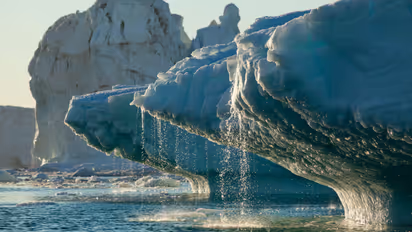
Scientists are raising concerns as Greenland's massive ice sheet is melting at a much quicker pace than in the past. A recent study led by the University of Barcelona, published in Nature Communications, reveals that extreme melting events are occurring more frequently, spreading across large areas, and releasing significantly more water.
Since 1990, the area affected by these intense melting events has expanded by roughly 2.8 million square kilometres every decade. At the same time, the volume of meltwater has increased sharply. Between 1950 and 2023, such events produced an average of about 12.7 gigatonnes of water per decade. After 1990, this amount surged dramatically to 82.4 gigatonnes per decade, a sixfold increase.
Rising Extremes
The most severe melting incidents have mainly taken place in recent years. Seven out of the ten largest events recorded have occurred since 2000, including significant events in 2012, 2019, and 2021. These events are remarkable because there have been no similar occurrences in earlier records.
Also read: Can Salt Save the Planet? UK Scientists' Plan to Block Sun’s Rays Raises Concerns
Not only are these events becoming more frequent, but each one is also producing more meltwater than before. Since 1990, the amount of meltwater from such events has increased by about 25% compared to similar conditions between 1950 and 1975.
When considering all extreme events together, the increase reaches up to 63%. This suggests that rising temperatures are playing a major role, causing more intense melting than changes in weather patterns alone would explain.
Northern Hotspot
Northern Greenland has now become one of the most affected regions, emerging as a key hotspot for extreme ice loss. Scientists warn that under high greenhouse gas emissions, the most intense melting could be up to three times stronger by the end of the century.
The study, led by researcher Josep Bonsoms with contributions from Marc Oliva, analyzed data from 1950 to 2023. The team employed a new method that combined various atmospheric circulation patterns with climate models. This enabled them to differentiate between the impacts of rising temperatures and shifts in weather systems.
Wider Impact
These findings underscore serious global consequences. Faster ice melt contributes to rising sea levels and can disrupt ocean circulation. At the same time, Greenland's changing environment is increasing its geopolitical and economic significance. Understanding these trends is crucial for preparing for future risks and developing effective climate policies.
Also read: Global Climate Warning: River Deltas Sinking Rapidly, Threatening Millions of Lives