Over 1,400 Deaths: Why 6.0 Magnitude Afghanistan Earthquake Killed So Many
Synopsis
A 6.0 earthquake in eastern Afghanistan killed 1,411 people, destroying fragile villages. Shallow depth worsened impact, trapping families and leaving survivors without aid, raising questions on why Afghan quakes cause such severe devastation.
When a magnitude 6.0 earthquake struck eastern Afghanistan on late Sunday night, it left behind widespread destruction. The Afghan Red Crescent Society has confirmed that 1,411 people have died and injured over 3,124 in the recent earthquake in Afghanistan, reports Al Jazeera. The humanitarian group said rescue teams are still searching through the rubble as survivors struggle for food, water and shelter.
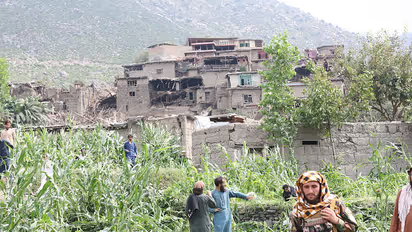
The tremor's epicentre was shallow, only about 8km underground, which amplified shaking at the surface. Entire villages made of fragile mud and stone crumbled within seconds, trapping families asleep inside their homes. This disaster raises a crucial question - Why are earthquakes in Afghanistan often so devastating compared to similar quakes in other parts of the world?
A region prone to earthquakes
Afghanistan lies in one of the world's most seismically active regions. The eastern provinces, including Kunar and Nangarhar near the epicentre, sit at the collision zone of the Indian and Eurasian tectonic plates. This ongoing movement pushes up the towering Himalayas and Hindu Kush mountains but also builds enormous underground stress, released through frequent earthquakes.
The region has a tragic history of deadly quakes. In October 2023, an earthquake killed over 1,500 people in western Afghanistan. A year earlier, another quake killed more than 1,000. Further back, disasters like the 2005 earthquake in Pakistan, which left 74,640-88,714 dead, over 138,000 injured while displacing around 2.8 million and the 2015 Gorkha earthquake in Nepal, which killed nearly 9,000 people highlight the recurring threat across South Asia.
Why Did Afghanistan Earthquake Kill So Many?
Experts often say: "Earthquakes don't kill people, buildings do." This phrase highlights how the built environment plays a larger role than the quake itself, says a study in The Conversation.
In rural Afghanistan, most families live in homes built from mud bricks, stone and timber - materials that are locally available but structurally weak. These houses are often 'monolithic', meaning heavy walls carry the entire load. When an earthquake's side-to-side shaking hits, these walls collapse instantly. Unlike reinforced concrete or engineered masonry, they provide almost no resistance, crushing anyone inside.
Another factor is timing. The quake struck just before midnight, when most people were sleeping indoors. With little chance to run to safety, many were buried alive under collapsing roofs.
A stark contrast with other countries
This Afghan earthquake, at magnitude 6.0, was similar in strength to the 2011 Christchurch earthquake in New Zealand, which killed 185 people. Despite hitting a dense city, the toll was far lower because buildings there were designed to meet strict seismic safety codes. The comparison highlights how poverty and lack of resilient infrastructure turn natural hazards into deadly disasters. Afghanistan’s rural communities lack resources for safer construction, and formal building codes are rarely applied outside major cities.
Can safer homes be built in poorer regions?
Examples from neighbouring countries of Afghanistan show progress is possible even with limited resources.
Pakistan (2005 earthquake): After more than 80,000 deaths, the government created the Earthquake Reconstruction and Rehabilitation Authority. It trained communities in safer construction techniques and provided support for rebuilding.
Nepal (2015 Gorkha earthquake): The government enforced its National Building Code, setting minimum standards for earthquake-resilient housing, even in villages.
India: Engineer Anand S Arya pioneered simple reinforcements for 'non-engineered' buildings, such as adding horizontal bands along walls and reinforcing corners. These low-cost measures dramatically improve stability during quakes.
These examples prove that earthquake resilience doesn’t always require expensive materials. With technical guidance, communities can rebuild safer homes using local resources such as mud, stone and wood while incorporating key reinforcements.
Climate risks amplify earthquake disasters in Afghanistan's fragile mountains
Although climate change did not cause Afghanistan earthquake; tectonic plate movement did, but warming can worsen its impacts in the Hindu Kush-Himalaya. Heavier downpours and faster glacier melt make slopes unstable, raising landslide and flash-flood risk after strong shaking. Rain-soaked, fractured hillsides collapse onto roads and villages, cutting access for rescue and aid. Heat, drought and deforestation weaken homes and soils, increasing damage. Planning should reflect these compound hazards: build to seismic codes, avoid high-risk slopes, stabilize hillsides, map landslide zones and set up early warnings for rainfall and glacial-lake outbursts. Reducing climate risk will save lives in future quakes.
Afghanistan's unique challenges
Years of conflict, poverty and limited governance have left little space for disaster-preparedness programs in Afghanistan. Roads are often cut off, rescue services are scarce, and communication networks collapse during disasters. Yet this very vulnerability makes 'building back better' a priority.
International organizations, engineering experts, and local leaders could collaborate to create cost-effective guidelines for safer rural housing. Even small interventions like reinforcing mud-brick homes with bamboo or timber bands can prevent walls from crumbling instantly. While no building can be made completely earthquake-proof, safer construction can mean the difference between life and death. If Afghanistan can take lessons from its neighbours, future earthquakes need not bring such catastrophic loss of life.
The deadly earthquake in eastern Afghanistan is a stark reminder of the region’s seismic risks and structural vulnerabilities. Nature's tremors are unavoidable, but mass casualties are not. The tragedy underscores the urgent need for safer construction, stronger institutions, and community awareness. If Afghanistan begins a path toward earthquake-resilient housing, its people may one day sleep more safely, even in a land that shakes often.