Why the Indian Army Needs 83 Akashteer Air Defence Carriers for Frontline Combat
Synopsis
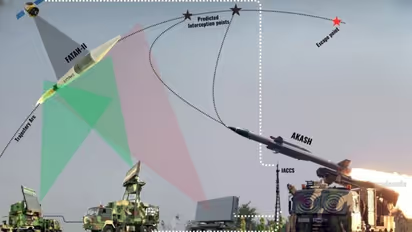
India's Ministry of Defence is procuring 83 Carrier Air Defence Tracked (CADET) systems. These purpose-built tracked vehicles will carry the Akashteer air defence command system, providing protection for mobile tank and armoured columns against aerial threats, including drones.
The Ministry of Defence has issued a request for proposal (RFP) for 83 Carrier Air Defence Tracked (CADET) systems -- purpose-built tracked platforms designed to carry Akashteer air defence command-and-reporting hardware into mechanized combat zones.
The Akashteer system, developed by the Defence Research and Development Organisation (DRDO), is designed to integrate various air defence sensors and weapons into an automated, real-time network.
Linking it to a tracked mobile platform -- rather than fixed or wheeled vehicles -- is intended to ensure it can keep pace with tank and armoured infantry columns, which are particularly vulnerable to aerial and drone threats during offensive operations.
These systems will be procured under the Buy (Indian-IDDM) category, mandating indigenous design and manufacture with at least 65 per cent local content -- part of the defence ministry’s broader push to reduce dependence on imported military platforms.
What it does
Conceived as a mobile command post for air defence gun-missile units, the CADET will operate alongside armoured formations.
It must carry Akashteer electronics -- supplied as buyer-furnished equipment and match the cross-country mobility of tank columns across plains, deserts and mountains up to 5,000 metres.
The platform is also earmarked for future drone detection, interdiction and counter-swarm systems, reflecting the army's recognition that battlefield air threats have expanded well beyond conventional aircraft.
Also Read: Securing the Blue Economy: Indian Navy's 516-Officer Training Effort in Mauritius
Technical specifications
The vehicle must operate in temperatures from minus 30 to plus 50 degrees Celsius, cover 320-plus kilometres on a tank, hit 45 kmph on roads and 15 kmph across country and accommodate at least four crew in a climate-controlled cabin.
Ballistic protection is set at STANAG Level III frontally and Level II on remaining surfaces.
A 30-kilowatt auxiliary power unit must sustain onboard systems for six hours independently of the main engine.
Navigation must draw on GPS, GLONASS and NavIC simultaneously, with the operator able to block any constellation against jamming. The platform must also meet US MIL-STD 461E and 464 electromagnetic compatibility standards.
Delivery and commercial terms
All 83 systems must be delivered within 36 months of advance payment.
If two qualified vendors emerge, the order splits 60:40 between the L1 and L2 bidders at the L1 price.
The warranty runs 24 months from acceptance; the designed service life is 20 years.
Significance
The programme addresses a recognised gap: wheeled command vehicles cannot keep pace with armoured formations in high-altitude terrain.
Required compatibility with C-17 airlift aircraft signals rapid-deployment intent -- a priority sharpened by the 2020 Ladakh standoff with China.
Also Read: Why Pahalgam? Inside the Calculated Terror Attack on Kashmir’s Tourism Hub
Stay updated with the Breaking News Today and Latest News from across India and around the world. Get real-time updates, in-depth analysis, and comprehensive coverage of India News, World News, Indian Defence News, Kerala News, and Karnataka News. From politics to current affairs, follow every major story as it unfolds. IMD cities weather forecastsRain Cyclone Asianet News Official App