West Asia conflict hits Malda's makhana exports to Middle East
Synopsis
Malda's growing makhana industry is crippled by the ongoing West Asia conflict, which has halted exports to its primary Middle East market. The disruption has caused a supply chain crisis, prompting traders to seek urgent government intervention.
Export Crisis Hits Malda's Makhana Industry
The growing makhana (fox nut) industry in West Bengal's Malda district has suffered a significant setback amid the ongoing West Asia conflict involving Israel, the US, and Iran, which has disrupted exports to key Middle Eastern markets.
Traders and exporters associated with the business said that logistical challenges, including delays and decline in demand and prices of the commodities, as well as severe disruption on shipments to the Gulf region, one of the primary destinations for ''makhana exports, have significantly affected the market.
With export orders declining and uncertainty looming over future trade, local businessmen have urged the state government to step in with measures to promote and stabilise the industry. They have called for policy support and market expansion initiatives to safeguard livelihoods dependent on the trade.
Makhana, increasingly recognised as a global superfood, has seen rising demand in international markets in recent years, making the current disruption a major concern for stakeholders in the region.
Supply Chain Disruption and Financial Impact
He said West Bengal's growing makhana (fox nut) industry, centred in Malda district's Harishchandrapur region, is grappling with the severe crisis as exports to the Middle East--its primary market- have nearly come to a halt.
He said the disruption, largely attributed to the ongoing West Asia conflict, has triggered a chain reaction across the supply chain, leaving farmers, traders and exporters struggling with falling demand and rising stock. "The entire cycle has been affected. When exports stop, demand falls. But production doesn't stop immediately, leading to oversupply," Lalit told ANI.
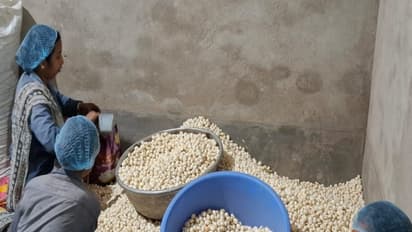
A trader from the region, Lalit, said that as stock continues to pile up, traders are facing financial losses, while farmers are unable to secure fair prices for their produce. He said, "Harishchandrapur has emerged as the hub of makhana production in the state, accounting for nearly 70 per cent of raw output."
"Makhana industry estimates suggest that around 12 lakh bags of makhana, close to one crore kilograms are produced annually in the region. In a favourable market, with prices ranging between Rs 700 and Rs 800 per kilogram, the trade generates an estimated annual turnover of Rs 700-800 crore. However, this year has brought an unexpected downturn, Lait said.
Asked about key demands of Makhana in the Middle East, Lalit said: "India, the only exporter of makhana globally, relies heavily on Dubai as a key trading hub. From there, the product is re-exported to countries such as China and across Europe. With shipments to Dubai now severely disrupted, exports have almost come to a standstill."
The impact is being felt across all levels of the industry. Workers involved in processing raw makhana, many of whom migrate seasonally for this work, are also seeing reduced opportunities. "From the grassroots level to large traders, everyone is being hit," another businessman noted.
Traders Urge Government Intervention
Despite the current crisis, industry stakeholders acknowledged that both the Central and West Bengal governments have extended support in recent years, albeit with some delay at the state level. Various initiatives over the past two to three years have helped strengthen the sector's foundation. However, traders believe more targeted intervention is now needed to address the present challenges.
Branding West Bengal's Makhana
A key demand from the industry is focused branding of West Bengal's makhana. At present, makhana is widely associated with Bihar, which dominates public perception despite West Bengal's significant production share. "The government must highlight that West Bengal is also a major producer. Branding can open new markets and increase demand," another trader said.
"The government must promote West Bengal as a major producer. Proper branding can boost trade and increase revenue," Lalit stressed.
Experts argue that a structured branding campaign could not only boost domestic consumption but also diversify export destinations, reducing dependence on a single hub like Dubai. Increased visibility could help the industry tap into health-conscious markets, where makhana is already gaining popularity as a nutritious snack.
Financial and Technical Support
Another major concern is the need for financial and technical support for small traders and farmers. Industry representatives have called for easier access to loans and the establishment of dedicated training institutes. Such centres could educate farmers on improving yield per bigha and adopting low-chemical or organic farming practices.
"The industry also needs easier loan access for small traders and specialised training institutes for farmers to improve cultivation techniques."
About Makhana (Fox Nut)
Makhana, commonly named as prickly water lily, fox nut and gorgon nut-- is a flowering plant classified in the water lily family, although it is occasionally regarded as a distinct family, Euryalaceae. Unlike other water lilies, the pollen grains of Euryale have three nuclei.
Makhana is a perennial plant native to eastern and southern Asia and is cultivated in ponds and wetlands in the Harishchandrapur area of Malda district. In Bihar, it is grown in nine districts like Madhubani, Darbhanga, Katihar, Sitamarhi, Purnea, Kishanganj, Araria, Saharsa and Supaul and in some hilly areas of Manipur. As per the Malda district figures, Bihar produces 90 per cent of the world's production of fox nut.
Makhana grows in water, producing bright purple flowers. The leaves are large and round, often more than a meter across, with a leaf stalk attached in the centre of the lower surface. The underside of the leaf is purplish, while the upper surface is green. The leaves have a quilted texture, although the stems, flowers and leaves which float on the water are covered in sharp prickles. Other leaves are submerged.
The plant produces starchy white seeds that are edible. The plant grows best in locations with hot, dry summers and cold winters. Seeds are collected in the late summer and early autumn, and may be eaten raw or cooked. Makhana seeds are often roasted or fried to crack like popcorn. These are then eaten, often with a sprinkling of oil and spices or with hot milk. It is used in cooking, especially to make a porridge or pudding called Kheer. (ANI)
(Except for the headline, this story has not been edited by Asianet Newsable English staff and is published from a syndicated feed.)Stay updated with the Breaking News Today and Latest News from across India and around the world. Get real-time updates, in-depth analysis, and comprehensive coverage of India News, World News, Indian Defence News, Kerala News, and Karnataka News. From politics to current affairs, follow every major story as it unfolds. IMD cities weather forecastsRain Cyclone Asianet News Official App