Vijay Tsunami Sweeps Tamil Nadu: How Political 'Startup' TVK Turned ‘Unicorn’ in One Shot
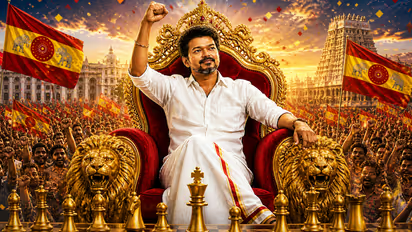
Synopsis
Vijay’s TVK stuns Tamil Nadu with a historic debut, challenging DMK-AIADMK dominance. Is this India’s biggest political startup success story and a sign of voter demand for change?
The stunning electoral debut of Tamilaga Vettri Kazhagam (TVK), led by actor-turned-politician Vijay, has not only reshaped Tamil Nadu’s political landscape but also reignited a larger national conversation — can political ‘startups’ really scale overnight?
In a state long dominated by the entrenched rivalry between Dravida Munnetra Kazhagam (DMK) and All India Anna Dravida Munnetra Kazhagam (AIADMK), TVK’s rise feels nothing short of an earthquake. With the party leading or winning in 108 seats — just shy of the majority mark of 118 — it has already established itself as the front-runner to form the government.
But beyond the numbers, this moment is symbolic. It signals a rare phenomenon in Indian politics: a “startup” party that doesn’t just disrupt — it dominates.
Walking the Rare Path: From Startup to Power
TVK’s journey echoes a handful of rare precedents in Indian political history — parties that transitioned from formation to governance almost instantly.
Among them is the Aam Aadmi Party (AAP), which formed the government in Delhi after its debut election in 2013 with Congress support under Arvind Kejriwal.
Then there’s the Asom Gana Parishad (AGP), which came to power in 1985 riding on the momentum of the Assam movement, supported by successful independent candidates aligned with the cause.
Perhaps the closest parallel is the Telugu Desam Party (TDP), founded by matinee idol N. T. Rama Rao. Within a year of its formation, the TDP stormed the Andhra Pradesh Assembly in 1983, winning a staggering 201 seats.
TVK now joins this exclusive club — but with its own unique context.
When Star Power Isn’t Enough
Tamil Nadu has seen its share of cinematic icons testing political waters — with mixed results.
Attempts by Rajinikanth to formally enter politics never materialised, while Kamal Haasan launched the Makkal Needhi Maiam (MNM) amid high expectations. Yet, MNM failed to win a single seat in the 2021 Tamil Nadu Assembly polls.
This is what makes Vijay’s success stand out. Unlike his predecessors, he has managed to convert popularity into political capital — and at scale.
“A Spectacular Debut”: What Analysts Are Saying
Former Congress leader and political analyst Sanjay Jha captured the significance of this moment succinctly:
“TVK's victory is a spectacular debut and is a manifestation of the fact that the voters are seeking change especially when they believe that there may be a governance deficit,” he told PTI.
He pointed to the deeply entrenched bipolar nature of Tamil Nadu politics:
“We have seen that attempts by both Rajinikanth and Kamal Haasan to break into politics of Tamil Nadu using their celluloid charms have not worked. Therefore, it is more astonishing that an organisation formed two years ago and by somebody who does not have a core base unlike the other two or a clear ideology, wins in this manner,” Jha said.
And perhaps most tellingly, he added:
“I don't think this has to do just with love in Tamil Nadu for film stars, it has to do with people looking at world of higher expectations from politicians. Clearly people were not satisfied with the DMK.”
He went even further, arguing that Vijay’s win may be more significant than AAP’s rise:
"Jha said Vijay's victory is more important than AAP's Arvind Kejriwal in Delhi as Tamil Nadu is a bigger state, he was taking on two big rivals and he hasn't had the benefit that Kejriwal had nationwide attention of the media."
The Prashant Kishor Factor — And the Bihar Contrast
Interestingly, TVK’s strategy is believed to have drawn inputs from political strategist Prashant Kishor, whose own political venture — Jan Suraaj — struggled to make an impact in Bihar just last year.
The contrast is stark. While Jan Suraaj “bit the dust,” TVK soared.
Yet, as Jha suggests, failure in one experiment doesn’t invalidate the model itself. If anything, TVK’s success could encourage more such attempts.
The Landscape of Political Startups: Few Winners, Many Aspirants
Across India, several small parties have tried to carve space, often with limited success.
In Bihar, outfits like the Plurals Party led by Pushpam Priya Choudhary have struggled to gain traction. Others like Hindustani Awam Morcha (Secular) led by Jitan Ram Manjhi and Rashtriya Lok Morcha of Upendra Kushwaha survive within limited pockets.
Uttar Pradesh too has its share of smaller players — NISHAD Party, Peace Party, Apna Dal (Sonelal), and Suheldev Bharatiya Samaj Party — but none have managed a statewide breakthrough on their own.
What Makes a Political Unicorn?
If TVK is now being called a “political unicorn,” what separates it from the rest?
Historically, successful parties in India have emerged from clear foundations:
- The Indian National Congress from the freedom movement
- The Bharatiya Janata Party from ideological roots and movements like Ram Janmabhoomi
- The Bahujan Samaj Party from social mobilisation
- The Communist Party of India (Marxist) from ideology
- The National People's Party from leadership-based splits
- AAP from the India Against Corruption movement
Regional powerhouses like All India Trinamool Congress under Mamata Banerjee, Biju Janata Dal under Naveen Patnaik, and All India Majlis-e-Ittehadul Muslimeen led by Asaduddin Owaisi have grown either through breakaways or inherited political capital.
Others like Lok Janshakti Party (Ram Vilas), Nationalist Congress Party (Sharad Pawar), and Shiv Sena (Uddhav Balasaheb Thackeray) fall into similar patterns.
Even issue-based parties like Viduthalai Chiruthaigal Katchi have had only limited electoral success.
Which is why TVK’s model — a relatively new party, without a traditional ideological base or legacy structure — stands out.
A Vote for Change, Not Just a Star
At its core, this election result may not simply be about Vijay’s popularity.
It reflects something deeper — voter impatience.
After decades of alternating dominance between DMK and AIADMK, Tamil Nadu’s electorate appears to have made a decisive statement: they want change, and they want it now.
TVK’s sweeping debut suggests that voters are willing to take risks — even on untested political formations — if they sense a governance deficit.
The Ripple Effect: Will India See More Political Startups?
TVK’s success could become a blueprint — or at least an inspiration.
As Sanjay Jha hinted, political experimentation in India is far from over. If anything, Vijay’s “blockbuster debut” may embolden others sitting on the fence.
For every failed experiment like Jan Suraaj, there may now be a TVK — waiting for the right moment, the right narrative, and the right public mood.
And in a democracy as vast and complex as India’s, that possibility alone can reshape the future of politics.
The Final Word
TVK’s rise is not just an electoral victory — it’s a disruption.
In startup terms, most political ventures fail, a few survive, and almost none become unicorns overnight.
But once in a while, one does.
And when it happens, it changes the rules of the game.
Stay updated with the Breaking News Today and Latest News from across India and around the world. Get real-time updates, in-depth analysis, and comprehensive coverage of India News, World News, Indian Defence News, Kerala News, and Karnataka News. From politics to current affairs, follow every major story as it unfolds. IMD cities weather forecastsRain Cyclone Asianet News Official App