'Vande Mataram' row: Congress cites 1937 rule, BJP alleges appeasement
Synopsis
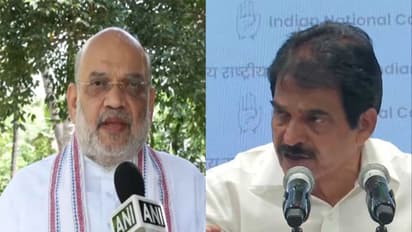
A political row erupted after the Congress decided to sing only the first two stanzas of 'Vande Mataram', citing a 1937 resolution. The BJP slammed the move, with Amit Shah accusing Congress of 'appeasement politics' and linking it to the Partition.
A political row has erupted between the Congress and the BJP over the recitation of the national song 'Vande Mataram', after the Congress Working Committee (CWC) declared that only the first two stanzas of the song would be sung at party events, citing its 1937 resolution.
The decision triggered sharp reactions from the BJP, with Union Home Minister Amit Shah accusing the Congress of repeating "politics of appeasement" and alleging that the party's 1937 decision contributed to the circumstances leading to the Partition of the country.
BJP Accuses Congress of 'Appeasement Politics'
Meanwhile, Congress Lok Sabha MP and AICC General Secretary, KC Venugopal defended the party's stand, saying 'Vande Mataram' was associated with the freedom struggle and held emotional significance for the Congress, while accusing the BJP of politicising the issue. Speaking to ANI, the Congress leader said the national song had emotional significance for his party because of its association with India's freedom struggle, while accusing the BJP of politicising it. "BJP was not a part of the freedom struggle. Vande Mataram was a part of the freedom struggle; it is emotional for us, but political for them (BJP)," Venugopal said, adding, "We have been reciting Vande Mataram since 1937, more than 90 years. What is new for us?" "They want to divert attention from the genuine issues of paper leaks, theft of donations and Chinese incursion in Arunachal Pradesh," Venugopal said.
Further, the Union Home Minister said that the Congress Working Committee has once again repeated the politics of appeasement by deciding to sing only two stanzas of 'Vande Mataram'. Shah said that the same decision taken by the Congress in 1937 had laid the foundation of the partition of the country. In the 150th year of 'Vande Mataram', the Modi Government, under the leadership of Prime Minister Narendra Modi, has corrected this historic mistake by deciding that the complete song will be sung at government programmes. The Union Home Minister described the Congress's decision as an act of appeasement and an insult to Bankim Chandra Chattopadhyay and the freedom fighters and appealed to the people to raise their voice against it.
BJP MLA Sumitro Chatterjee, a direct descendant of Bankim Chandra Chattopadhyay, criticised the Congress, alleging that the party was using the issue to gain political attention and had lost its relevance. Speaking to ANI, Chatterjee said, "In the political scenario in India, Congress holds no value. They are doing this drama to gain some value, so that they can come into the limelight. Right now, Congress has become history." He also said that legal action would be considered after discussions with his family and party. "We will take legal steps. I need to speak with my family. I will also speak to my party. After that, we will take legal steps. But if a legal step is to be taken, it will be taken by the family - this is what we want... CWC is not above Indian law. They will have to act within the purview of Indian law," Chatterjee further said.
Union Minister JP Nadda also slammed the Congress, alleging that the party's 1937 resolution was driven by "appeasement politics" and contributed to the circumstances that led to the Partition. In a post on X, Nadda said the Congress' decision in 1937 to divide 'Vande Mataram' into two parts fuelled the two-nation theory and ultimately led to the partition of the country.' "Citing its 1937 resolution, the Congress has decided to sing only two stanzas of 'Vande Mataram'. The nation must remember that in 1937, under the politics of appeasement, the Congress's decision to divide 'Vande Mataram' into two parts fuelled the two-nation theory and ultimately led to the partition of the country," Nadda said. "Today, in the 150th year of 'Vande Mataram', the government under the leadership of respected Prime Minister Shri Narendra Modi has corrected this historical mistake by deciding to sing Bankim Babu's immortal creation in its entirety and giving a legal framework to singing it completely at all official functions," he said.
Union Minister Giriraj Singh accused the Congress leadership of disrespecting the legacy of India's freedom fighters and operating under ideological pressure. "This is not just opposition to Vande Mataram but against our revolutionaries," Singh said, adding, "Now, the Congress has become the Muslim League. This is not Gandhi ji's Congress but Sonia Gandhi and Rahul Gandhi's Congress."
Madhya Pradesh Chief Minister Mohan Yadav said that the party has shown disrespect towards the national song and demanded that it clarify its position and apologise to the country. "It is very unfortunate to say that Congress is continuously becoming a subject of condemnation in the country because of its double standards regarding Vande Mataram. On one hand, they show a feeling of disrespect towards the honour of Vande Mataram. Their councillors in the Indore municipal corporation disrespected Vande Mataram, and by not taking any action against them, they have revealed their sentiments towards Vande Mataram. Now, the decision to adopt the singing of only two stanzas, the country will not forgive them," CM Yadav said.
BJP MP Dinesh Sharma accused the opposition leadership of harbouring "Muslim League-like thinking." He equated senior Congress leaders with Muhammad Ali Jinnah, the founder of Pakistan who spearheaded the Two-Nation Theory, to criticise the Congress party's approach toward national symbols.
Union Minister Rajiv Ranjan (Lalan) Singh said, "The resolution passed in the Congress Working Committee itself shows that the Congress party has no regard for patriotism. It has no regard for nationalism. They just want to please a particular section of society, so they take such decisions. Patriotism means nothing to them..."
Congress Hits Back, Cites Freedom Struggle Legacy
Meanwhile, Congress leaders strongly defended the party's decision and targeted Shah over his criticism. Congress leader Pawan Khera said that the BJP leader considers himself greater than the likes of "Sardar Patel, Mahatma Gandhi, Pandit Jawaharlal Nehru, and C Rajagopalachari." Khera accused Shah of speaking against the view adopted by the Constituent Assembly and placing himself above BR Ambedkar. He stated that the status of Vande Mataram was supported and approved in the Constituent Assembly, yet the Union Home Minister places himself above everyone else. "Does this mean Amit Shah now considers himself greater than Sardar Patel, Mahatma Gandhi, Pandit Jawaharlal Nehru, and C Rajagopalachari? He is speaking against the Constituent Assembly; he has placed himself even above Dr. Ambedkar. The Constituent Assembly comprised people representing every ideology of the nation. The status of Vande Mataram was also approved and supported there. Yet, he has begun considering himself greater than all of them," said Khera.
Congress MP Renuka Chowdhury hit out at the BJP and rejected Union Home Minister Shah's allegations of minority appeasement. Chowdhury backed Congress' position on the "two stanza" version of Vande Mataram and said that party leaders had sacrificed their lives while singing the national song in the fight against colonial rule. "Our ancestors sacrificed their lives while singing 'Vande Mataram'. Where were you people (BJP) then? For so many years, you were also singing this same version. You have been in power for 12 years, and you were singing the very same version. Did you suddenly remember this overnight?" she said.
Congress national spokesperson Atul Londhe Patil hit back at Amit Shah's remark, questioning whether freedom movement leaders including Subhas Chandra Bose, Rabindranath Tagore, Mahatma Gandhi, Jawaharlal Nehru and Acharya Kriplani would also be considered "anti-nationals". "Perhaps as per him, Subhas Chandra Bose, Rabindranath Tagore, Mahatma Gandhi, Nehru ji, Acharya Kriplani are all anti-nationals," Londhe Patil said while speaking in Pune.
Congress MP Amar Singh and KPCC President BK Hariprasad also backed the CWC decision, alleging that the BJP was raising the issue to divert attention from other matters. Congress MP Amar Singh said, "BJP and RSS are those who made no contribution to the freedom struggle. There are letters from Savarkar in which he kept apologizing to the British and acted as a British informer. Yet today, they are the ones lecturing the Congress on what patriotism means... The reality is that, amidst the ongoing student protests and the issues of unemployment and other crises, they are diverting attention, bringing up 'Vande Mataram', to distract from the real issues..."
KPCC President BK Hariprasad said, "It is the Congress party's working committee's decision. Every congressman will adhere to that... The BJP has no moral right to speak on the freedom struggle.... I welcome the decision of the working committee to sing only two stanzas in every Congress program..."
Historical Context of the 1937 Resolution
A day earlier, KC Venugopal said the party's stand on the recitation of Vande Mataram was clear and that it would follow the decisions taken by Mahatma Gandhi, Jawaharlal Nehru and Sardar Vallabhbhai Patel in 1937. Venugopal said "Vande Mataram" and the National Anthem are emotional issues for the Congress, alleging that the BJP was politicising the matter. He termed the controversy over its recitation at the Congress headquarters a "communication gap" and said the issue was closed.
The controversy began after the BJP accused Congress president Mallikarjun Kharge and party parliamentary chairperson Sonia Gandhi of conversing during the rendition of 'Vande Mataram' at Independence Day celebrations on August 15 and demanded an apology.
The 1937 Congress Working Committee resolution adopted only the first two stanzas of Vande Mataram as the National Song, following advice from Rabindranath Tagore to avoid communal friction over later verses. At a meeting in October 1937 with leaders like Mahatma Gandhi, Jawaharlal Nehru, and Subhas Chandra Bose, the CWC decided to drop the later stanzas because their explicit Hindu imagery and context in Anandamath caused political controversy with the Muslim League.
On January 24, 1950, President Rajendra Prasad declared in the Constituent Assembly that Vande Mataram shall be honoured equally with Jana Gana Mana (the National Anthem), though it holds the status of National Song, not National Anthem. (ANI)
(Except for the headline, this story has not been edited by Asianet Newsable English staff and is published from a syndicated feed.)Stay updated with the Breaking News Today and Latest News from across India and around the world. Get real-time updates, in-depth analysis, and comprehensive coverage of India News, World News, Indian Defence News, Kerala News, and Karnataka News. From politics to current affairs, follow every major story as it unfolds. IMD cities weather forecastsRain Cyclone Asianet News Official App