Vande Mataram biggest victim of Congress appeasement: Yogi Adityanath
Synopsis
UP CM Yogi Adityanath alleged in the State Assembly that Vande Mataram was the 'biggest victim of Congress's appeasement politics.' He claimed Congress truncated the song in 1937 to appease Muhammad Ali Jinnah, laying the foundation for partition.
Vande Mataram Victim of Appeasement Politics: CM Yogi
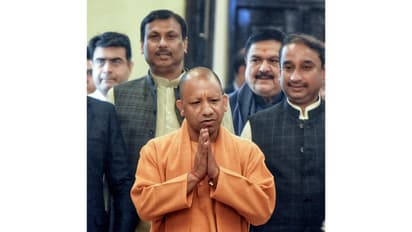
Uttar Pradesh Chief Minister Yogi Adityanath on Monday said Vande Mataram is not merely a song but the soul of India's freedom struggle, adding that the national song of the country became the first and biggest victim of Congress' appeasement politics.
Participating in a discussion marking 150 years of 'Vande Mataram' in the State Legislative Assembly during the winter session, CM Yogi said, "Vande Mataram became the first and biggest victim of Congress's politics of appeasement. Was limiting Vande Mataram to two stanzas the result of a religious compulsion or a planned conspiracy against national consciousness?"
Congress Truncated Song to Appease Jinnah
The UP Chief Minister claimed that Muhammad Ali Jinnah objected to Vande Mataram and that the Congress in 1937 decided to remove parts of the song to appease the founder of Pakistan, as a "gesture of goodwill".
'Foundation of India's Partition'
"As long as Jinnah was in the Congress, Vande Mataram was not a decisive point of contention. The moment he left the Congress, Jinnah made it a tool of the Muslim League and deliberately gave the song a communal colour. The song remained the same, but the agenda changed. On October 15, 1937, in Lucknow, Mohammad Ali Jinnah raised his voice against Vande Mataram, and at that time, Pandit Nehru was the Congress president. On October 20, 1937, Nehru wrote a letter to Subhas Chandra Bose and said that the background was making Muslims uncomfortable," CM said. "On October 26, 1937, the Congress decided to remove parts of the song. This was called a gesture of goodwill, while in reality, it was the first official instance of appeasement. The 'desh-bhakts' protested against it. Jinnah raised demands to change the song. At the time, Congress remained silent on this, which, as a result, emboldened the Muslim League. This laid the foundation of India's partition," he added.
A Brief History of Vande Mataram
The 150th anniversary of India's National Song, Vande Mataram, was observed on November 7 this year. Composed by Bankim Chandra Chatterjee, 'Vande Mataram' was first published in the literary journal Bangadarshan on November 7, 1875. Later, Bankim Chandra Chatterjee incorporated the hymn into his immortal novel 'Anandamath', published in 1882. It was set to music by Rabindranath Tagore. It has become an integral part of the nation's civilisational, political and cultural consciousness. (ANI)
Stay updated with the Breaking News Today and Latest News from across India and around the world. Get real-time updates, in-depth analysis, and comprehensive coverage of India News, World News, Indian Defence News, Kerala News, and Karnataka News. From politics to current affairs, follow every major story as it unfolds. IMD cities weather forecastsRain Cyclone Asianet News Official App