UPI@10: When the Bank Came into the Hands of Every Indian
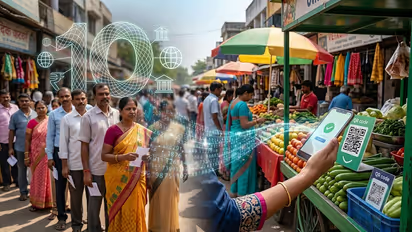
Synopsis
Unified Payments Interface has revolutionized India's financial landscape by turning mobile phones into personal banking gateways. Over its ten-year journey, UPI expanded from 1.78 crore transactions in FY 2016-17 to over 24,162 cr in FY 2025-26, driving a cash-to-digital transition across street vendors, small retailers and households nationwide.
Article By A Sakthivel
(Lawyer, Social Thinker & Policy Commentator)
From Standing in Bank Queues to Paying with a Tap
The story of UPI is not merely the story of a payment system. It is the story of how technology transformed the everyday financial experience of an ordinary Indian. I am 38 years old, a family man and a proud Indian, and I have personally witnessed this transformation. I remember my parents and me standing in long queues at banks to deposit money, withdraw cash, send money to someone or get a demand draft prepared. Buying vegetables, groceries and fruits, paying a bus fare or making a small payment to a local shopkeeper meant carrying cash and often ensuring that we had the right change. Carrying substantial amounts of cash also meant worrying about losing it, having it stolen or simply misplacing it.
I experienced this reality myself as a student. Whenever I needed to pay my college fees through a demand draft, I had to visit the bank, stand in a queue, get the draft prepared and then submit it to the institution. At that time, this was simply how banking worked. Today, as a father, I experience the complete opposite. I can pay my daughter's fees through UPI from my mobile phone within seconds. No bank visit, no queue, no demand draft and no cash. That personal journey, from standing in a bank queue as a student to paying my daughter's fees with a few taps on my phone, perhaps captures the UPI transformation better than any statistic.
Bringing the Bank into Every Hand
For decades, one of India's major development challenges was taking banking facilities to every village and every citizen. It required branches, buildings, employees, counters and physical infrastructure across a country of enormous geographical and economic diversity. Had the Modi government followed only the conventional approach, creating such physical infrastructure everywhere would have taken many years and enormous resources. Instead, the government chose a different path, using technology and UPI to transform the way this challenge could be addressed. Rather than only taking citizens to the bank, technology made it possible to bring banking services directly into their hands.
Today, a mobile phone has become a gateway to a bank account, a payment system and a wide range of financial services. A person does not necessarily have to travel to a bank branch to conduct a transaction. The service can come to the citizen. That is the deeper significance of UPI. It is not merely another payment application. It is a nationwide interoperable infrastructure connecting banks, citizens, merchants and digital platforms in real time.
The Vision That Proved the Critics Wrong
When Prime Minister Narendra Modi placed Digital India and the vision of a less cash economy at the centre of India's transformation, the idea was met with scepticism in many quarters. Critics questioned whether a country as vast, diverse and complex as India could embrace digital payments at mass scale. There were doubts about connectivity, digital literacy, banking access and whether ordinary citizens, small traders and people in rural India would be able to participate.
Prime Minister Modi chose not to be defined by those doubts. He did not look at India only through the lens of its limitations. He looked at India's enormous potential. His determination, political will and commitment to Digital India helped create an ecosystem in which digital payments could reach millions of citizens and businesses across the country.
Ten Years of Extraordinary Growth
The Unified Payments Interface was launched on 25 August 2016 by the National Payments Corporation of India under the regulatory oversight of the Reserve Bank of India. At the time, its eventual scale would have been difficult to imagine. In FY 2016-17, UPI recorded just 1.78 crore transactions. By FY 2025-26, annual transaction volume had crossed 24,162 crore, representing an almost 13,000-fold increase. Transaction value rose from ₹0.07 lakh crore in FY 2016-17 to approximately ₹314 lakh crore in FY 2025-26, a more than 4,000-fold increase.
The number of participating banks tells another part of the story. From just 44 banks live on UPI in FY 2016-17, the ecosystem expanded to 703 banks by FY 2025-26. These figures demonstrate not just the growth of a payment platform, but the creation of a nationwide financial infrastructure operating at extraordinary scale.
From Carrying Cash to Carrying Confidence
Before digital payments became widespread, cash was an essential part of everyday life. We had to think about how much money to carry, where to withdraw it, whether we had enough change and how safely we could keep it. A wallet could disappear, cash could be stolen and money withdrawn from a bank had to be physically carried and protected.
UPI changed that equation. Today, money can remain in the bank account while the ability to transact travels with the citizen through a mobile phone. The money stays in the bank, but the power to use it stays in your hands.
This has made financial transactions simpler and more accessible. Whether a person is in a village, a city, a marketplace or a neighbourhood shop, the mobile phone can provide the ability to make a payment within seconds.
A Revolution for Small Merchants
Perhaps the most visible symbol of India's UPI revolution is the QR code. Today, vegetable vendors, tea sellers, street vendors, auto drivers, small retailers and large businesses can accept digital payments with remarkable ease. For millions of small merchants, the QR code has effectively become a digital cash counter.
It reduces the need to maintain large amounts of cash, eliminates the problem of exact change and allows customers to make payments without searching for an ATM. What is remarkable is that sophisticated digital infrastructure has been converted into an extremely simple experience: scan, authenticate and pay.
UPI has therefore made digital payments part of India's everyday marketplace, not just its formal financial sector.
From the Smallest Purchase to Family Support Across Thousands of Kilometres
UPI's importance is also reflected in the way it connects people. Person-to-Merchant transactions represent a major share of transaction volume, reflecting the enormous number of frequent, relatively small retail payments made every day. At the same time, Person-to-Person transactions account for a major share of transaction value, highlighting UPI's importance for transfers between individuals and families.
For me, this has a deeply personal meaning. Sitting in Delhi, I can recharge the television or mobile phone of my parents living in a remote village in Tamil Nadu. If they need something, I can order it online and make the payment from Delhi. If they need money, I can instantly transfer it to a relative living nearby who can help them. Thousands of kilometres no longer have to separate a family from its everyday financial needs.
That is not merely convenience. It is a fundamental change in how families remain financially connected.
India Builds a Global Benchmark
What began as an Indian solution to an Indian challenge has now attracted global attention. As of 2025, UPI accounted for nearly 49% of the world's real-time payment transaction volume, a milestone recognised by the International Monetary Fund. With more than 66 crore transactions processed every day, UPI has established India as a global leader in instant digital payments.
Its international footprint has also expanded to 11 countries, including the United Arab Emirates, France, Bhutan, Sri Lanka, Nepal, Singapore, Mauritius, Qatar, Cambodia, Greece and the Maldives. An innovation created to address India's own needs is now being adopted and studied as an example of what Digital Public Infrastructure can achieve at population scale.
A Transformation Made Possible by Leadership
Behind this extraordinary transformation is the vision, leadership and determination of Prime Minister Narendra Modi, along with the dedicated efforts of his government, policymakers, institutions, banks, technology partners and countless people who worked to make this vision a reality. My sincere appreciation goes to Prime Minister Modi and his entire team for having the courage to think beyond conventional solutions, build for India's scale and create a digital ecosystem that has empowered millions of Indians. What was once a vision has become an everyday reality, and what began as an Indian innovation is today earning global recognition. UPI@10 is a testament to what decisive leadership, political will and collective effort can achieve for the common citizen.
The Challenge Before the Government and the Alertness of Users
UPI has transformed the way India pays, but the rise of cyber fraud and digital scams presents a new challenge. The government must continue strengthening fraud detection, real time alerts and faster mechanisms for reporting and recovering fraudulent transactions. At the same time, users must remain vigilant, never share OTPs, UPI PINs or banking details, and always verify payment requests before authorising them. A safer digital India requires both stronger systems from the government and greater alertness from every user.
Disclaimer: The opinions expressed are solely those of the author and do not reflect the views or stance of the organization. The organization assumes no responsibility for the content shared.
Stay updated with the Breaking News Today and Latest News from across India and around the world. Get real-time updates, in-depth analysis, and comprehensive coverage of India News, World News, Indian Defence News, Kerala News, and Karnataka News. From politics to current affairs, follow every major story as it unfolds. IMD cities weather forecastsRain Cyclone Asianet News Official App