Universities key to democratic society, free thinking: Justice Bhuyan
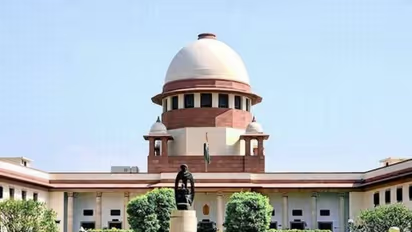
Synopsis
Supreme Court Justice Ujjal Bhuyan, addressing NLU Delhi students, emphasized universities' role in fostering a democratic society. He urged for a campus culture of free thinking, questioning established ideas, and respecting diverse viewpoints.
Supreme Court Justice Ujjal Bhuyan has stressed the important role of universities in building a democratic society that respects liberty, diversity, and viewpoints. He said the culture of questioning and free thinking must begin on university campuses.
Addressing graduating students at National Law University Delhi, Justice Bhuyan said universities should not be limited to passing knowledge from one generation to another. They should also help students think independently, question established ideas and understand views different from their own.
The University's Role in Democracy
Justice Bhuyan said that if society wants a democracy that truly respects liberty and differences, the foundation for it must be built in universities. He said a university should be one of the first places where students learn to think freely. "They should not accept an idea simply because it is familiar, has been followed for years or comes from a person in authority. Instead, universities should create an atmosphere where students can examine ideas and ask difficult questions without fear, even when the answers may be uncomfortable."
A Crucible for Legal Minds
The judge said this freedom to question is particularly important for law students. Legal education, he said, cannot remain limited to textbooks and classrooms because the law often deals with situations where the rights and freedoms of different people come into conflict. "In such situations, legal professionals have to balance competing rights and examine the exercise of power against individual freedoms and constitutional principles."
Justice Bhuyan said even an established position may need to be reconsidered if it does not stand up to constitutional scrutiny. "This is why law students must learn to question, analyse and look beyond established positions, rather than simply memorising legal rules."
Disagreeing Without Hostility
He also linked the ability to question with the larger functioning of a constitutional democracy. Justice Bhuyan said the ability to live with disagreement is not merely a matter of tolerance or good social behaviour. "It is an essential part of a liberal constitutional democracy, where people with different beliefs and opinions must be able to live together with equal dignity."
He said universities have a special responsibility because they bring together students with different experiences, ideas and beliefs. A university, he said, should be a place where established views can be examined and questioned, while disagreements are addressed through reason, discussion and debate rather than hostility.
Justice Bhuyan's remarks also highlight that disagreement should not automatically be seen as a threat. "Different views can help students develop a better understanding of law, the Constitution and the society in which they will eventually practise." He stressed that students should learn to engage with opposing opinions rather than treating disagreement as something that needs to be silenced.
From Theory to Cultural Practice
Justice Bhuyan also stressed that liberty and respect for differences cannot remain limited to constitutional provisions. "These values must become part of the culture of institutions and society".
For this reason, he said, the process should begin in universities, where young people learn to listen to different viewpoints, question assumptions, ask difficult questions and disagree without hostility. He said a healthy democracy requires institutions that give people the space to think differently, question established positions and express their views. (ANI)
(Except for the headline, this story has not been edited by Asianet Newsable English staff and is published from a syndicated feed.)Stay updated with the Breaking News Today and Latest News from across India and around the world. Get real-time updates, in-depth analysis, and comprehensive coverage of India News, World News, Indian Defence News, Kerala News, and Karnataka News. From politics to current affairs, follow every major story as it unfolds. IMD cities weather forecastsRain Cyclone Asianet News Official App