TN launches 'Vizhithirai Kaappom' to fight diabetes-related blindness
Synopsis
Tamil Nadu Health Minister KG Arunraj launched the 'Vizhithirai Kaappom' scheme to prevent diabetes-related blindness. The ₹45.53 crore initiative will establish retina screening centres across the state's health infrastructure to serve the diabetic population.
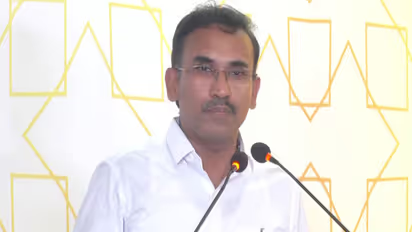
Tamil Nadu Health Minister KG Arunraj "pre-launched" the 'Vizhithirai Kaappom' (Save Eye Retina) scheme at the Government Eye Hospital, Egmore, in an event organised by the Regional Institute of Ophthalmology. The event aimed at strengthening the state's health infrastructure to prevent diabetes-related blindness.
Scheme's Scope and Budget
Explaining the scope of the initiative, Arunraj said the government had announced the setting up of non-communicable disease care centres across the state, under which retina screening would be implemented at all 385 block primary health centres, 37 government district hospitals, 150 urban primary health centres, and medical college hospitals in Tamil Nadu. "We've allocated ₹45.53 crore," he said.
Tackling Diabetes-Linked Vision Loss
Speaking about the scale of the problem, Arunraj said patients with advanced, uncontrolled diabetes accounted for around 17 to 20 per cent of the state's total diabetic population. "These are the people who are going to come back to us over the next five to ten years with varying degrees of vision loss or visual impairment. It's very difficult to intervene at the other end of the spectrum because it involves laser surgeries, and sometimes vision might not fully recover," he said, adding that vision loss often leaves patients dependent on their families for everyday activities.
He said the solution lay in strict control of diabetes and hypertension through home-delivered medication and regular monitoring, combined with periodic retinal screening. "To prevent the advancement of microvascular complications in the retinal vasculature, the only way we can intervene is by checking the retinas of all diabetes patients at least once every six months or once a year," Arunraj said, adding that this required both field-level infrastructure and trained technicians.
Future Goals and Technology Integration
He expressed confidence that bridging these gaps could significantly cut down cases of blindness. "We will be able to reduce the number of cases of blindness or vision loss caused by diabetes and hypertension by almost 50 per cent over the next 5 to 7 years," he said, urging the Regional Institute of Ophthalmology to take ownership of the programme and integrate digital technology into the screening process.
"Analytic software fed into computers can actually give you a very clear record of exactly what's seen in the fundus photograph. It can even provide an individual risk score for each patient, giving a huge health database for our country," he said.
Minister's Personal Connection
Arunraj also recalled his own association with the hospital as a former medical student. "Back when I was studying at Madras Medical College, our ophthalmology postings were here at this very hospital in Egmore. So, I came as a medical student, and now I've come as a minister," he said, thanking the Tamil Nadu Chief Minister for the opportunity.
Implementation Strategy and Existing Capacity
Earlier during the event, Dr SV Chandrakumar, Project Director of the Tamil Nadu District Vision Loss Prevention Association, said, "Over 400 eye doctors work in our state. More than 200 of them have specialised training. We already have 180 AI-equipped field-level fundus cameras up and running."
He added that Regional Eye Care Centres had been established in Salem, Thanjavur, Madurai and Tirunelveli, with more planned for Chengalpattu, Vellore and Dharmapuri, and noted, "19 per cent of the people are diabetic. We already have a list of 1 million people," citing a pilot screening programme that had identified several patients with severe complications.
Director of Medical Education and Research, Professor Dr V Loganayagi, said, "To prevent avoidable blindness, we need to screen people not just at the centre, but also in the periphery, that is, using the hub and spoke model. The main idea of this scheme is to train experts to reach those areas."
The event also featured felicitation ceremonies honouring senior ophthalmologists and administrators, in the presence of senior officials from the Regional Institute of Ophthalmology, Appasamy Associates, and representatives from Madras Medical College, Stanley Medical College, Omandurar Medical College and Kilpauk Medical College. (ANI)
(Except for the headline, this story has not been edited by Asianetnews Editorial staff and is published from a syndicated feed.)Stay updated with the Breaking News Today and Latest News from across India and around the world. Get real-time updates, in-depth analysis, and comprehensive coverage of India News, World News, Indian Defence News, Kerala News, and Karnataka News. From politics to current affairs, follow every major story as it unfolds. IMD cities weather forecastsRain Cyclone Asianet News Official App