The Great Squeeze: How BJP & Congress Are Shrinking Space For Regional Parties
Synopsis
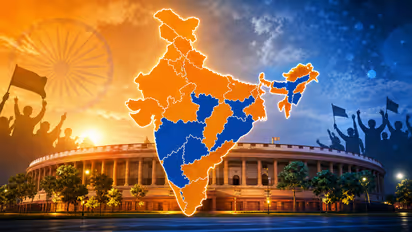
India's political landscape is experiencing a "great squeeze" as national parties, particularly the BJP, expand at the expense of regional ones. Once powerful kingmakers, regional parties now face pressure from strong central leadership and changing voter preferences for stability.
The Great Squeeze: National Parties vs Regional Satraps
India’s political landscape is undergoing a major transformation, marked by what analysts describe as a “great squeeze”—a steady shrinking of space for regional parties as national players, particularly the Bharatiya Janata Party (BJP) and to a lesser extent the Congress, expand their footprint across states. Once powerful kingmakers in coalition-era politics, regional parties are now facing mounting pressure from a centralised and increasingly dominant national narrative.
For decades, regional satraps held sway in Indian politics, often dictating terms in coalition governments at the Centre. Parties such as the Trinamool Congress (TMC), Samajwadi Party (SP), Bahujan Samaj Party (BSP), Shiv Sena, and others built strong state-level bases rooted in identity politics, regional pride, and caste equations. However, this dominance is now being challenged by a new political reality shaped by strong central leadership, expansive organisational machinery, and a shift in voter preferences.
At the forefront of this shift is the BJP, which has executed a carefully calibrated strategy to expand beyond its traditional strongholds in northern and western India. The party’s recent electoral successes—most notably in states like West Bengal and Maharashtra—demonstrate its ability to penetrate regions long dominated by regional forces. In Maharashtra, for instance, the BJP’s performance in civic polls weakened the grip of regional players like the Shiv Sena, which had controlled key institutions for decades.
This expansion is not merely electoral but structural. The BJP has invested heavily in grassroots organisation, cadre-building, and voter outreach, allowing it to challenge regional parties at their own game. By combining localised strategies with a strong national narrative centred on development, governance, and leadership, the party has broadened its appeal across diverse voter groups.
Prime Minister Narendra Modi’s leadership has been a crucial factor in this transformation. His personal popularity and centralised campaign style have enabled the BJP to maintain message consistency across states. Elections increasingly revolve around national leadership rather than purely local issues, reducing the relative advantage that regional leaders once enjoyed.
At the same time, the Congress party, though weaker compared to its historical peak, has shown signs of revival in certain states, further intensifying competition for regional players. In states like Karnataka and Kerala, Congress has managed to regain ground, creating a bipolar contest that leaves limited space for smaller parties to thrive independently.
Changing Voter Trends and the Future of Regional Politics
Another key factor contributing to the decline of regional parties is the changing nature of voter expectations. There is a growing preference for stability, strong leadership, and governance-oriented politics over fragmented coalition arrangements. Voters are increasingly aligning with parties that promise decisive leadership and national-level impact, rather than those focused solely on regional issues.
The erosion of regional parties is also linked to internal challenges. Many of these parties are heavily dependent on charismatic leaders or family dynasties, making them vulnerable to leadership crises and succession disputes. In contrast, national parties like the BJP have built more institutionalised structures that can sustain long-term growth.
Defections have further accelerated this trend. Leaders from regional parties have frequently switched sides to join national parties, weakening the organisational strength of their former outfits. These shifts not only reduce the electoral base of regional parties but also enhance the credibility and reach of national players in new territories.
However, the “great squeeze” is not uniform across India. Certain states continue to resist the dominance of national parties. Tamil Nadu remains a stronghold of Dravidian politics, where regional parties like the DMK and AIADMK maintain deep-rooted support. Similarly, Kerala’s political landscape is defined by ideological competition between the Left and Congress-led alliances, leaving limited space for the BJP. These exceptions highlight the enduring relevance of regional identity and local political cultures in certain parts of the country.
Despite these pockets of resistance, the broader trend is clear: Indian politics is moving towards a more centralised and bipolar structure. The BJP’s rise as a dominant force and the Congress’s attempts at revival are gradually squeezing out the space once occupied by regional parties. This shift has significant implications for governance, federalism, and the balance of power between the Centre and the states.
Critics argue that this centralisation could weaken the federal structure by reducing the influence of regional voices in national decision-making. Supporters, on the other hand, contend that a stronger central mandate leads to more coherent policy implementation and political stability.
Ultimately, the “great squeeze” reflects a deeper transformation in how Indian democracy functions. The era of fragmented coalitions and regional kingmakers is giving way to a more consolidated political order dominated by national parties. Whether this trend continues or regional parties find ways to reinvent themselves will shape the future trajectory of Indian politics.
Also Read: BJP’s Big Leap Explained: How NDA Expanded to 21 States, Rewriting India’s Political Map
Stay updated with the Breaking News Today and Latest News from across India and around the world. Get real-time updates, in-depth analysis, and comprehensive coverage of India News, World News, Indian Defence News, Kerala News, and Karnataka News. From politics to current affairs, follow every major story as it unfolds. IMD cities weather forecastsRain Cyclone Asianet News Official App