Tharoor: Dialogue With Pakistan Only After Dismantling Terror Groups
Synopsis
Congress MP Shashi Tharoor states that bilateral dialogue with Pakistan depends on the country dismantling its terror infrastructure, despite acknowledging the continued relevance of multilateral forums for diplomatic communication.
Tharoor: Dialogue With Pakistan Only After Dismantling Terror Groups
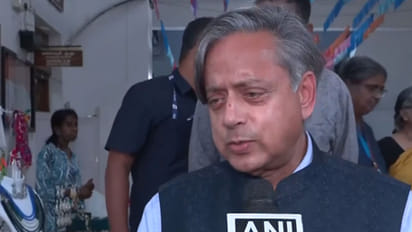
New Delhi [India], November 22 (ANI): On Pakistani Minister Musadik Masood Malik's visit to India, Congress MP Shashi Tharoor on Sunday said multilateral forums had their own place despite strained relations between the two countries, while reiterating that bilateral dialogue could resume only if Pakistan dismantled its terror infrastructure. He maintained that India would not resume the bilateral dialogue that existed in the past until Pakistan takes concrete action against terrorist infrastructure operating from its territory.
Tharoor said, "Even though we had rather strained relations with Pakistan even in those days—so these are things you have to understand—multilateral forums have their own place. As for bilateral relations, we have made it clear that the kind of bilateral dialogue we used to have in the past can only be resumed if Pakistan dismantles the infrastructure of terror in its country. You cannot have these terrorist camps, headquarters, training grounds, and so on—which are regularly being used to unleash violence on our people—and then expect to talk. No one wants to talk with a gun pointed at their head, and we are not going to do so either"
The remarks came as Pakistan's Federal Minister for Climate Change and Environmental Coordination Musadik Masood Malik visited India to participate in the three-day SCO Civilisational Dialogue Forum in New Delhi. Malik led the Pakistani delegation to the inaugural SCO Civilisational Dialogue Forum, being hosted by India in New Delhi from November 20 to 22. His visit marks the first visit by a Pakistani minister to India in three years.
On a US panel report highlighting China's military support to Pakistan during Operation Sindoor, the Congress MP said the developments were already being discussed during the operation last year and that the report had confirmed information available in the public domain. "I don't think we needed a U.S. report to confirm this. It was already being talked about last year during Operation Sindoor. The government may not have talked about it publicly, but there were already reports at the time of two particular developments. One was that there were Chinese engineers and officers in some of the Pakistani command-and-control centers. The second issue that we heard about from the outgoing Deputy Chief of the Army Staff—if I remember correctly—was that real-time satellite intelligence was being provided by China to Pakistan. The American report has confirmed these two points from their perspective, but I think the government of India must have known all this already,“ he said.
He further said the report might be new to sections of the media but did not reveal information that was previously unavailable, adding that China's military cooperation with Pakistan had wider strategic implications for the subcontinent. Tharoor said,“I don't think it's news to the Government of India; it may be news to the media. We have always been very conscious—those of us who think about foreign policy—that China took a step in that direction with Pakistan last year, which has very profound implications for larger strategic considerations on the subcontinent. I do believe that this is merely confirming something that has been available in the public domain for those who knew where to look for it"
On Prime Minister Narendra Modi's criticism of corporates for allegedly retaining the benefits of corporate tax reductions instead of using them to boost investments and employment, Tharoor said the Prime Minister had highlighted a reality, while expressing concern over the country's employment situation. "I think what the Prime Minister said is a reality. The corporates may have their own defense of it, but his argument, as I understand it, is that the government has lowered taxes to encourage companies to invest more, create more jobs, and raise salaries, and the companies have not kept their share of the bargain...The public tells us that it's very difficult to get jobs—that for the first time, for example, an IIT graduate couldn't get placement. I mean, this kind of thing was not heard in the past, so it suggests that the environment for employment, particularly of college graduates, is rather grim,” Tharoor said.
Tharoor further called for regulatory simplification and improvement in the ease of doing business, alleging that corruption had worsened and that the government needed to pay greater attention to the economy. “The economy requires attention, and if the Prime Minister is pointing fingers at the companies and the companies want to point fingers at government policies, that's something we can watch. We do believe there are things the government could be doing better. They could certainly be simplifying regulations; ease of doing business is not a reality. And I'm sorry to say that corruption, according to every businessman I speak to, is much worse than it's ever been. And this is something which, honestly, the Prime Minister had famously said: "Na khaunga, na khane dunga." And now we realize he only meant beef," he said.
On the development challenges facing Kerala, the Congress MP said the state needed to prioritise attracting investments, generating revenue and creating growth, while accusing the previous Left Democratic Front (LDF) government of leaving behind a financially distressed treasury. "For me, the most important challenge in Kerala is the challenge of development. We are facing an enormous burden. The last government left a bankrupt treasury. I was shocked to see that the first tribal panchayat in Kerala had to close because there is no money to pay salaries. That's how broke this government is, and it's not because of anything we have done. We've just come to power six months ago. It is because of the irresponsible management of the economy by the previous LDF government. Rather than pointing fingers at each other, we should be rising now to deal with development, to deal with the challenges of attracting investment to Kerala, generating new revenues, and transforming the state. We all have very good ideas. Kerala is a great place for ideas, but to implement them, you need money as well, and we need to generate that through investment and through growth. That's the priority for Kerala in my view," he said.
Tharoor also criticised the Centre over its handling of parliamentary sessions, alleging that the government was reluctant to prorogue the previous session and was attempting to shorten Parliament's functioning. He said, "We're very surprised by the government's reluctance to prorogue the session. The main technical difference is that if the previous session is prorogued, then they would have to give two weeks' notice to call the next session. So normally, the winter session should be called by about now. In UPA time, the winter session would start already by the third week of November and go on till the third week of December, or up to the week before Christmas. That was our standard practice. Under this government, they don't seem to like Parliament very much, so they keep shortening the duration more and more. But this is a very peculiar situation—that they seem to be waiting to somehow stitch together the kind of two-thirds majority they need to pass a delimitation bill, and on that basis to convene the monsoon session within two days' notice. If they want to do that, they're already reaching the territory of the winter session...The government is really making a mockery of Parliament and of the public through its behaviour in this manner." (ANI)
Stay updated with the Breaking News Today and Latest News from across India and around the world. Get real-time updates, in-depth analysis, and comprehensive coverage of India News, World News, Indian Defence News, Kerala News, and Karnataka News. From politics to current affairs, follow every major story as it unfolds. IMD cities weather forecastsRain Cyclone Asianet News Official App