Scindia slams Rahul Gandhi on UPI, says he sees 'bhoot of America'
Synopsis
Jyotiraditya Scindia slammed Rahul Gandhi's criticism of UPI MDR, saying there's no US pressure. He clarified the 0.4% charge is only for some merchants, not customers, and that 96% of UPI transactions remain free of any MDR charge.
Scindia Attacks Rahul Gandhi Over UPI Criticism
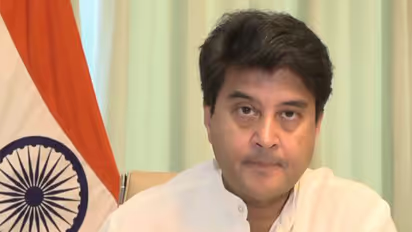
Union Minister for Communications Jyotiraditya Scindia on Wednesday attacked Rahul Gandhi over his criticism of the Modi government over UPI Merchant Discount Rate decision, saying the Congress leader “sees the 'bhoot' of America everywhere” and that “there is no talk of nation-building”.
In an interview with ANI, Scindia said that there is no recommendation to levy charges on the customer and doing so would violate the law and amount to a criminal offence. Scindia, who is also Union Minister for Development of North Eastern Region, said people of the country have no room in their minds or hearts for negative thinking or negative tendencies and the BJP-led government is moving forward with a positive mindset.
"Rahulji sees the 'bhoot' of America everywhere. There is no talk of nation-building. Whether within the country or abroad, the focus remains on disparaging the nation. The people of our country have no room in their minds or hearts for negative thinking or negative tendencies. We are moving forward with a positive mindset and ideology,” Scindia said.
“Every citizen is working day and night with the sole intention of propelling the country forward. I am not responding to American experts or authorities. I have clearly explained to you and the public the reasons behind this, how we are implementing it and on whom it will apply. There will be no burden on the customer. This charge falls on the merchant, specifically on merchants whose monthly UPI-based payments exceed Rs 1 lakh. As I mentioned, this applies to only 4% of merchants," he added.
He was responding to a query on Rahul Gandhi's accusations that UPI MDR transaction charges are being levied due to American pressure.
Rahul Gandhi had attacked the BJP-led government over the proposed transaction fee on UPI transactions, alleging that Prime Minister Narendra Modi should "stand straight" instead of "lying down" before US President Donald Trump. He said the Prime Minister should "have a spine" and "take back” the UPI charges.
UPI MDR Explained: No Charge for Customers
Scindia also outlined the rationale behind MDR structure on the Unified Payments Interface (UPI) platform. The minister noted that the central government initially financed both capital expenditure and yearly operational costs from ordinary taxpayer funds to build and maintain the digital payment rail. To transition the architecture into an autonomous mechanism, a tiered pricing model now applies strictly to merchants without affecting retail end-users.
As per National Payments Corporation of India (NPCI), UPI transactions above Rs 2,000 will attract a Merchant Discount Rate (MDR) of 0.4 per cent under a revised framework, while consumers will continue to transact free of cost using UPI. The revised UPI Merchant Discount Rate framework will come into effect from October 15, 2026, and will apply to select merchant transactions.
The minister stated that for transactions between Rs 2,000 and Rs 75,000, the fee is 0.4 per cent, while amounts exceeding Rs 75,000 carry a flat maximum cap of Rs 300. He affirmed that this rate applies solely to the merchant rather than individual consumers.
"When a technology, a system, is to be completely independent, then it should also be on its feet. Just like every child, after receiving education, after receiving experience, also contributes to their family. And on the basis of this thought, today the MDR, Merchant Discount Rate, which has been put on the UPI system, is 0.4%," he said.
How the 0.4% MDR Applies to Merchants
Detailing the cost comparison against traditional payment instruments, Scindia observed that credit card transaction costs range between 1.5 per cent and 2.5 per cent, while debit card costs stand at 0.9 per cent. In contrast, the government and the Reserve Bank of India set the UPI benchmark at 0.4 per cent under defined thresholds.
"Up to Rs. 2000….on that, 0% will be the charge of the MDR. I am saying it again, 0%. And today, all the transactions of UPI, i.e. the transactions of Rs. 360 lakh crores, 96% of them, are less than Rs. 2000. That means, only for 4% of the transactions, this cost will be charged," Scindia said.
"This charge is not levied on the customer, not on you or me, but on the merchant. This means we do not have to pay even a single paisa extra. The charge falls on the merchant to ensure the robustness of the entire UPI system. In short, it makes no difference to the average customer," Scindia said.
He added that peer-to-peer transfers among relatives or friends remain at zero charge. Merchants recording monthly volumes below Rs 1 lakh also face zero liability, while utility payments, railway bookings, insurance, and fuel purchases carry a capped merchant levy of Rs 5.
Govt Clarifies Stance on UPI Ecosystem
"We are strengthening our infrastructure, including server networks and overall technology. Second, a dedicated fund is being created to provide subsidies that will help bring merchants from rural areas and smaller towns into this system," Scindia said.
The government said on Tuesday that the new UPI framework has no impact on any person to person transactions and UPI will continue to remain completely free for all person-to-person transactions, irrespective of the amount transferred.
The government clarified that MDR is neither a tax nor a charge collected by it or NPCI and will be distributed among payment ecosystem participants, including banks and payment application providers, to support the operation and continued expansion of the UPI ecosystem. (ANI)
(Except for the headline, this story has not been edited by Asianet Newsable English staff and is published from a syndicated feed.)Stay updated with the Breaking News Today and Latest News from across India and around the world. Get real-time updates, in-depth analysis, and comprehensive coverage of India News, World News, Indian Defence News, Kerala News, and Karnataka News. From politics to current affairs, follow every major story as it unfolds. IMD cities weather forecastsRain Cyclone Asianet News Official App