Reimagining Samagra Shiksha 3.0: Centre consults states, experts
Synopsis
Union Minister Dharmendra Pradhan chaired a meeting on 'Reimagining Samagra Shiksha 3.0' to develop a roadmap with states and stakeholders, focusing on strengthening governance, infrastructure, teacher training, and student entitlements.
Centre Holds Consultation on 'Reimagining Samagra Shiksha 3.0'
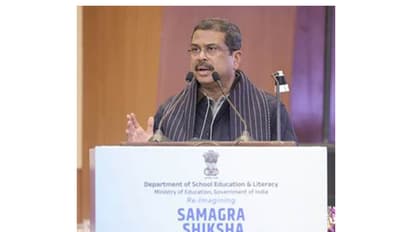
Union Minister for Education, Dharmendra Pradhan, chaired a day-long consultation meeting with the stakeholders on Samagra Shiksha 3.0, titled 'Reimagining Samagra Shiksha', at Sushma Swaraj Bhawan, Pravasi Bharatiya Kendra, New Delhi, on Friday.
The meeting aimed to develop a strategic, consultative, and implementable roadmap for Samagra Shiksha 3.0 through collaborative deliberations with States, UTs, and sectoral stakeholders. The discussions focused on emerging challenges, best practices, and priority interventions required to strengthen governance, infrastructure, teacher training, and student entitlements in the next phase of the scheme.
The meeting was attended by Jayant Chaudhary, Minister of State (Independent Charge) for Skill Development & Entrepreneurship and Education; Sanjay Kumar, Secretary, School Education and Literacy; Dr. Vineet Joshi, Secretary, Higher Education; Additional and Joint Secretaries of the Ministry; State Education Secretaries and State Project Directors (SPDs) of Samagra Shiksha from 11 States and Union Territories; representatives from various Ministries and eminent experts from the education sector.
Pradhan Outlines Vision for Viksit Bharat Through Education
Speaking on the occasion, Pradhan said that Prime Minister Narendra Modi has outlined a vision of Viksit Bharat by 2047, which can be realised only when every child in India has access to quality education and the country achieves 100 per cent enrolment up to Class XII. He emphasised that bridging learning gaps, reducing dropouts, improving learning and nutrition outcomes, strengthening teacher capacity, fostering critical skills, and moving the 'Amrit Peedhi' beyond the Macaulay mindset are collective responsibilities for building a strong human capital base.
The Union Education Minister added that the collaborative deliberations and pioneering ideas shared at the forum would help chart a clear roadmap for strengthening the school education ecosystem and reimagining Samagra Shiksha to make it outcome-oriented, globally competitive, rooted in Bharatiyata, and responsive to the diverse needs of students.
Pradhan stressed that to promote the holistic development of students and expand access to knowledge through the meaningful integration of technology, it is essential to once again entrust schools to society.
Referring to the next phase of Samagra Shiksha, Pradhan said that five years after the implementation of NEP 2020, we are entering a new phase of educational reform aligned with national development goals. He urged all stakeholders to come together to prepare a robust and holistic annual plan for the academic year 2026-27 and take it forward as a nationwide movement, noting that the convergence of ideas will strengthen collective capacity.
Pradhan also appreciated the enthusiastic participation and valuable suggestions of academic experts, senior officials from sectoral Ministries and representatives from the 11 participating States and Union Territories.
Jayant Chaudhary on Bottom-Up Approach and Skilling
While addressing, Jayant Chaudhary said that the schemes are most successful when they are prepared through a bottom-up approach, grounded in the realities of schools and States. He further said that Samagra Shiksha 3.0 represents this spirit as the larger, operational expression of the National Education Policy, where schools act as agents of change.
By embedding skilling, vocational pathways, digital learning and inclusion within a multidisciplinary education framework, Samagra Shiksha moves beyond reform to prepare students for work, life and a rapidly changing economy, he added.
Focus on Learning Outcomes and Technology Integration
Sanjay Kumar, while addressing the gathering, underscored the need to improve learning outcomes, as one of the primary drivers of school education, among students, emphasised the importance of age-appropriate learning, and highlighted the need for curriculum equivalence across different state boards.
He also stressed the importance of leveraging technology, particularly Artificial Intelligence, by interweaving it into the curriculum and integrating it as a key component of Samagra Shiksha.
Progress and Future Milestones Outlined
A detailed presentation was made by Dheeraj Sahu, Addl. Secretary, School Education & Literacy on the occasion. It highlighted significant progress under Samagra Shiksha and NEP 2020, while outlining a framework and milestones for the coming years.
Key focus areas mentioned were access, equity, quality, teacher capacity building, digital education, and outcome-based learning, among others.
About the Samagra Shiksha Scheme
Samagra Shiksha is an integrated, centrally sponsored scheme for school education that marks a paradigm shift by adopting a holistic approach to school education, covering the entire continuum from pre-primary to senior secondary level without segmentation. (ANI)
(Except for the headline, this story has not been edited by Asianet Newsable English staff and is published from a syndicated feed.)Stay updated with the Breaking News Today and Latest News from across India and around the world. Get real-time updates, in-depth analysis, and comprehensive coverage of India News, World News, Indian Defence News, Kerala News, and Karnataka News. From politics to current affairs, follow every major story as it unfolds. IMD cities weather forecastsRain Cyclone Asianet News Official App