Rahul Gandhi in Kota, addresses student mental health, education crisis
Synopsis
Rahul Gandhi visited Kota, addressing the educational crisis and student mental health. He slammed the system for paper leaks and high fees, accusing the Modi govt of negligence and calling their ban on Telegram a superficial move.
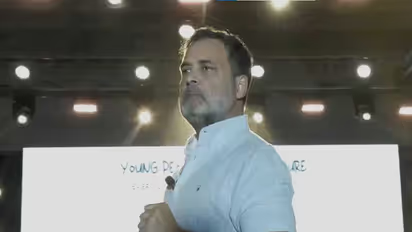
Leader of Opposition and Congress MP Rahul Gandhi on Wednesday visited Kota, Rajasthan, to engage directly with students regarding the mounting pressures within India's educational landscape. Steering clear of partisan rhetoric and departure from traditional political discourse, Rahul Gandhi framed the dialogue as a necessary intervention to address the mental health crisis and systemic limitations facing the nation's youth during his outreach programme "Echo of Students." The campaign aims to raise voice against problems like paper leaks, rigging in exams, declining standards of education, and rising fees.
Critique of a 'Pressure-Cooker' System
Addressing a gathering in the city known for its intense coaching culture, the LoP emphasised that the meeting was strictly non-political. His primary objective, he stated, was to confront the harsh realities experienced by students who are "struggling to get a future." "This evening is about you. It is about what you are facing. It is about the challenges that you're dealing with every single day."
Reflecting on insights gained during his cross-country Yatra, Gandhi questioned the structural shifts in the educational landscape, specifically highlighting the decline of the public sector and the prohibitive costs of private education. He offered a sharp critique of the current pedagogical approach: He argued that the system "pressures, stresses, suppresses, and crushes its children," creating a high-stakes environment that has led to tragic outcomes. The LoP set a sombre, urgent goal for the dialogue: to work toward a future where no student in India feels the desperation that leads to self-harm.
Narrow Career Paths and Unfulfilled Dreams
A central theme of his address was the lack of vocational and creative diversity within the Indian career path. Gandhi noted that during his interactions with millions of young people, he consistently received the same five career aspirations: Engineer, Doctor, Lawyer, IAS, and Forces. "The biggest shortcoming of our education system is that we do not fulfil our children's dreams," Gandhi remarked. He challenged the status quo, asking why the system fails to foster broader ambitions or respect the diverse, individual choices of its students. By highlighting this narrow scope, he called for a reimagining of an educational framework that empowers, rather than suppresses, the aspirations of the next generation.
Systemic Failure and Government Negligence
Rahul Gandhi has intensified his campaign against what he described as a "corrupt and broken system." In a post on X, he announced his arrival at Kota and said that the ongoing student distress was not a series of isolated incidents, but a systemic failure fueled by government negligence.
Gandhi did not mince words regarding the financial burden placed on Indian families, claiming the education sector has devolved into an "extortion mechanism." "Just think--the amount of money families across the country spend just on NEET preparation is equal to the entire education budget of the Government of India," Gandhi wrote. He highlighted the tragic loss of two young students, Umesh in Sikar and Riya in Dehradun, who reportedly took their own lives under the pressure of the Re-NEET cycle.
For Gandhi, these deaths are the direct consequence of a "broken and corrupt" administration, specifically targeting Prime Minister Narendra Modi and Education Minister Dharmendra Pradhan. He accused them of prioritising the protection of "future-traders" and paper-leak mafias over the lives of students.
'Attack the Mafia, Not the Students'
Addressing the government's recent decision to ban Telegram to curb paper leaks, Gandhi dismissed the move as a superficial attempt to deflect responsibility. Gandhi argued that banning a platform used by millions of students for notes, test series, and collaborative learning is not a solution. "Instead of catching the thief, [the government] is putting a lock on the victim's house," he stated.
He questioned the efficacy of such measures, noting that students and the paper-leak mafias alike know these bans are not "foolproof." He warned that this logic could lead to further restrictions on other platforms like WhatsApp.
"Modi ji, stop the posturing. Attack the mafia, not the students," Gandhi challenged. He warned the government to heed the voices of the youth, asserting that the current wave of student anger is the beginning of a larger movement to reclaim their rights.
The NEET-UG 2026 re-examination is scheduled to be held on June 21, following the cancellation of the May 3 exam due to paper leak controversies. (ANI)
(Except for the headline, this story has not been edited by Asianet Newsable English staff and is published from a syndicated feed.)Stay updated with the Breaking News Today and Latest News from across India and around the world. Get real-time updates, in-depth analysis, and comprehensive coverage of India News, World News, Indian Defence News, Kerala News, and Karnataka News. From politics to current affairs, follow every major story as it unfolds. IMD cities weather forecastsRain Cyclone Asianet News Official App