Projecting Power, Not Playing Defence: India’s Case for Carrier Battle Groups Against China’s String of Pearls
Synopsis
India must strengthen its maritime strategy by developing carrier battle groups to counter China’s growing presence in the Indian Ocean. Beijing’s “String of Pearls” network and expanding naval deployments pose strategic challenges to India’s sea lanes.
New Delhi: The Indian Ocean is not a quiet backyard; it is a crowded arena where great powers compete for sea lanes, energy routes, and bases.
India’s official maritime strategy has long recognised that geography gives New Delhi leverage over key chokepoints such as Hormuz, Bab el-Mandeb, and the Malacca, Sunda and Lombok straits, but only if India has the naval power to exploit that position.
A navy built mainly for coastal defence cannot do this job. It can watch the traffic pass; it cannot shape it.
India’s economy depends on seaborne trade and energy imports that pass through these same chokepoints. Any state that can threaten these arteries gains coercive power over India’s choices in war and in peace. A serious maritime strategy must therefore focus on sea control and forward presence, not just surveillance and point defence.
China’s “String of Pearls”
China has quietly built a network of ports and access points from the South China Sea to the Red Sea, often called the “String of Pearls”.
Facilities at Gwadar in Pakistan, Hambantota in Sri Lanka, and Djibouti in the Horn of Africa give Beijing logistical depth and the option over time to support more frequent and more capable PLAN deployments in the Indian Ocean.
Since 2008, China has kept a continuous naval task force in the Gulf of Aden, rotating modern destroyers, frigates, and support ships through far-seas operations and gaining hard experience in the Indian Ocean Region (IOR).
China keeps roughly seven to eight naval assets in the IOR on a more or less permanent basis, often under the cover of anti-piracy or “research” missions. This is not a theoretical threat; it is China practicing how to operate on India’s maritime flank.
Why Carriers Matter?
In this setting, an aircraft carrier is not a luxury; it is a tool of power politics. An Indian carrier battle group (CBG) is a mobile airfield at sea that can move thousands of kilometers in a few days, take its own fighters and helicopters with it, and sustain operations without asking anyone’s permission. It allows India to project air power over vast stretches of ocean, support submarines and surface forces, and dominate a patch of sea and sky for as long as required.
This mobility changes the game at the chokepoints.
With carriers, India can push its defensive line forward to the Malacca, Sunda and Lombok straits, and even beyond. Instead of waiting for PLAN task groups to approach the Andaman and Nicobar Islands or the Indian mainland, a CBG can intercept and shadow them near these funnels, signal resolve, and, if needed, block or attrit them before they become a direct threat. A land-based air force cannot offer the same persistent presence over these distant waters without tanker-heavy, fragile, and politically constrained operations.
From Continental to Maritime Mindset
India’s strategic culture has been shaped by land wars with Pakistan, with China, and by internal security challenges. This has created a preference toward continental defence by building land-based firepower. That logic made sense when the main threats were across the land border. It does not hold when China’s most dynamic advances against India’s interests are at sea.
A carrier-centred navy is the maritime equivalent of Mearsheimer’s “regional hegemon” logic, one that India must dominate its own strategic backyard if it wants security and autonomy. If India leaves the IOR open, China will fill the space with ships, bases and political influence. A defensive fleet hugging the coast simply invites Beijing to operate comfortably in the wider ocean and to treat Indian protests as noise.
Deterrence and Perception
Deterrence is, above all, about perception. China will take India seriously at sea only if Indian naval forces can threaten assets that Beijing values such as its sea lanes, its expeditionary task groups, and its “pearls” along the rim. A credible Indian CBG presence in the eastern and western IOR signals that any crisis could put Chinese shipping and forward bases at real risk.
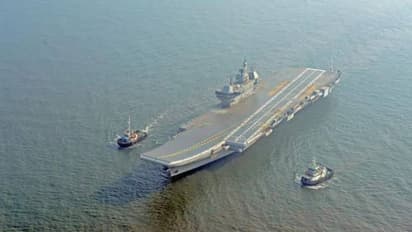
That is how you shape Chinese calculations, not by issuing statements while PLAN ships cruise near your islands. Indian policymakers have already moved in this direction. INS Vikramaditya and the indigenously built INS Vikrant are the visible symbols of a carrier-centric approach in Indian maritime doctrine, which now stresses sea control and power projection rather than mere denial.
A parliamentary Standing Committee on Defence has endorsed the Navy’s aim of a three-carrier force, recognising that at least two fully operational CBGs are indispensable for sustained presence in both the Arabian Sea and the Bay of Bengal.
India now faces a clear choice. It can cling to a continental, risk-averse mindset, under-invest in carriers, and watch as Chinese warships, submarines, and auxiliaries turn the Indian Ocean into a second playground after the South China Sea or it can embrace a maritime strategy that matches its geography and ambitions--build and sustain carrier battle groups, use them to police regional chokepoints, and signal to Beijing that the IOR will not become another sphere of Chinese influence.
A state that aspires to shape the balance of power in Asia cannot retreat behind its beaches. For India, an aircraft carrier is a decisive instrument of maritime power projection and a necessary answer to China’s “String of Pearls”.
Stay updated with the Breaking News Today and Latest News from across India and around the world. Get real-time updates, in-depth analysis, and comprehensive coverage of India News, World News, Indian Defence News, Kerala News, and Karnataka News. From politics to current affairs, follow every major story as it unfolds. IMD cities weather forecastsRain Cyclone Asianet News Official App