Pralhad Joshi holds meet to strengthen CBSE's academic, exam process
Synopsis
Union Education Minister Pralhad Joshi reviewed CBSE's academic and exam processes amid the Supreme Court's scrutiny of the board's three-language policy, questioning its practical implementation regarding textbooks and teachers.
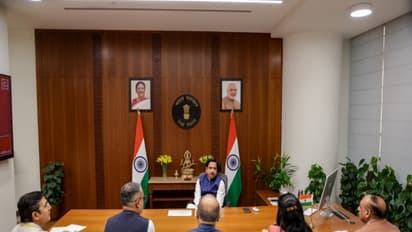
Union Education Minister Pralhad Joshi held a meeting with senior officials of the Department of School Education and Literacy to review key issues concerning the Central Board of Secondary Education (CBSE), with discussions focusing on strengthening academic, examination and administrative processes.
"Convened a meeting with senior officials of the Department of School Education and Literacy, @EduMinOfIndia, to discuss issues pertaining to CBSE," Joshi wrote in a post on X.
He said the meeting reviewed key priorities for strengthening CBSE's academic, examination and administrative processes, with an emphasis on greater efficiency, transparency and improved support for students and teachers. "The meeting reviewed key priorities for strengthening CBSE's academic, examination and administrative processes, with a focus on greater efficiency, transparency and improved support for students and teachers," he said.
SC questions CBSE's three-language policy
The meeting comes amid the ongoing debate over the implementation of CBSE's three-language policy for Class 9 students under the National Education Policy (NEP) 2020.
The Supreme Court on August 20 questioned several aspects of the policy, including the availability of textbooks and qualified teachers, the potential burden on students and the manner in which the language requirement would be implemented across schools.
A bench headed by Chief Justice of India Surya Kant and Justices Joymalya Bagchi and V Mohana was hearing pleas challenging the CBSE's three-language policy.
Petitioners raised concerns over the availability of learning material and teaching staff for Indian languages prescribed under the scheme.
The court was also informed that some schools were yet to receive textbooks for certain languages.
Senior advocate Anand Grover questioned how students could be expected to learn a new language without basic learning material.
However, Additional Solicitor General Aishwarya Bhati, appearing for the CBSE and Centre, said the scheme contemplated internal assessment and there would be no holding back of Class 9 students for failing to qualify in the additional languages.
Foreign languages and teacher availability
The bench also clarified that students already studying foreign languages such as French would not be required to discontinue them.
CJI Surya Kant said there was "no question of boycotting languages taught earlier" and stressed the importance of respecting all languages.
The court further examined teacher availability, particularly for languages such as Sanskrit, and questioned the broader administrative implementation of the policy.
Bhati submitted that 99.19 per cent of CBSE schools were already compliant with the requirement of teaching two Indian languages, while around 235 schools remained non-compliant.
The Supreme Court said the policy would need to be examined from both constitutional and practical perspectives, including language classification, teacher availability, textbooks and the burden on students.
(ANI)
(Except for the headline, this story has not been edited by Asianet Newsable English staff and is published from a syndicated feed.)Stay updated with the Breaking News Today and Latest News from across India and around the world. Get real-time updates, in-depth analysis, and comprehensive coverage of India News, World News, Indian Defence News, Kerala News, and Karnataka News. From politics to current affairs, follow every major story as it unfolds. IMD cities weather forecastsRain Cyclone Asianet News Official App