From Pollution Anger to Maoist Slogans: What Really Happened at India Gate in Delhi
Synopsis
A protest against Delhi's pollution at India Gate turned violent after a group of youth displayed posters of slain Maoist commander Madvi Hidma and allegedly used chilli spray on cops. Over 15 were arrested for blocking road, assaulting police.
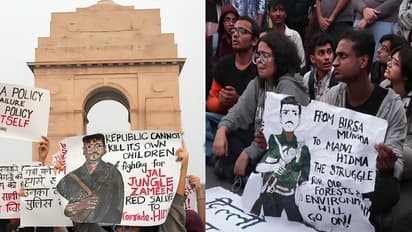
A protest against Delhi's toxic air turned into a tense and dramatic incident on Sunday evening, when a group of young demonstrators at India Gate allegedly raised Maoist slogans, displayed posters of slain Maoist commander Madvi Hidma, and used chilli spray on police officers. What began as a gathering over air pollution quickly shifted into a political and ideological flashpoint, drawing sharp reactions from the police, the BJP, and the Aam Aadmi Party (AAP). More than 22 people were detained, and several were arrested under serious charges.
How the protest started at India Gate
On Sunday evening, a group of people gathered at C-Hexagon near India Gate to protest against the rising pollution levels in the National Capital Region (NCR). Such gatherings had already taken place earlier on November 9, when citizens urged the government to enforce stronger measures to reduce smog.
The protest on Sunday was expected to be similar, peaceful, youth-led, and focused on demanding action to control Delhi’s hazardous air. But within minutes, the situation changed sharply.
When the Maoist angle emerged at the protest
What drew sudden attention were the posters held by several demonstrators. These posters carried pictures of Maoist commander Madvi Hidma, a top leader of the CPI (Maoist), who had been killed in an encounter on November 18 in the Maredumilli forests of Andhra Pradesh’s Alluri Sitarama Raju district. Another poster reportedly carried the slogan 'Madvi Hidma Amar Rahe' (Long live Madvi Hidma).
Hidma was behind the deaths of several innocents, especially over 70 CRPF jawans in Chhattisgarh. He was a CPI(M) Central Committee member and the secretary of the Dandakaranya Special Zonal Committee, one of the most powerful Maoist units. He was named in multiple deadly attacks on security forces.
The appearance of his posters at an air pollution protest immediately raised questions:
- Were the protesters trying to give the protest a Maoist colour?
- Were they aware of Hidma’s background?
- Was this an organised attempt or the act of a small group?
Delhi Police quickly confirmed that Maoist posters were indeed present, and that this was highly unusual for a civic protest about pollution.
Why Hidma posters matter: Background of the slain Maoist commander
Madvi Hidma, originally from Chhattisgarh, had been linked to several high-profile Maoist attacks. His death in an encounter a week earlier had generated responses from Maoist sympathisers across some states.
According to security forces, Hidma and his group had opened fire during a cordon-and-search operation on November 18, which led to a long encounter. His wife, Rajje, and four other Maoists were also killed.
Because Maoist groups rarely operate openly in cities, the sudden sight of Hidma posters in the nation’s capital became a central point of controversy.
Chhattisgarh deputy Chief Minister reacts to slogans
Chhattisgarh deputy chief minister Vijay Sharma commented on the matter, saying the “children” taking part in the protest had no real understanding of what they were shouting.
He said, “They mentioned 'Jantana Sarkar', but they have neither seen it themselves nor understood its real impact. They are kids; they will understand eventually. Still, they need to learn how democracy functions, how real governments work, and how policies are made.”
His comments suggested that the demonstrators may not truly understand Maoist ideology and may have been influenced without knowing the full context.
Police version: Chilli spray, barricade-breaking, and road blockade
Delhi Police gave a detailed account of what happened after the crowd gathered at C-Hexagon.
There were attempts tt break through barricades. According to officials, the protesters first moved inside the C-Hexagon area and then tried to cross the barricades placed to restrict movement.
When police asked them to step back, the group reportedly broke the barricades, came onto the road, and sat down, blocking traffic at a busy roundabout.
Ambulances stuck behind protest
DCP Devesh Kumar Mahla told ANI that an ambulance and medical staff were stuck behind the protesters and required emergency passage. But the demonstrators did not move.
Scuffle with police
Police then started removing the protesters to clear the road. During this, several protesters scuffled with police, and multiple officers were injured.
First-ever use of chilli spray on Delhi Police
The most shocking element came next. For what the police said was the first time in such a protest, some demonstrators allegedly used chilli spray on police officers.
A few officers were reportedly sprayed directly in the eyes. Some were admitted to RML Hospital for treatment. DCP Mahla said, “For the first time, we encountered the use of chilli spray against police personnel. Legal action is being taken.”
FIR, arrests and charges
Delhi Police quickly registered an FIR and confirmed that more than 15 protesters were arrested with some reports saying the total number of detained individuals was over 22. The FIR includes charges for:
- Assaulting police officers
- Obstructing official work
- Blocking a public road
- Using chilli spray against police
Police have also noted the presence of Maoist posters as part of their ongoing investigation.
BJP responds with strong criticism
The BJP reacted sharply, calling the demonstrators 'professional protesters' and linking the incident to what they described as the 'urban Naxal network'.
Shahnawaz Hussain's statement
BJP leader Shahnawaz Hussain said: “They came claiming to protest against pollution, but that was not their real purpose. Those with a polluted mind began raising slogans in support of Hidma.”
He added that the incident showed that “urban Naxals” were active in the capital and that such groups often used social issues to hide their real agenda.
BJP MP Praveen Khandelwal calls it a conspiracy
Praveen Khandelwal criticised the protesters, saying, "neither students nor concerned environmental protesters. These are clearly people with Naxalite tendencies." He added: “Under the pretext of pollution, some Naxalite elements staged a protest at India Gate and violated every norm of democracy. They raised pro-Naxal slogans and sprayed chilli spray into the eyes of the police personnel. This clearly shows a pre-planned conspiracy.”
The BJP maintained that the protest had gone beyond an environmental issue and had entered security territory.
AAP questions Delhi government’s inaction on pollution
While BJP focused on the Maoist connection, AAP trained its attention on the pollution crisis and the Delhi administration’s response. AAP leader Priyanka Kakkar said: “This is a national health emergency. The central government should act like a responsible government. It’s been 10 months since they have been in Delhi. Have you heard of even one step taken to control pollution? Nothing.” She demanded:
- An emergency meeting with all Chief Ministers of the NCR
- A coordinated plan to reduce pollution
- Stronger action under the Graded Response Action Plan (GRAP)
- She said citizens were protesting again and again because they “understood the fraud” being committed with public health.
Air quality worsens as protest unfolds
Even as the political fight intensified, Delhi woke up Monday morning to extremely polluted air. AQI numbers on Monday morning, according to the Central Pollution Control Board (CPCB) were:
- Overall Delhi AQI at 7 am: 396 (Very Poor)
- Ghazipur: 441 (Severe)
- Anand Vihar: 440 (Severe)
- Bawana: 434 (Severe)
- NSIT Dwarka: 322 (Very Poor)
A thick layer of smog covered areas around India Gate, AIIMS, Safdarjung Hospital, ITO, Mayur Vihar and Akshardham. The Air Quality Early Warning System (EWS) forecast predicted very poor air quality from November 23 to 26.
(With ANI inputs)
Stay updated with the Breaking News Today and Latest News from across India and around the world. Get real-time updates, in-depth analysis, and comprehensive coverage of India News, World News, Indian Defence News, Kerala News, and Karnataka News. From politics to current affairs, follow every major story as it unfolds. IMD cities weather forecastsRain Cyclone Asianet News Official App