PM Modi's vision: 'Made-in-India' aircraft and self-reliant shipping
Synopsis
PM Modi, becoming the longest-serving continuously elected PM, emphasised a 'Made-in-India' vision for civil aircraft and shipping, highlighting the nation's economic resilience and focus on domestic manufacturing under the NDA government.
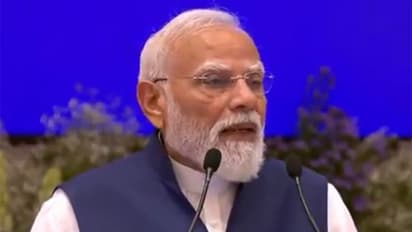
Marking the historic milestone of becoming the longest-serving continuously elected Prime Minister, PM Modi emphasised domestic manufacturing, particularly in transport and aviation, stating that work is underway for "Made-in-India vimaan "(aircraft) for civil purposes.
'Made-in-India' Vision for Aviation and Shipping
Addressing the NDA leaders' meeting, PM Modi said, "India is advancing towards new goals of self-reliance in the shipping sector. We are moving towards a future where we will conduct trade using 'Made in India' ships and containers. India will provide services ranging from ship maintenance and repair to scrapping. We hold the same vision for our aviation sector. Today, we are manufacturing 'Made in India' transport aircraft. The day is not far when India will also manufacture 'Made in India' civil aircraft, and our citizens will travel in them; I foresee that day coming"
Stable Government Fuels Economic Growth
PM Modi highlighted the work done under the NDA since 2014, highlighting the nation's resilience amid global instability, resulting in a Gross Domestic Product of 7.7% in the year 2025-26. He credited these achievements to the benefits of having a stable government, recalling how India continued to forge ahead even during the challenging times of the COVID-19 pandemic.
Reflecting on the country's economic transformation, PM Modi remarked, "There is another notable aspect of the NDA's achievements over these 12 years: we secured them amidst a period of global instability and turmoil. This era has repeatedly demonstrated the benefits of having a stable government. We can never forget the time of the COVID-19 pandemic; while there was chaos and distress everywhere, India successfully forged ahead even while confronting that crisis. Even as the economies of major nations across the world struggle, India has achieved a growth rate of 7.7% in 2025-26. Furthermore, in the last quarter, which ended on March 31st, India's growth rate stood at 7.8%."
Empowering the Middle and Neo-Middle Classes
He emphasised that the government is fully dedicated to fulfilling the hopes and dreams of the middle and neo-middle classes, who serve as the primary drivers of the nation's aspirations.
Detailing the measures made for the middle class, the Prime Minister contrasted the current landscape with the pre-2014 era. "Prior to 2014, the middle class often bore the brunt of legal and bureaucratic tangles. A complex tax system, limited income sources, a heavy tax burden, and the impact of poor governance were daily challenges for the common citizen," he explained.
Tax Relief and Eased Burdens
He highlighted that today, income up to Rs 12 lakh is completely tax-free, and that reforms such as the expanded Ayushman Bharat scheme and GST changes have made life easier and more affordable for families. "However, we understood the struggles and aspirations of the middle class; that is why, today, income up to Rs 12 lakh is completely tax-free. The country now boasts a simplified tax system, and a robust infrastructure has made life easier. Over the past 12 years, new opportunities have emerged across various sectors for the children of middle-class families. The government is also helping to fulfil the dream of home ownership for the middle class," he said.
"To alleviate the financial burden of medical treatment, the Ayushman Bharat scheme has been expanded to include the elderly, regardless of income limits. The middle class has also benefited immensely from GST reforms; health insurance has become more affordable, as have the goods and services linked to their dreams. The result of these efforts is that the country's middle class is now breaking free from uncertainty and propelling the nation's development journey with immense self-confidence," he added.
India's Industrial and Infrastructural Leap
The Prime Minister also shared specific data to showcase India's progress in industrial and infrastructural sectors over the past 12 years. He noted, "In 2014, India imported the majority of the mobile phones it required. Today, India manufactures over 330 million mobile handsets domestically. In 2014, solar capacity stood at just 2.5 gigawatts; today, it exceeds 150 gigawatts. Ethanol blending was merely 1.5% in 2014, whereas today it has reached 20%. In 2014, the country did not have a single semiconductor unit; today, more than 10 semiconductor units under construction are propelling India towards modernity. We made the country's needs the foundation of our policies and decisions, adopting a fresh mindset to take new initiatives."
Ensuring Inclusive Development
To ensure that no segment of society is left behind, PM Modi detailed the creation of new government bodies, such as the Ministry of Skill Development, the Ministry of Cooperation, and the Ministry of Fisheries. "Our focus was clear: no one should be left behind in this race for development. We enacted legislation for Divyangjan (differently-abled persons) and launched schemes like 'Janman' for tribal communities. Previously, livestock rearers and fisherfolk did not benefit from the Kisan Credit Card; we extended this facility to them as well. Furthermore, our government has provided the 'SVANidhi' credit card facility to street vendors," said the PM.
A New Governance Model of Delivery
The Prime Minister compared the current governance model with that of previous decades. "The point is, if so much could be achieved in 12 years, why didn't it happen over the preceding decades? This illustrates the difference between the Congress-era growth rate and the NDA-era growth rate. One system kept people waiting; today's system delivers results. One system used to stall and derail work; today's system ensures that work gets done on time and on a massive scale," he asserted.
He described the period from 2014 to 2026 as the story of an India that is finally operating at its full potential, setting ambitious goals and working tirelessly to deliver results on a massive scale. "The story from 2014 to 2026 is not merely a tale of statistics. It is the story of an India that has, for the first time, begun to run at its full potential, an India that sets ambitious goals and works tirelessly to achieve them," he said.
Historic Milestone for PM Modi
The Union Cabinet today passed a resolution marking June 10, 2026, as an historic milestone in the journey of Indian democracy, applauding PM Modi for becoming the longest-serving continuously elected Prime Minister of the country. By establishing a record of 4,399 days of continuous service as an elected PM, he has surpassed the previous record held by India's first Prime Minister Jawaharlal Nehru, who served for 4,398 continuous days from 1952 to 1964. The resolution stated that this occasion stands as a symbol of India's democratic consciousness, public trust, and the power of public participation, reflecting the unprecedented support bestowed by the people upon a leader guided by the 'Nation First' resolve. (ANI)
(Except for the headline, this story has not been edited by Asianet Newsable English staff and is published from a syndicated feed.)
Stay updated with the Breaking News Today and Latest News from across India and around the world. Get real-time updates, in-depth analysis, and comprehensive coverage of India News, World News, Indian Defence News, Kerala News, and Karnataka News. From politics to current affairs, follow every major story as it unfolds. IMD cities weather forecastsRain Cyclone Asianet News Official App