Pilots Entitled to Labour Law Protection as 'Workmen', Says Delhi HC
Synopsis
The Delhi High Court has ruled that airline pilots are 'workmen' under the Industrial Disputes Act. The court held that their primary duty is the technical task of flying, not management, and high salaries or titles do not exclude them from labour law protections.
Pilots are 'Workmen' Under Industrial Disputes Act
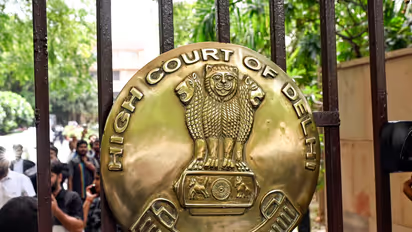
The Delhi High Court has held that airline pilots, including pilots-in-command, fall within the definition of "workman" under the Industrial Disputes Act, ruling that their primary role is technical and operational flying the aircraft and not managerial or supervisory in nature.
The Court found that job titles, command responsibilities during flights, or high salaries cannot, by themselves, exclude pilots from labour law protections. A Division Bench of Justice Anil Kshetarpal and Justice Harish Vaidyanathan Shankar delivered the ruling while deciding a batch of Letters Patent Appeals filed by King Airways against its former pilots, including Captain Pritam Singh, Manjit Singh and ND Kathuria. The airline had challenged earlier orders directing payment of unpaid salary, incentives for extra flying hours and related dues.
'Predominant Nature of Duties' Test is Key
At the outset, the Court recorded a clear finding that the "predominant nature of duties" test is decisive. It noted that although a pilot-in-command may, in theory, be described as being in charge of a flight, the evidence on record showed that pilots do not exercise supervisory or managerial control over crew in the industrial or administrative sense. Their core function, the Bench held, remains the skilled and technical task of operating the aircraft.
Rejecting the airline's argument that pilots are excluded from the definition of "workman" because they draw high salaries or are designated as senior commanders, the Court observed that the salary threshold becomes relevant only if an employee is first shown to be performing supervisory duties. In the absence of proof that pilots actually discharge such supervisory functions, the question of exclusion under Section 2(s)(iv) of the Industrial Disputes Act does not arise.
Aviation Regulations Not Equivalent to Labour Law
The Bench also examined the reliance placed by King Airways on the Aircraft Rules and internal operations manuals to argue that pilots supervise crew members. It held that any supervision referred to in aviation regulations is incidental to flight safety and cannot be equated with managerial supervision contemplated under labour law. The Court emphasised that statutory terms used in one regulatory framework cannot be mechanically transplanted into another with a different purpose and context.
Back Wages Upheld for Illegal Termination
On the issue of back wages, the Court upheld the Industrial Tribunal's award, noting that the pilots' termination was illegal and effected without due process. Applying Supreme Court precedents, the Bench reiterated that reinstatement with continuity of service and back wages is the normal rule in cases of wrongful termination, particularly where the employer fails to show that the workman was gainfully employed elsewhere.
While affirming the earlier judgment in favour of the pilots in three connected appeals, the High Court set aside a separate single-judge order that had remanded one case back to the tribunal on the question of whether a pilot was a "workman." The Division Bench held that this issue had already been conclusively settled in the connected matters and did not warrant reopening.
With these findings, the Court dismissed King Airways' appeals challenging the pilots' status and dues, reinforcing that highly skilled professionals like pilots are not automatically outside the protective umbrella of labour law merely because of their designation or pay scale. (ANI)
Stay updated with the Breaking News Today and Latest News from across India and around the world. Get real-time updates, in-depth analysis, and comprehensive coverage of India News, World News, Indian Defence News, Kerala News, and Karnataka News. From politics to current affairs, follow every major story as it unfolds. IMD cities weather forecastsRain Cyclone Asianet News Official App