Owaisi opposes Bill, says it violates federalism, targets South, OBCs
Synopsis
AIMIM's Asaduddin Owaisi opposed the Constitution (131st Amendment) Bill, stating it violates federalism and the constitution's basic structure. He alleged the bill's main goal is to 'rule the south' and erase OBC representation in legislatures.
Owaisi Alleges Violation of Federalism, Targeting of South and OBCs
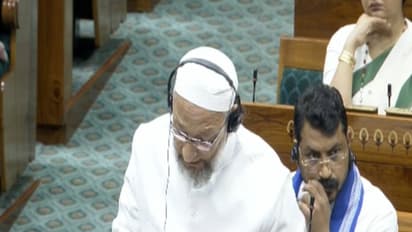
All India Majlis-e-Ittehadul Muslimeen (AIMIM) chief Asaduddin Owaisi on Thursday opposed the introduction of the Constitution (One Hundred and Thirty-First Amendment) Bill, asserting that it violates federalism, which is the basic structure of the Indian Constitution. While addressing the Lok Sabha, he said that the main goal of the Constitutional Amendment Bill introduced by Union Law Minister Arjun Meghwal is to "rule the south" and intends to "erase the representation of OBCs from the legislature."
"I oppose this introduction of this Constitutional Amendment Bill because it violates the Parliamentary form of democracy and federalism, which are both part of the basic structure of the constitution. This is not about women's reservation. The main goal is to rule South and to completely erase the representation of OBCs from the legislature," Owaisi said.
He said that by removing the delimitation freeze of changing the size and composition of the Lok Sabha and state assemblies on the basis of population, the larger population will be given more power, while a "fair voice" to the small population will be denied. "Federalism is the basic structure of the Constitution. Removing the delimitation freeze, it gives more seats and power to the larger population while denying a fair voice to the smaller population. This again is the violation of federalism. The Hindi heartland has 38.1 per cent, and it will increase to 43.1 per cent. Southern states will decrease from 24 per cent to 20 per cent," Owaisi said.
Cites Procedural Violations
"It also violates the direction. The Minister has to give a seven-day notice for introducing a bill in this House. Similar copies of the Bill need to be given to the members two days before introduction. This is a clear violation of 123 B of RPA 1951. One week before voting, I call this a corrupt practice," he added.
After this, the result of the division was declared with 251 ayes and 185 noes, with the majority in favour of introducing the Constitutional Amendment Bill.
Bill's Link to Delimitation and Women's Reservation
The three key bills--The Constitution (One Hundred and Thirty-First Amendment) Bill, 2026, The Delimitation Bill, 2026, The Union Territories Laws (Amendment) Bill, 2026--were introduced subsequently. The Constitutional Amendment bill's implementation is tied to a population-based revision of constituencies based on the 2011 census. It proposes delimitation--a wider political overhaul--aiming to change the size and composition of state legislative assemblies and Lok Sabha.
The opposition to the proposed delimitation bill has been mounting for a long time and has escalated after the Centre's recent approval of draft amendment bills to operationalise the Nari Shakti Vandan Adhiniyam, 2023.
The government plans to implement the women's reservation ahead of the 2029 General Elections by bringing in an amendment to the 2023 Act and a constitutional amendment to delink the delimitation process from the 2027 census.
The government has proposed to increase the number of seats in the House to 850, with 815 seats proposed for the States and the remaining 35 for the Union Territories. The Lok Sabha has 543 seats at present.(ANI)
(Except for the headline, this story has not been edited by Asianet Newsable English staff and is published from a syndicated feed.)Stay updated with the Breaking News Today and Latest News from across India and around the world. Get real-time updates, in-depth analysis, and comprehensive coverage of India News, World News, Indian Defence News, Kerala News, and Karnataka News. From politics to current affairs, follow every major story as it unfolds. IMD cities weather forecastsRain Cyclone Asianet News Official App