Operation Sindoor 2.0: What India Must Learn From Iran War Before Next Pakistan Conflict
Synopsis
Modern warfare is evolving, as shown by events like Operation Sindoor. Future conflicts are expected to be swift, decided by drone swarms, cyberattacks, and precision strikes rather than traditional forces. These new threats require advanced defenses like layered air defense and underground command centers.
Operation Sindoor 2.0: The New Rules of War India Cannot Ignore
A year after Operation Sindoor altered India’s military posture against Pakistan, defence experts believe the ongoing Iran conflict has delivered a stark warning about the future of warfare. From drone swarms and cyber disruption to underground command centres and AI-assisted targeting, modern battlefields are evolving rapidly — and India is being forced to rethink its next military doctrine.
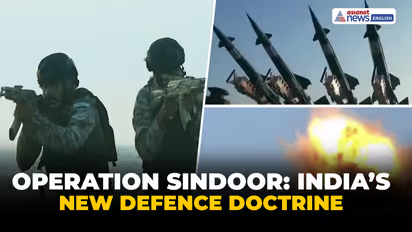
Operation Sindoor, launched after the Pahalgam terror attack in 2025, marked one of India’s most aggressive cross-border military responses in recent years. The Indian armed forces targeted terror infrastructure across Pakistan and Pakistan-occupied Kashmir in what later evolved into an 88-hour confrontation involving missile strikes, drones, air defence systems and electronic warfare.
But military planners now believe the next India-Pakistan conflict could look dramatically different.
According to the India Today report, future wars may no longer depend on tanks crossing borders or prolonged troop mobilisation. Instead, they may be decided within hours through “precision strikes, cyber paralysis, electronic warfare and drone dominance.”
Drone Warfare Has Changed Everything
One of the biggest lessons emerging from both Operation Sindoor and the Iran war is the growing dominance of drones. Analysts say the India-Pakistan confrontation of 2025 effectively became the “first drone battle” between two nuclear powers.
Pakistan reportedly relied heavily on drone intrusions and low-cost aerial systems during the confrontation, while India used layered air defence systems to intercept and neutralise threats. The experience convinced Indian military planners that future conflicts would involve mass drone attacks aimed at overwhelming traditional defence systems.
The Iran war reinforced the same concern on a much larger scale. Swarm drones, loitering munitions and AI-enabled surveillance systems demonstrated how relatively inexpensive technology could damage high-value military infrastructure. Experts cited in recent defence assessments warned that countries failing to invest rapidly in counter-drone systems could suffer devastating losses within minutes.
India has since accelerated procurement of anti-drone technologies, electronic jammers and indigenous unmanned combat systems. Reports indicate that the armed forces are focusing heavily on military-grade drone manufacturing and integrated counter-UAS networks after identifying capability gaps during Operation Sindoor.
Military analysts also stress that future wars will not be fought only in the skies. Drones may increasingly be used for intelligence gathering, sabotage missions, supply-chain disruption and precision strikes against command centres, radar installations and ammunition depots.
Air Defence, Underground Bases And Cyber Power
Another major takeaway from Operation Sindoor was the importance of layered air defence. Former Air Marshal Narmdeshwar Tiwari reportedly stated that India managed to protect all its military bases because of a “robust, layered air defence shield.”
Following the operation, India reportedly began prioritising the construction of underground command and control centres, hardened military shelters and protected operational hubs to withstand missile and drone attacks.
The Iran conflict further highlighted why underground infrastructure matters. Repeated precision strikes on military facilities in the region demonstrated how exposed surface-level installations can become vulnerable in modern wars dominated by satellite imagery, AI-assisted surveillance and long-range precision weapons.
Cyber warfare has emerged as another crucial battlefield.
Recent analyses of Operation Sindoor revealed that cyberattacks, malware deployment and disinformation campaigns were used alongside military action. Experts warned that future conflicts may involve simultaneous attacks on power grids, communication systems, banking infrastructure and digital networks before conventional combat even begins.
The India Today report argues that the next war may begin not with fighter jets, but with cyber paralysis — disabling enemy systems before physical strikes are launched.
This has pushed India to accelerate investments in electronic warfare, AI-assisted surveillance and integrated command systems capable of coordinating responses across the Army, Navy and Air Force simultaneously.
Why Clear War Objectives Matter
Military strategists also believe Operation Sindoor underscored the importance of clearly defined war aims.
Several analysts have contrasted India’s limited, high-precision military objectives with longer conflicts elsewhere that became strategically unclear over time. An Economic Times analysis noted that modern wars often spiral when governments fail to define precise political and military goals from the beginning.
Operation Sindoor, despite its intensity, remained limited in scope and duration. India projected it as a calibrated response focused on dismantling terror infrastructure rather than triggering full-scale escalation.
Defence experts argue that this clarity helped India maintain strategic focus while avoiding uncontrolled escalation between two nuclear-armed neighbours.
The Iran conflict, however, exposed how rapidly regional wars can expand into economic and geopolitical crises. Pakistan itself reportedly faced fuel shortages, shipping disruptions and economic stress during the Gulf tensions.
For India, the lesson is clear: future conflicts may not remain confined to borders. Energy supply chains, maritime trade routes, diplomacy, cyber systems and economic stability could all become part of the battlefield.
The Future Of India-Pakistan Conflict
Experts increasingly believe the next India-Pakistan confrontation could unfold at unprecedented speed.
The India Today report warns that future wars may be fought in “minutes and hours, not weeks and months.” Precision missiles, cyber operations, autonomous drones and AI-powered targeting systems could compress decision-making timelines dramatically.
Operation Sindoor already revealed the growing role of integrated warfare, where air power, intelligence systems, cyber operations and drones operate together in real time.
India has since intensified efforts to strengthen indigenous defence manufacturing, modernise air defence networks and improve jointness among the three armed services.
But analysts caution that technology alone will not guarantee superiority. Speed of decision-making, cyber resilience, electronic warfare preparedness and the ability to absorb surprise attacks may determine the outcome of future wars.
The Iran war has effectively become a live demonstration of what modern high-intensity conflict could look like in South Asia. For India, Operation Sindoor may have been only the beginning of a much larger transformation in military doctrine — one where future wars are faster, smarter, more digital and far deadlier than before.
Stay updated with the Breaking News Today and Latest News from across India and around the world. Get real-time updates, in-depth analysis, and comprehensive coverage of India News, World News, Indian Defence News, Kerala News, and Karnataka News. From politics to current affairs, follow every major story as it unfolds. IMD cities weather forecastsRain Cyclone Asianet News Official App