'One Nation, One Election' Bill: Panel gets suggestions, some differ
Synopsis
The parliamentary panel on 'One Nation, One Election' received suggestions to define grounds for deferring polls. P Chidambaram opposed the bill, while Padma Awardees supported it, citing benefits for development and administration.
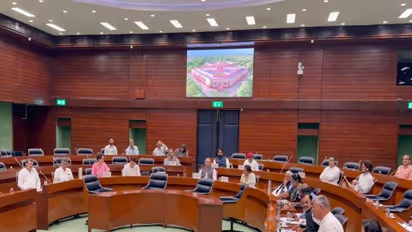
Congress leader and former Union Finance Minister P Chidambaram, Padma Awardees - Meenakshi Jain, Dr Saumitra Rawat and Dr. Ashok Seth - and representatives of Nation First Policy Research Centre and of Vidhi Centre for Legal Policy gave their views to the panel. The Joint Parliamentary Committee on the Constitution (One Hundred and Twenty-Ninth Amendment) Bill, 2024 and the Union Territories Laws (Amendment) Bill, 2024, is headed by BJP MP PP Choudhary. The JPC conducted four comprehensive stakeholder hearings on Monday and the day-long proceedings spanned financial and legal critiques.
Chidambaram Voices Opposition
Sources said Chidambaram expressed opposition to the proposed Bill, asserting that it is the Bill in its present form is flawed in certain aspects. He is learnt to have contended that the legislation undermines the basic structure of the Constitution, particularly the core principles of parliamentary democracy. The Committee recorded his concerns and invited specific suggestions and recommendations for improvement, sources said.
Policy Centres Urge Technical Refinements
The last two sessions focused on technical and statutory refinements to the 129th Constitutional Amendment Bill, sources said with Nation First Policy Research Centre and of Vidhi Centre for Legal Policy giving their views. " Both organizations urged replacing subjective discretion with defined, judicially traceable grounds for deferring state assembly polls, paired with fixed outer limits and mandatory parliamentary oversight," a source said.
They are learnt to have stressed the necessity of preventing legal vacuums during poll deferrals, advocating for structured President's Rule bounds or caretaker ministries restricted strictly to routine administrative duties. The sources said that Nation First emphasized structural stability mechanisms--such as constructive votes of no-confidence and Union Territory parity while Vidhi highlighted basic structure protections and limiting delegated modification powers.
Padma Awardees Extend Unanimous Support
The sources said that the Padma Awardees, who gave their views as expert citizens across diverse sectors, extended unanimous support for the One Nation One Election reform, noting its alignment with the larger national vision of Viksit Bharat. " They recommended introducing clearer statutory provisions regarding election schedules and re-election timelines," the source said.
Meenakshi Jain is learnt to have noted that frequent Model Code of Conduct (MCC) enforcement halts developmental projects, emphasizing that synchronized elections would ensure uninterrupted regional development. Dr Rawat highlighted how continuous election cycles disrupt academic calendars and entrance examination schedules such as NEET, the sources said, adding that Dr Seth pointed out that recurring polls strain the healthcare ecosystem by repeatedly reallocating medical staff and administrative authorities (e.g., District Magistrates), "which delays critical procurements and administrative decision-making".
The term of One Nation One Election panel has been extended till the winter session of Parliament. (ANI)
Stay updated with the Breaking News Today and Latest News from across India and around the world. Get real-time updates, in-depth analysis, and comprehensive coverage of India News, World News, Indian Defence News, Kerala News, and Karnataka News. From politics to current affairs, follow every major story as it unfolds. IMD cities weather forecastsRain Cyclone Asianet News Official App