Nyoma Airbase: How India's New High-Altitude Fortress Is Reshaping Military Balance With China
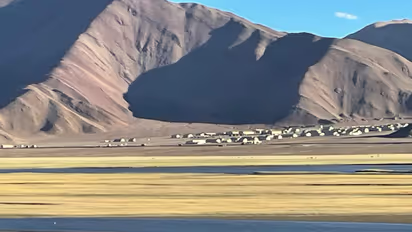
Synopsis
At 13,700 feet, India’s new Nyoma airbase near the LAC marks a turning point in its Ladakh strategy. Built for fighters like Rafale and Su-30MKI, it strengthens India’s high-altitude deterrence against China and redefines Himalayan airpower dynamics.
For much of the past decade, the India–China frontier in eastern Ladakh has been defined by a hardening of positions, rapid military construction and a collapse of diplomatic trust. Quietly but deliberately, India has now added a new element to that landscape. The commissioning of the Nyoma airbase, situated at 13,700 feet and barely 35 kilometres from the Line of Actual Control (LAC), marks one of the most significant shifts in India’s high-altitude military posture since the 2020 border crisis.
On 11 November, India’s Air Chief Marshal AP Singh flew a C-130J Super Hercules into the newly renovated base to signal its formal operationalisation. The transformed airfield — once a mud airstrip used intermittently for transport flights — has been upgraded into the world’s highest operational fighter-capable airbase, capable of hosting the Su-30MKI, Rafale, and India’s heavy-lift fleet.
Its construction is as much a logistical achievement as a strategic one: a full-length 2.7km runway, hardened shelters, fuel and munitions storage, and an air traffic control complex, all built in an environment that routinely dips below –40°C in winter and offers only a limited construction window of six to seven months each year.
Yet the significance of Nyoma lies not only in its engineering scale, but in the quiet recalibration of deterrence it represents along one of Asia’s most contentious borders.
A Post-2020 Imperative
The Ladakh clashes of 2020, which resulted in the worst violence between the two countries in more than four decades, forced a reassessment of India’s ability to rapidly deploy airpower in extreme terrain. The People’s Liberation Army (PLA) already possessed a network of high-altitude military infrastructure across the Tibetan plateau, including all-weather roads, stabilised fuel supply lines and the forward airbase at Ngari-Gunsa, located roughly 180 kilometres from Nyoma.
Chinese forces could move men and materiel quickly along the G219 Highway, a strategic corridor cutting through Aksai Chin. The Indian Air Force (IAF), by contrast, relied primarily on Leh and Thoise — both high-altitude but far from the most sensitive flashpoints.
The decision in 2023 to invest nearly ₹218 crore (£20m) to upgrade Nyoma was therefore driven by operational necessity. According to a senior official quoted in Indian media, forward deployments have continued for a sixth consecutive winter, underscoring that “confidence-building measures have not translated into de-escalation on the ground.”
Against this backdrop, Nyoma offers one asset India has consistently lacked in the region: reaction time.
Proximity as Capability
Nyoma’s geographical position makes it uniquely valuable. It sits close to three sectors that have experienced persistent Chinese military activity:
- Depsang Plains, where India’s patrols have been obstructed since 2013
- Demchok, marked by recurring stand-offs
- The Chushul–Spanggur corridor, the site of repeated friction in 2020
From Nyoma, fighters do not need the steep and fuel-intensive climbs required from Leh. Already at cruising altitude, they can establish air presence across the Kailash Range within minutes. The base also enables C-17 and IL-76 aircraft to land nearer to the LAC than ever before, substantially improving India’s ability to reinforce forward posts or reposition air defence equipment.
For New Delhi, this is not an act of provocation. Rather, it is intended to ensure that India can respond proportionately and promptly to any PLA mobilisation across the high ridgelines. The base also enhances intelligence, surveillance and reconnaissance (ISR) coverage, enabling the deployment of long-endurance drones and other unmanned systems.
Infrastructure as Strategy
The airbase’s commissioning is part of a broader, multi-year infrastructure push in Ladakh. The Border Roads Organisation (BRO) has accelerated the construction of all-weather routes, including the recently completed Likaru–Mig La road, now among the highest motorable roads in the world. These arteries support both military logistics and civilian access across a region where movement is often dictated by snowfall.
Nyoma now sits at the centre of an integrated network of roads, forward logistics nodes, and the nearby Mahe Field Firing Range, which enables realistic high-altitude training for ground forces. Together, these developments allow the IAF and Indian Army to operate with a continuity and scale previously limited by weather and distance.
But the reliance on high-altitude airfields is not without challenges. Aircraft operating at Himalayan elevations face restrictions on payload and range; engines function less efficiently, and strong winds can complicate take-offs and landings. Extreme cold necessitates heated hangars, specialised lubricants, and the winterisation of electronics and hydraulic systems.
Nevertheless, India has now accumulated decades of experience in running such bases. Leh, Thoise and Daulat Beg Oldi (DBO) — all at elevations above 10,000 ft — have been operational for years, giving the military a familiarity with the demands of mountain aviation that is rare globally.
A Measured Shift in the Indo-Chinese Equation
Beijing will doubtless monitor Nyoma closely. The PLA has long emphasised infrastructure parity along contested borders, and China’s own upgrade cycles across Tibet have been steady. But the location of Nyoma — closer to the LAC than any Chinese fighter base is to Indian territory — introduces an asymmetry that was previously absent.
The airfield is also grounded in a reality that both sides increasingly acknowledge: the LAC has become a permanent militarised frontier, one where disengagement agreements coexist uneasily with year-round deployments.
While India and China continue periodic diplomatic exchanges, neither appears prepared to dilute its position on the ground. As a result, infrastructure becomes a form of signalling — quiet, incremental, and cumulative.
Nyoma is part of that continuum. It is not designed to alter the strategic stability of the region, nor is it intended as a tool of escalation. It reflects instead a sober assessment: that airpower, logistics and time are decisive in high-altitude contingencies, and that India must position itself to respond within minutes, not hours.
The Road Ahead
The IAF expects regular fighter detachments to operate from Nyoma by early 2026, supported by transport aircraft, attack helicopters and unmanned platforms. For ground forces in eastern Ladakh, the base will function as both a logistical lifeline and a rapid-reinforcement hub.
Infrastructure expansion will continue in parallel. Broader connectivity projects — including the proposed Bilaspur–Leh railway line — aim to reduce Ladakh’s geographical isolation and enhance year-round resilience.
In many ways, Nyoma encapsulates a strategic shift unfolding along the Himalayas. Where the region once depended on seasonal access, it is slowly becoming part of a permanent national security architecture. And where airfields were once marginal, they are now central to India’s military calculus.
As India charts its next phase of posture along the LAC, Nyoma’s commissioning suggests a future defined less by episodic crisis management and more by sustained readiness.
The Himalayas, long imagined as a natural barrier, are now a theatre where altitude is no impediment to airpower — and where the margins of time may determine the balance of calm or confrontation.
Stay updated with the Breaking News Today and Latest News from across India and around the world. Get real-time updates, in-depth analysis, and comprehensive coverage of India News, World News, Indian Defence News, Kerala News, and Karnataka News. From politics to current affairs, follow every major story as it unfolds. IMD cities weather forecastsRain Cyclone Asianet News Official App