NFHS-6 row: Ministry says full report will have much wider data
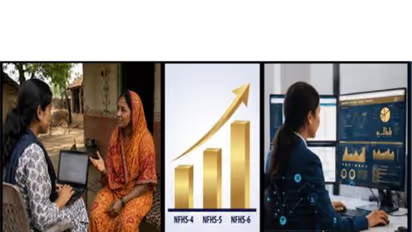
Synopsis
Union Health Ministry sources have rebutted claims that key indicators were dropped from NFHS-6 fact sheets, clarifying they are preliminary. A comprehensive national report with a wider range of data will be released subsequently, they said.
Union Health Ministry sources have rebutted claims that the recently released National Family Health Survey (NFHS)-6 Fact Sheets had "dropped" several indicators and noted that a comprehensive report will be released with a much wider range of indicators and analysis.
They clarified that the Fact Sheets are only the first stage of dissemination and should not be viewed as the comprehensive NFHS-6 National Report, which will be released subsequently with a far wider range of indicators, detailed analysis and methodological documentation.
Responding to some "unfounded commentary" in sections of the media regarding the absence of certain indicators, officials emphasised that the Fact Sheets are designed to present the most policy-relevant headline findings while supporting efforts to streamline reporting across India's growing network of specialised surveys and administrative databases.
The detailed NFHS-6 report that will be released later will include granular family planning indicators, selected child health interventions and further aspects related to women's health and HIV-related findings, the sources said.
"The objective is to ensure that each indicator is reported through the most appropriate and authoritative source, reducing duplication and improving overall data coherence," a senior Health Ministry official said.
Kharge Accuses Govt of Hiding 'Crucial Health Data'
Congress President Mallikarjun Kharge had accused the BJP government of hiding crucial health data and "betraying women and children" in the recently released NFHS-6 Fact Sheets.
Kharge had on June 4, in a post on X, claimed the survey unmasked the government's "absolute incompetence," pointing out that 1 in 5 children suffer from acute malnutrition, a third are underweight, and 84% of children aged 6 to 23 months lack adequate nutrition. He also highlighted the alarming anaemia statistics from NFHS-5 (57% of women). Kharge criticized the removal of anaemia estimation from the current NFHS-6 survey. https://x.com/kharge/status/2062400865856897407?s=20
'Half-Knowledge is Dangerous': JP Nadda Rebuts Kharge
Following this, Union Minister J P Nadda hit out at Kharge's criticism, stating that "half-knowledge is dangerous". He referreed to NFHS-6 findings and emphasised major, nationwide improvements in maternal healthcare, institutional deliveries, and immunisation coverage.
"The NFHS-6 data clearly demonstrates the remarkable transformation in India's health ecosystem under the leadership of Prime Minister Narendra Modi," Nadda said.
Further, Nadda said, "The gains reflected in NFHS-6 extend far beyond maternal healthcare and stand in sharp contrast to the poor outcomes witnessed during the UPA era."
"What is most revealing is what the Congress leadership chooses not to acknowledge. For decades, India struggled with poor health outcomes, inadequate healthcare access and weak delivery systems despite repeated promises. The consequences of that prolonged policy failure were visible across generations. Today, NFHS-6 reflects a different reality--greater access to healthcare, stronger maternal and child health services, wider social protection and measurable improvements in key indicators. Challenges remain and the Government continues to address them with urgency. But denying progress does a disservice to the millions of frontline health workers and beneficiaries who have driven this transformation. Facts matter. Outcomes matter. NFHS-6 speaks for itself," Nadda said in a post on X. https://x.com/JPNadda/status/2063152955998748727?s=20
Ministry Explains Rationale for Indicator Changes
Officials at the Health Ministry noted that several indicators cited as missing from the Fact Sheets are already being monitored through dedicated national systems. Sanitation and clean cooking fuel coverage, for instance, are tracked through specialised surveys and administrative platforms such as Swachh Survekshan Grameen and the Ministry of Statistics and Programme Implementation's surveys, making duplication within the Fact Sheets unnecessary.
Similarly, key statistics relating to mortality, birth registration and population characteristics continue to be generated through established systems such as the Sample Registration System (SRS), Civil Registration System (CRS) and Census framework, which remain the country's designated sources for these indicators.
Meanwhile, on questions regarding the absence of anaemia estimates in the fact sheets, officials explained that haemoglobin testing was not undertaken in NFHS-6 due to concerns surrounding the capillary blood sampling methodology used in previous rounds.
"Instead, anaemia prevalence estimates will be derived from the Indian Council of Medical Research's Diet and Biomarkers Survey, which employs gold-standard venous blood sampling methods to improve accuracy and reliability," they said.
NFHS-6 Adds New Indicators, Widens Scope
Far from narrowing the survey's scope, NFHS-6 has introduced several new indicators into the Fact Sheets, including population composition, elderly population share, financial inclusion, antenatal care utilisation, vaccination coverage, severe diarrhoeal disease prevalence and expanded breastfeeding indicators.
'A More Comprehensive Picture': Officials on Evolving Data System
Health Ministry sources stressed that NFHS remains India's largest and most comprehensive household health survey and continues to serve as a cornerstone for evidence-based policymaking. The final National Report is being prepared in consultation with technical experts, relevant ministries and development partners before its release.
According to officials, the NFHS questionnaire undergoes periodic refinement to reflect emerging policy priorities while maintaining survey quality and reducing respondent burden. Such refinement, they noted, is a globally accepted practice adopted by major household surveys worldwide.
Officials added that the evolution of the NFHS reporting framework reflects the growing maturity of India's statistical architecture, where multiple specialised surveys and administrative databases increasingly complement one another to provide a more comprehensive, accurate and policy-relevant picture of the country's development journey.
"The Fact Sheets are the first stage of dissemination. The detailed National Report will provide a much broader picture. The focus of NFHS-6 remains unchanged--delivering high-quality evidence to support better health outcomes and informed policymaking," the official said.
The release of the National Family Health Survey (NFHS)-6 Fact Sheets marks an important milestone in India's evolving health and statistical ecosystem, highlighting key gains in health, nutrition and population indicators while advancing the government's broader efforts to harmonise national data systems, officials said.
The National Family Health Survey (NFHS)-6 Fact Sheets provides estimates on 101 key indicators and highlight improvements in key health, nutrition and demographic indicators while supporting the government's push towards greater data harmonisation across national information systems, they said.
The sources clarified that the fact sheets have been designed to focus on the most policy-relevant findings while supporting the government's broader objective of streamlining data reporting across multiple specialised surveys and administrative databases.
The Fact Sheets, the key findings of the Sixth Round of the National Family Health Survey (2023-24), contain the highlights for the country and State/UT-wise estimates on population, health, family planning and nutrition-related key indicators such as fertility, maternal, child and adult health, women and child nutrition.
"These indicators throw light on important aspects of family well-being of the population of different States/UTs. As in previous rounds, the NFHS-6 estimates will help to track the performance of various flagship programmes launched by the Government of India in recent years," Nadda said.
(Except for the headline, this story has not been edited by Asianet Newsable English staff and is published from a syndicated feed.)Stay updated with the Breaking News Today and Latest News from across India and around the world. Get real-time updates, in-depth analysis, and comprehensive coverage of India News, World News, Indian Defence News, Kerala News, and Karnataka News. From politics to current affairs, follow every major story as it unfolds. IMD cities weather forecastsRain Cyclone Asianet News Official App