New NCERT Class 7 book details Mahmud of Ghazni's brutal invasions
Synopsis
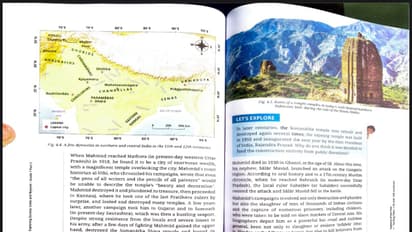
The new Class VII NCERT Social Science textbook has added a six-page section on Mahmud of Ghazni. It details his 17 campaigns, the plunder of cities like Mathura and Somnath, and the slaughter of Hindus, Buddhists, Jains, and rival Muslims.
The new NCERT Social Science textbook for Class VII carries an extensive section on the Ghaznavids, detailing Mahmud of Ghazni's plunder of Indian cities and the slaughter of "infidels," including Hindus, Buddhists, Jains, and even rival Islamic sects. The six-page section, titled The Ghaznavid Invasions, states that Mahmud of Ghazni conducted 17 campaigns in India, returning each time with large quantities of treasure. The old NCERT class 7 history textbook had a paragraph on Mahmud of Ghazni.
The new book titled "Exploring Societies: India and Beyond", issued on Friday, describes in detail the plundering of cities such as Mathura and Somnath. Mahmud conquered parts of India in the 11th century after defeating Jayapala and, in 1008, overcoming Jayapala's son following a long battle. "Mahmud's campaigns involved not only destruction and plunder but also the slaughter of tens of thousands of Indian civilians and the capture of numerous prisoners, including children, who were taken to be sold in the slave markets of Central Asia," the book states.
Details of the Invasions
The book mentions that his biographers portray him as a powerful but cruel and ruthless general, determined "not only to slaughter or enslave 'infidels' (that is, Hindus, Buddhists, or Jains) but also to kill believers from rival sects of Islam." In all, Mahmud carried out 17 campaigns in India; after each one, he returned to Ghazni with large amounts of loot.
"Although he faced strong resistance--particularly from the Chandellas of central India--and narrowly escaped defeat on several occasions, his large army's rapid marches and daring cavalry attacks, supported by mounted archers, ultimately proved decisive," the section reads.
Sacking of Mathura and Somnath
The book highlights Mahmud's plunder of Mathura, described as a city of immense wealth with a magnificent temple overlooking it. "Mahmud destroyed the temple and seized its treasure before proceeding to Kannauj, where he surprised one of the last Pratihara rulers and looted and destroyed several temples. A few years later, another campaign took him to Gujarat and the seaport of Somnath (in present-day Saurashtra). Despite strong local resistance and heavy losses to his forces, Mahmud eventually prevailed after several days of fighting, destroyed the Somnath Shiva temple, and carried away its vast treasures," the book added.
'Hindus Became Like Atoms of Dust'
The book also quotes the Persian scholar Abu Rayhn al-Biruni, who noted the impact of Mahmud's military campaigns on India's scientific traditions. "Mahmud utterly ruined the prosperity of the country and performed there, Centuries of wonderful feats, by which the Hindus became like atoms of dust. Scattered in all directions," the book quotes Al-Biruni.
Stay updated with the Breaking News Today and Latest News from across India and around the world. Get real-time updates, in-depth analysis, and comprehensive coverage of India News, World News, Indian Defence News, Kerala News, and Karnataka News. From politics to current affairs, follow every major story as it unfolds. IMD cities weather forecastsRain Cyclone Asianet News Official App