New Multi-Lane Free-Flow Toll System Planned for Delhi Entry Points
Synopsis
Delhi is introducing a Multi-Lane Free-Flow toll system at 154 entry points to eliminate traffic queues. Using RFID and license plate recognition, the technology aims to reduce congestion and pollution by enabling automated, non-stop payments.
New Multi-Lane Free-Flow Toll System Planned for Delhi Entry Points
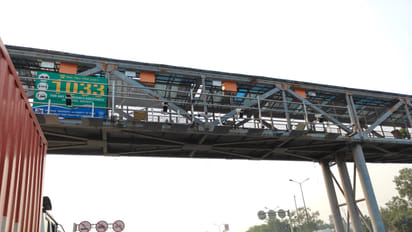
Ghazipur (Uttar Pradesh) [India], November 22 (ANI): Vehicles entering the national capital may soon be able to pass through toll plazas without stopping, as a Multi-Lane Free-Flow (MLFF) toll system is being developed at 154 entry points to Delhi to reduce traffic congestion and curb pollution. The system has already been installed at select locations, where trials are underway.
To raise public awareness about the new toll mechanism, pamphlets are also being distributed among commuters at toll plazas. Under the MLFF system, motorists will no longer need to stop at toll booths to make payments, as the entire process will be handled automatically through technology. The initiative is aimed at addressing the long queues frequently witnessed at Delhi's entry-point toll plazas, which lead to delays for commuters and contribute to pollution due to vehicles idling for extended periods.
Following a directive from the Supreme Court, the Municipal Corporation of Delhi (MCD) has accelerated work on the project. The system will use Radio Frequency Identification (RFID) technology and License Plate Recognition to identify vehicles and process toll payments automatically. Sensors and RFID tag readers will scan tags affixed to vehicles, while specialised cameras will capture images of their number plates to record registration details. Through these technologies, vehicles will be identified without requiring them to stop at toll booths, allowing traffic to move through entry points with fewer interruptions.
The technology is also expected to assist law enforcement agencies in monitoring vehicle movement. The Delhi Police will have access to data related to the movement of vehicles, including both private and commercial vehicles. This is expected to support vehicle identification and surveillance. The reduction in the need for personnel at toll plazas is also expected to help lower operational costs and reduce pollution. However, effective implementation of the system will require the gradual phasing out of manual toll collection and the installation of the necessary technological infrastructure at toll plazas. This will include RFID tag readers, automated number plate recognition systems and other equipment required to facilitate seamless toll collection. Informing vehicle owners about the new system and simplifying the payment process will also be important for its smooth implementation.
Once the MLFF toll system is implemented across all 154 entry points to Delhi, the national capital's toll infrastructure could transition to a fully digital format. The system is expected to help reduce traffic congestion and pollution, although its actual impact will become clear only after the project is fully implemented. (ANI)
Stay updated with the Breaking News Today and Latest News from across India and around the world. Get real-time updates, in-depth analysis, and comprehensive coverage of India News, World News, Indian Defence News, Kerala News, and Karnataka News. From politics to current affairs, follow every major story as it unfolds. IMD cities weather forecastsRain Cyclone Asianet News Official App