Military power is an extension of political will: Gen Anil Chauhan
Synopsis
Former CDS General Anil Chauhan stated that national security and democratic governance are intertwined, with military power being an extension of political will. The armed forces are just one instrument to safeguard a nation's supreme political interests.
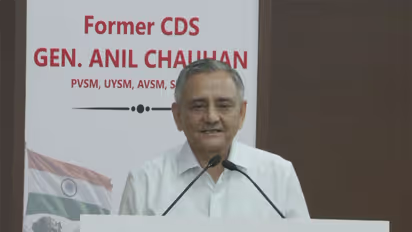
At the 'VIMARSH' event on Operation Sindoor and its aftermath at Vivekanand International Foundation, former Chief of Defence Staff (CDS) General Anil Chauhan on Tuesday delivered a clear-eyed assessment of how national security interacts with democratic governance, emphasising that military power remains a direct extension of political will.
Invoking Carl von Clausewitz's famous axiom that war is the continuation of politics by other means, General Chauhan stated that a nation's political interests are supreme. In this framework, the armed forces operate as just one of several national instruments available to safeguard those interests. "Let's start by saying that politics and war are inseparable. Clausewitz said that war is a continuation of politics by other means. A nation's political interests are paramount; they are supreme, and armed forces are one of the instruments acting to protect it, just one of the instruments. There are many instruments," General Chauhan said.
Prussian general Carl von Clausewitz's On War (Vom Kriege), published posthumously in 1832 by his wife Marie von Bruhl after he campaigned against Napoleon, remains the cornerstone of modern Western military theory.
Military's Role in a Democracy
Within a political democracy, General Chauhan highlighted a two-fold responsibility for military leadership when the state considers deploying force. Generating flexible options by providing the political leadership with a diverse menu of military choices tailored to achieve specific strategic objectives and instilling strategic confidence, assuring the government that the military can execute these options effectively, provided sufficient peacetime investments were made into defence capabilities.
"And in a political democracy, whenever the government decides to use force for attainment of its political objectives, then I think it is the role of the armed forces, the defence forces or the military, I think it is twofold," the former CDS said. "Firstly, it is to provide options to the government for application of that particular force, so that it can achieve its objectives. And second is to provide some kind of confidence to the government, so the government can have as many options as it desires, provided it has spent that much amount of money during peacetime to develop its capabilities," he added.
Peacetime Preparation and Risk Assessment
The range and quality of these options, he noted, do not materialise overnight. They rely heavily on peacetime preparation, including rigorous training, wargaming, and contingency planning. Every military option carries inherent risk, requiring commanders and politicians to carefully balance risk against the desired political outcome.
"The options also depend on the military leadership, the kind of training they have imparted, the kind of wargames they have conducted, the kind of contingencies they have played out. This will increase the number of options that are available to us," he said. He further stressed that military planning is ultimately an exercise in balancing risks against the political objectives an operation is intended to achieve. "Each option has a certain kind of risk involved in it, and also it will satisfy the political need for which it was to be used. So, it's an interplay between risk and attainment of political objectives," General Chauhan said.
Reflecting on Operation Sindoor
Reflecting on Operation Sindoor nearly 15 months after the conclusion of its major active operations, the former CDS noted that its strategic impact endures. Evaluating such operations requires a holistic view, combining operational lessons learned, rectifying identified deficiencies, and adapting to the changing nature of modern warfare amid broader global uncertainties.
"It's almost a year and three months since we concluded. In some ways, it is ongoing. The major part of active operations has concluded, but this remains a subject of interest for the strategic community, not only in India but abroad also," he said. He added that the deficiencies identified during the operation, the steps taken to address them, and the evolving nature of modern warfare need to be assessed together alongside the broader geopolitical environment. "The measures taken to overcome the deficiencies which people noticed in this particular operation, combined with how this warfare is changing and with global uncertainties altogether, throw up a new kind of challenge for all of us," the former CDS said. (ANI)
(Except for the headline, this story has not been edited by Asianet Newsable English staff and is published from a syndicated feed.)Stay updated with the Breaking News Today and Latest News from across India and around the world. Get real-time updates, in-depth analysis, and comprehensive coverage of India News, World News, Indian Defence News, Kerala News, and Karnataka News. From politics to current affairs, follow every major story as it unfolds. IMD cities weather forecastsRain Cyclone Asianet News Official App