MHA's new FCRA rules define religious activities, tighten compliance
Synopsis
MHA has notified the FCRA Amendment Rules, 2026, detailing permissible religious activities for foreign-funded NGOs. The new rules tighten compliance, enhance accountability, and restrict eligibility for organisations receiving foreign funds in India.
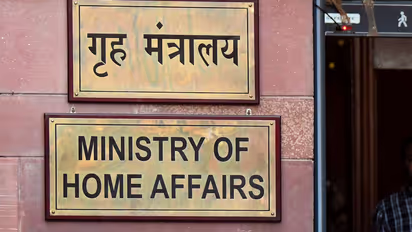
The Ministry of Home Affairs (MHA) has notified the Foreign Contribution (Regulation) Amendment Rules, 2026, introducing a detailed framework classifying permissible activities under the religious category while also tightening compliance requirements for organisations receiving foreign funding in India. The amendment modifies the Foreign Contribution (Regulation) Rules, 2011, and introduces a dedicated schedule outlining activities eligible for registration under religious purposes.
Permissible Religious Activities Outlined
The listed activities include construction, renovation and maintenance of places of worship such as temples, mosques, churches, gurudwaras, monasteries, synagogues and other religious sites. The schedule also permits preservation, printing, translation and digitisation of sacred scriptures and commentaries, support for institutions engaged in the study of religious philosophy and history, and provision of amenities for pilgrims, including drinking water, sanitation and shelter facilities at heritage religious sites.
It further allows the establishment of dharamshalas, langars, annadans and community kitchens under religious initiatives. Other permitted activities include religious education, moral instruction, satsangs, discourses, meditation retreats, promotion of devotional music, chants, theatre and liturgical arts, as well as documentation and revival of indigenous and tribal faith practices. However, the rules clearly exclude any activity involving proselytisation.
Enhanced Compliance and Accountability Measures
Alongside the classification of activities, the MHA has introduced broader compliance reforms aimed at enhancing transparency and accountability in the use of foreign contributions. A key change is the introduction of the term "key functionary," expanding accountability to include directors, partners, trustees, karta of Hindu Undivided Families, office-bearers and any person responsible for the management or control of an organisation.
Registration and Operational Area Specifics
The amended rules also mandate that registration certificates clearly specify the exact purpose and geographical area of operation. Organisations will now be required to choose their objectives strictly from the prescribed schedule and declare the states or Union Territories where activities will be carried out. Existing FCRA-registered entities have been given one year to submit updated details to the Centre.
Restrictions on 'Key Functionaries'
The rules further restrict eligibility by stating that organisations with foreign nationals (other than those of Indian origin) as key functionaries will generally not qualify for registration, unless specifically permitted.
Stricter Fund Utilisation and Disclosure Rules
In another significant change, NGOs will be required to utilise at least 75 per cent of previously received foreign funds before being eligible for subsequent instalments. Additional provisions define "reasonable activity" thresholds linked to fund utilisation over a specified period.
The amendment also introduces stricter disclosure norms, requiring organisations to declare social media accounts, websites and publications such as books, magazines or articles. Fee structures have also been revised, with additional charges applicable for organisations operating across multiple states or multiple purposes.
Streamlining Foreign Funding Regulations
The MHA said the changes are aimed at streamlining foreign funding regulations, improving transparency and ensuring clearer classification of permissible activities across sectors, including religious, educational, cultural and social domains.
The Foreign Contribution (Regulation) Act, originally enacted in 1976 and later replaced in 2010, has undergone multiple amendments in recent years. Registrations under the Act remain valid for five years and require periodic renewal. (ANI)
(Except for the headline, this story has not been edited by Asianet Newsable English staff and is published from a syndicated feed.)Stay updated with the Breaking News Today and Latest News from across India and around the world. Get real-time updates, in-depth analysis, and comprehensive coverage of India News, World News, Indian Defence News, Kerala News, and Karnataka News. From politics to current affairs, follow every major story as it unfolds. IMD cities weather forecastsRain Cyclone Asianet News Official App