Matsya 6000: How India Plans to Use the 6,000m Submersible? Expert Breaks Down
Synopsis
India unveils Matsya 6000, its first indigenously built deep-sea submersible, capable of reaching 6,000 meters. Expert PR Srikant explains its research and seabed exploration potential.
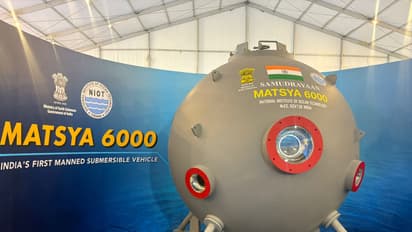
New Delhi: India has inched one step closer to unlocking the mysteries of the ocean floor. At the India International Science Festival (IISF) 2025, the country unveiled a technological milestone—Matsya 6000, a fully manned submersible designed to take humans as far as 6,000 meters beneath the sea. The moment marked more than just the display of a machine; it symbolised a quiet but determined national ambition to become a serious player in the world’s deep-sea exploration race.
A Homegrown Engineering Feat
Part of the Samudrayaan Project, Matsya 6000 has been indigenously developed by the National Institute of Ocean Technology (NIOT) in Chennai. Built with a robust titanium hull, it is designed to withstand the immense pressure of the deep sea.
The submersible can carry three scientists to depths where pressure is nearly 600 times greater than at the surface. Only a handful of countries—the US, the UK, Russia, China, Denmark, Switzerland and Italy—operate similar human-rated deep-sea systems.
An official explained that Matsya 6000 could transform India’s access to the unexplored regions of the deep ocean. According to him, the submersible could help unlock untapped marine resources, accelerate scientific discoveries and even pave the way for deep-sea tourism in the future.
What Matsya 6000 Was Built to Do
To understand the vessel from an operator’s lens, Asianet Newsable English spoke with former Indian Navy officer PR Srikant, who explained the vessel’s purpose in simple, clear terms:
“It is a research vessel which is used for the seabed survey. The vessel has all the equipment which are required for the research purpose. This particular vessel will go deep down of 6,000-meter for research. The seabed, which we have, has oil, mineral resources, and then the study of underwater lives also like flora and fauna.”
Srikant also highlighted the sophistication of its tools:
“The vessel has sophisticated camera installed outside the vehicle and sonar to record data.”
Why the Deep Sea Suddenly Matters
Globally, nations are eyeing the deep ocean not just for science but for strategy, economics and potential conflicts.
Under UNCLOS (United Nations Convention on the Law of the Sea), each nation has rights over resources within its Exclusive Economic Zone (EEZ), stretching 200 nautical miles (around 370 km) from the coast.
For India, that zone has an average depth of 3,741 meters—making Matsya 6000 critical for accessing its deepest, largely unmapped regions.
Srikant underlined the challenges awaiting any country operating in this environment, noting that deep-sea missions demand specialised engineering because of pressure, temperature variations, and sound propagation behaviour in the depths.
A Crucial Series of Tests Completed
Earlier this year, the Matsya underwent a comprehensive series of integrated dry tests over a 500-meter operational range to ensure a seamless integration of all systems within its exo-structure.
The tests were aimed to meticulously assess Matsya's performance across several critical parameters. The next stages will bring live trials, ocean-run tests, and eventually manned descents.
Stay updated with the Breaking News Today and Latest News from across India and around the world. Get real-time updates, in-depth analysis, and comprehensive coverage of India News, World News, Indian Defence News, Kerala News, and Karnataka News. From politics to current affairs, follow every major story as it unfolds. IMD cities weather forecastsRain Cyclone Asianet News Official App