Lessons From Operation Sindoor: Defence Ministry Floats RFI For Next-Gen Air Defence Gun To Counter Drone Swarms
Synopsis
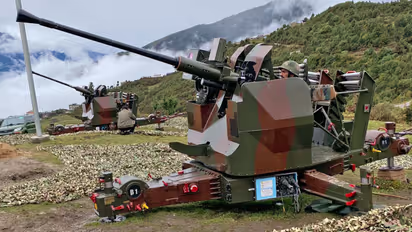
The Ministry of Defence has floated a request for information (RFI) for the procurement of next-generation air defence gun system (ADG-NG) and ammunition for the Indian Army, designed to counter evolving aerial threats, including drones, aircraft, and missiles.
New Delhi: The Ministry of Defence has floated a request for information (RFI) for the procurement of next-generation air defence gun system (ADG-NG) and ammunition for the Indian Army, designed to counter evolving aerial threats, including drones, aircraft, and missiles.
The next-generation air defence gun system (ADG-NG) and ammunition must have indigenous content of at least 50%, with emphasis on local manufacturing and technology transfer.
The move comes at a time when the threat landscape has fundamentally shifted from conventional fighter jets and helicopters to electrically operated drones with very low radar cross-section and infrared signatures.
The RFI explicitly references Operation Sindoor, noting that adversaries on the Western Front employed drones and swarm drones for both surveillance and strikes against civil and defence installations.
Why does Indian Army want to procure ADG-NG system?
The Army intends to procure these gun systems to ensure timely detection, tracking and cost-effective neutralization thereby protecting the Vulnerable Areas and Vulnerable Points (VAs/VPs) from critical damage.
Envisioned as a vehicle-mounted or towed gun platform, the next-generation air defence gun can autonomously detect, track, and engage a wide range of aerial and ground threats – day or night – using an integrated Electro-Optical Fire Control System (EOFCS).
The system must provide terminal all-weather air defence protection, capable of engaging a broad spectrum of threats, including fixed-wing aircraft, helicopters (including hovering), remotely piloted aircraft and drones, cruise missiles, precision-guided munitions, and RAM (Rocket, Artillery & Mortar) threats at ranges of 4000 meters or more, with a target engagement speed of 500 m/s.
The gun should have a rate of fire of at least 300 rounds per minute with effective engagement height of 2500 meters or more.
As per the RFI, micro-light aircraft, para-motors, paragliders, and aero models have also been listed as targets.
The power supply options must include onboard generator, batteries, or mains, with silent operation capabilities. The system should be upgradeable, modular, and capable of integration with existing radars and navigation systems.
On the ammunition front, the Indian Army requires the gun to fire both smart programmable rounds – pre-fragmented and proximity-fused – and standard High Explosive rounds with tracers.
All rounds must feature self-destruction capability. The autoloader system must allow reloading by no more than two personnel, and ammunition must carry a shelf life of at least 10 years.
The RFI also sought specific detection, recognition, and identification (DRI) ranges for targets including a DJI Mavic Pro 3 drone, a Cheetah helicopter, and a Rafale fighter jet.
Vendors have been asked to submit detailed technical and product information by June 11.
Stay updated with the Breaking News Today and Latest News from across India and around the world. Get real-time updates, in-depth analysis, and comprehensive coverage of India News, World News, Indian Defence News, Kerala News, and Karnataka News. From politics to current affairs, follow every major story as it unfolds. IMD cities weather forecastsRain Cyclone Asianet News Official App