JP Nadda inaugurates 10 Critical Care Blocks, 12 Labs in Andhra
Synopsis
Union Health Minister JP Nadda inaugurated 10 Critical Care Blocks and 12 Integrated Public Health Laboratories in Andhra Pradesh. The move aims to enhance public health preparedness and build a stronger health security architecture in the state.
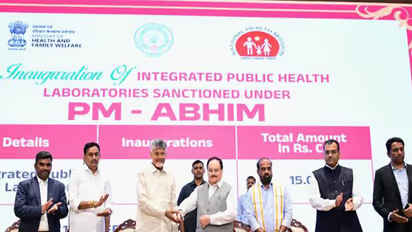
Union Minister for Health and Family Welfare, Jagat Prakash Nadda, on Saturday inaugurated 10 Critical Care Blocks (CCBs) and 12 Integrated Public Health Laboratories (IPHLs) in Andhra Pradesh in the presence of Chief Minister of Andhra Pradesh N Chandrababu Naidu and Minister for Health, Family Welfare & Medical Education, Government of Andhra Pradesh Satya Kumar Yadav, along with Members of Parliament, Members of the Legislative Assembly and Legislative Council, senior officers, doctors and healthcare professionals.
According to the release, the 10 Critical Care Blocks inaugurated today are located at GMC Kadapa, ACSR GMC Nellore, GMC Srikakulam, AMC Visakhapatnam, GMC Ongole, District Hospital Anakapalli, GMC Rajamahendravaram, KMC Kurnool, District Hospital Hindupur and SMC Vijayawada, while the 12 Integrated Public Health Laboratories are located at Area Hospital Seethampeta, Area Hospital Guntakal, Area Hospital Palamaner, Area Hospital Aganampudi, Area Hospital Nandigama, Area Hospital Chirala, Area Hospital Araku, Area Hospital Narasaraopeta, Area Hospital Banaganapalli, Area Hospital Anaparthy, Area Hospital Tuni and Area Hospital Gudur. Nadda said the facilities mark an important step towards strengthening public health preparedness and health-security architecture in Andhra Pradesh and across the country.
Strengthening Health Security in Andhra Pradesh
Addressing the gathering, Nadda said the inauguration was “not simply an infrastructure inauguration, but an important step towards building a stronger health security architecture for Andhra Pradesh and the nation.” He said Critical Care Blocks and Integrated Public Health Laboratories represent two essential dimensions of a resilient health system: “the capacity to save lives when a patient is critically ill, and the capacity to detect and respond to disease threats before they become major public health emergencies.”
Lessons from COVID-19 and the PM-ABHIM Mission
Recalling the lessons of the COVID-19 pandemic, the Union Health Minister said the crisis demonstrated how quickly a health emergency can become an economic, social, livelihood and ultimately a national emergency. “COVID-19 taught us that health security is national security,” Nadda said. The pandemic also highlighted the need to ensure that health infrastructure can withstand emergencies without disrupting routine healthcare services. Nadda noted that during the pandemic, regular hospital infrastructure had to be converted into isolation and COVID-care facilities, affecting the delivery of several non-COVID essential health services.
The Pradhan Mantri Ayushman Bharat Health Infrastructure Mission (PM-ABHIM) was conceived against this background, with the objective of strengthening the health system's ability to respond to future pandemics and public health emergencies while ensuring continuity of routine healthcare. “We can no longer think of hospitals only in terms of the number of beds,” Nadda said, adding that “a resilient health system must have critical-care capacity, oxygen and medical-gas systems, isolation facilities, trained manpower, laboratory capacity and the ability to detect outbreaks early while maintaining routine health services.”
The Union Minister said PM-ABHIM represents a fundamental shift in India's approach to public health infrastructure. “The objective is not merely to build more facilities. It is to create a health system that is: prepared, connected, resilient and capable of responding to future health emergencies,” he said.
PM-ABHIM in Andhra Pradesh
Under PM-ABHIM, the Government of India has sanctioned 631 Critical Care Blocks across States and Union Territories, creating a nationwide network of critical-care capacity. For Andhra Pradesh, the Government of India has approved Rs 1,271.80 crore for the five-year scheme period under four key components — Critical Care Blocks, Integrated Public Health Laboratories, Urban Ayushman Arogya Mandirs and Rural Ayushman Arogya Mandirs. Shri Nadda said this reflects the Government's comprehensive approach to strengthening healthcare from the community level to district and tertiary-care facilities.
Under PM-ABHIM, 24 Critical Care Blocks have been sanctioned in Andhra Pradesh, with an estimated investment of approximately Rs 606 crore. These have been planned across Government Medical Colleges, District Hospitals and Area Hospitals. Emphasising the importance of timely access to advanced care, Nadda said, “Critical care must be available close to the community.”
A Two-Pronged Approach: CCBs and IPHLs
Nadda said that while CCBs strengthen the health system's capacity to respond to critically ill patients, Integrated Public Health Laboratories strengthen its ability to understand, detect and control disease. Under PM-ABHIM, 26 Integrated Public Health Laboratories have been sanctioned for Andhra Pradesh with an allocation of Rs 32.50 crore. Civil works of all 26 IPHLs have been completed; 14 are already functional and the remaining 12 are ready for inauguration.
“The lesson from COVID-19 was very clear: We cannot fight a health emergency effectively if we cannot detect it early,” Nadda said. He described laboratory capacity as more than a diagnostic service, calling it “a component of national health security.”
A Shift Towards Comprehensive Healthcare
The Union Minister said the Government's vision under PM-ABHIM extends beyond tertiary hospitals and encompasses all levels of healthcare. At the grassroots level, Ayushman Arogya Mandirs bring comprehensive primary healthcare closer to communities. Strengthened PHCs and CHCs provide referral and secondary care, while Critical Care Blocks provide advanced emergency and intensive care at the district level and IPHLs provide diagnostic and surveillance capacity. “Together, these components create a continuum of care and public health preparedness,” he said. He described this as an important change in India's health policy: “We are moving from a hospital-centric approach to a health-system approach.”
Nadda said the transformation of India's health sector must be seen in the context of the National Health Policy, 2017, which marked an important shift towards a preventive, promotive and comprehensive approach to healthcare. He said that prior to 2017, the focus was largely on preventive healthcare, while the approach thereafter has been to develop a strong linkage between preventive, primary, secondary and tertiary healthcare. “We have tried to develop a strong linkage between preventive, secondary and tertiary healthcare so that healthcare becomes comprehensive and people-centric,” he said. He added that this approach has resulted in the creation of a more integrated healthcare framework, with simultaneous strengthening of primary and secondary healthcare and expansion of tertiary healthcare institutions.
Strengthening Primary Healthcare and Immunisation
Nadda said more than 1.75 lakh Ayushman Arogya Mandirs have been established across the country, bringing comprehensive primary healthcare closer to people's doorsteps. These centres provide a range of services including screening for diabetes and hypertension, antenatal check-ups, immunisation and other preventive and promotive healthcare services. He said more than 42 crore people have been screened for diabetes and hypertension, over 36 crore for oral cancer, more than 17 crore women for breast cancer and over 9 crore women for cervical cancer. He also highlighted the introduction of the HPV vaccine as an important step towards strengthening preventive healthcare and protecting future generations from cervical cancer.
The Union Health Minister also highlighted the strengthening of India's immunisation programme through digital technology. He said 12 vaccines are administered from birth up to the age of 16 years, with vaccination records being digitally tracked through U-WIN. The platform enables digital recording of vaccinations and helps ensure that children and pregnant women receive their due vaccines on time. Nadda praised Andhra Pradesh for its strong performance in immunisation and said the State has done very well under Mission Indradhanush, demonstrating its commitment to ensuring high vaccination coverage.
Positive Health Outcomes and Infrastructure Expansion
Highlighting the broader outcomes of India's health-system transformation, Nadda said institutional deliveries have reached over 90 per cent in 2023-24. He noted that India's maternal mortality ratio has declined by 86 per cent, compared to a global decline of 48 per cent, while under-five mortality has declined by 79 per cent compared to a global decline of 61 per cent. Neonatal mortality has declined by 70 per cent, against a global decline of 54 per cent. He further noted that, according to the WHO 2025 report, India's TB incidence has declined by 25 per cent compared to a global decline of 12 per cent, while treatment coverage for TB has crossed 90 per cent.
Nadda said the decline in out-of-pocket expenditure to 43.4 per cent is also an important indicator of the increasing financial protection being provided to citizens. He added that the country's health infrastructure has expanded significantly, with 16 new AIIMS being established in a span of just 12 years, taking the total number of AIIMS in the country to 23.
Acknowledging State Efforts and Healthcare Professionals
Nadda also praised Andhra Pradesh's Sanjeevani programme for taking healthcare to people's doorsteps and facilitating testing for 41 health parameters. He appreciated the State's innovative approach to bringing screening and healthcare services closer to communities and said that such initiatives provide valuable models for strengthening primary healthcare. He expressed interest in examining the potential of replicating the Sanjeevani model at the national level.
The Union Health Minister appreciated the leadership of the Government of Andhra Pradesh and the efforts of its Health Department, officials and healthcare professionals in taking forward PM-ABHIM projects. He also expressed appreciation to doctors, nurses, paramedical staff, laboratory technicians, emergency-care teams, ASHAs, ANMs and frontline health workers. “Infrastructure can create capacity. Technology can create connectivity. Laboratories can create diagnostic capability. But ultimately, people deliver healthcare to people,” Shri Nadda said.
Recalling the courage displayed by healthcare workers during COVID-19, he urged all healthcare professionals to use the new facilities to provide care with “competence, compassion and dignity.” Nadda said Andhra Pradesh has an important role to play in India's health transformation and that the experience and best practices emerging from the State can contribute to the larger national effort to strengthen public health. (ANI)
(Except for the headline, this story has not been edited by Asianetnews Editorial staff and is published from a syndicated feed.)
Stay updated with the Breaking News Today and Latest News from across India and around the world. Get real-time updates, in-depth analysis, and comprehensive coverage of India News, World News, Indian Defence News, Kerala News, and Karnataka News. From politics to current affairs, follow every major story as it unfolds. IMD cities weather forecastsRain Cyclone Asianet News Official App