Identity Checks, Kalava, Tilak: Why Non-Hindus Are Being Barred From Garba Events In Jaipur?
Synopsis
Banners barring non-Hindus from Garba venues have appeared across Jaipur, where Sanatan Suraksha Dal says it has deployed 27 teams to monitor Navratri celebrations. Founder Ravi Gautam has urged organisers to check identity cards and follow traditional practices. Garba is a Gujarati folk dance performed in devotion to Goddess Amba during Navratri.
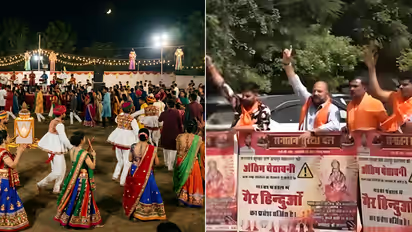
Banners declaring that non-Hindus are not allowed at Garba events have appeared outside several venues in Jaipur, Rajasthan during Navratri, bringing the question of religious identity and access to public celebrations into focus. The banners were put up by the Sanatan Suraksha Dal, whose founder, Ravi Gautam, said the organisation had launched a campaign ahead of the festival. He said 27 teams had been assigned different areas of Jaipur to contact Garba organisers and monitor the celebrations. The organisation has urged event organisers to check participants' identity cards, apply tilak to their foreheads and tie kalava, a sacred thread, around their wrists.
Jaipur : Sanatan Suraksha Dal launches city wide campaign for entry restrictions on non Hindus at Garba venues during Navratri. https://t.co/HEB7AWiK0C
— News Arena India (@NewsArenaIndia) October 13, 2026
Why are non-Hindus being barred from Garba events in the city?
The campaign reflects a view among some Hindu groups that Garba should be treated primarily as a religious gathering rather than a general entertainment event. Supporters of such restrictions argue that identity checks and traditional rituals can help preserve the religious character of Navratri celebrations. Sanatan Suraksha Dal chief was quoted by news agency PTI that Garba was not 'merely a dance event but a tradition' rooted in religious faith and culture.
The demand for identity cards, tilak and kalava is part of the Jaipur organisation's stated approach. Its monitoring campaign also seeks to maintain contact with organisers across different areas.
However, Garba has also developed into a large community celebration, attracting participants from different backgrounds. Whether an individual event imposes entry conditions depends on its organisers and the rules applicable to that venue.
What is Garba, and how did the tradition begin?
Garba is a traditional Gujarati folk dance performed during Navratri, the nine-night Hindu festival dedicated to the worship of the divine feminine, or Shakti.
The dance traditionally takes place around a lit earthen pot, known as a garbo, or an image of Goddess Amba. Participants move in circles, clapping their hands and following rhythmic music as the tempo gradually increases.
The circular formation carries symbolic meaning, representing continuity, life and the relationship between the individual and the divine. The lamp at the centre is associated with the source of life and feminine energy.
Garba developed through generations of community practice in Gujarat, with songs, dance steps, costumes and rituals passed down over time. Dandiya Raas, another popular Navratri dance involving decorated sticks, is often performed alongside Garba, although the two have distinct traditions.
In December 2023, UNESCO added Garba of Gujarat to its Representative List of the Intangible Cultural Heritage of Humanity. The recognition highlighted its devotional roots, cultural importance and role in bringing communities together. UNESCO
Why is Garba significant during Navratri?
Navratri celebrates the power of the goddess and, in Hindu tradition, the victory of good over evil. Garba provides a way for devotees to express their faith through music, movement and collective worship.
The celebrations traditionally include prayers, aarti and devotional songs. Participants often wear colourful Gujarati attire, including chaniya cholis and kediyus, while musicians perform traditional compositions alongside newer arrangements.
Over time, Garba has expanded beyond temple courtyards and neighbourhood gatherings to ticketed events, large grounds and organised cultural festivals. Its religious significance remains central to many celebrations, even as the dance has gained wider popularity.
Famous Garba events across India
Gujarat remains the heart of large-scale Garba celebrations, with major events attracting thousands of dancers.
Vadodara's United Way of Baroda Garba Mahotsav is among the best-known events, combining traditional dance with community fundraising. Ahmedabad also hosts major Navratri celebrations, including the Vibrant Navratri Festival at GMDC Ground, organised with the support of Gujarat Tourism.
Vadodara's heritage Garba celebrations at Lakshmi Vilas Palace offer another setting for the traditional dance. Outside Gujarat, cities such as Mumbai, Pune and Delhi host organised Garba and Dandiya nights, attracting Gujarati communities and other festival-goers.
These events vary in scale, format and entry conditions. The Jaipur campaign therefore raises a question about how organisers balance religious observance, cultural preservation and access to celebrations that have become popular far beyond their traditional home.
(With agency inputs)
Stay updated with the Breaking News Today and Latest News from across India and around the world. Get real-time updates, in-depth analysis, and comprehensive coverage of India News, World News, Indian Defence News, Kerala News, and Karnataka News. From politics to current affairs, follow every major story as it unfolds. IMD cities weather forecastsRain Cyclone Asianet News Official App