Inside India’s Deadly Game-Changing Smart Anti-Airfield Weapon
Synopsis
At Rahim Yar Khan Air Base in Pakistan, the main runway tells the story. During Operation Sindoor, India's strikes on Pakistani airbases last year, a bomb tore a massive crater into it, and the frontline base could not function for months.
At Rahim Yar Khan Air Base in Pakistan, the main runway tells the story. During Operation Sindoor, India's strikes on Pakistani airbases last year, a bomb tore a massive crater into it, and the frontline base could not function for months. The weapon behind that blow was the Smart Anti Airfield Weapon, or SAAW, and India now wants many more of them.
Earlier this week, a deal worth ₹811 crore, more than $84 million, was signed for 160 of these bombs for the Indian Air Force. When a weapon proves itself in real combat, a country does not shelve it. It orders more. The message is clear: India wants a bigger stock of bombs that can shut down enemy airfields.
Why target a runway at all? We usually picture air battles as fighter jets chasing each other across the sky. But an air force is only as strong as the ground it takes off from. Think of a runway as the only road out of a city. Break the road, and every car stays parked, however powerful its engine. Along with runways, the SAAW is built to hit taxi tracks, hangars, bunkers, radars and air traffic control buildings, everything that makes flying possible. It does not need to destroy an enemy's whole fleet. It only needs to take the runway offline.
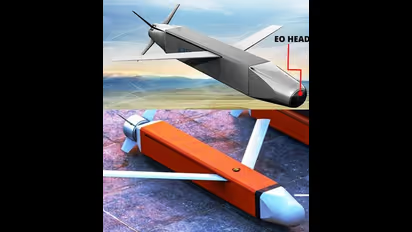
The version India is buying is the satellite-guided SAT SAAW, an air-to-ground weapon dropped from an aircraft. It is a lightweight glide bomb with no engine. Picture a paper plane released from a height: it keeps moving forward on its own. In the same way, the SAAW glides nearly 100 kilometres to its target, so pilots can release it from a safe distance, well away from enemy air defences.
A pair of wings on its body works like a bird's, helping it turn and steer in flight. Satellite navigation guides it to within just seven metres of its aim. Because it follows satellites, like the map on a phone, the enemy cannot easily confuse it with false radar signals or jamming.
Most importantly, once the bomb leaves the aircraft, it needs no further instructions. It finishes the job on its own. That is why it is called a fire-and-forget smart bomb, and why it ranks among the smartest weapons of its kind in the world. Three Indian Air Force aircraft can carry it today: the Su-30MKI, the Jaguar and the Hawk.
Its battle record sealed this order. During Operation Sindoor, India used several standoff weapons, meaning weapons fired from a distance, to strike 11 Pakistani airbases. The SAAW was one of them, and Rahim Yar Khan showed what a single well-placed bomb can do.
The SAAW is also part of a growing Indian family of glide bombs. The Gaurav, a long-range glide bomb, reaches nearly 150 kilometres and, like the SAAW, has foldable wings and satellite navigation. The Gautam is a glide bomb without wings, with a strike range of 30 kilometres. The Khagantak-243 goes farthest, at nearly 180 kilometres. It was successfully tested on 2 September and is moving towards final induction.
Behind all of them lies something deeper than hardware. For years, India had to turn to Russia, Israel or France for glide and standoff weapons, and every purchase came with a cost and political strings. Today, these smart bombs are made at home by Indian talent. That cuts the import bill, removes the political costs, and means India will not have to wait on others when it matters most.
The SAAW brings together precision, long reach and a simple target. For the pilots who fly with it and the country that built it, 160 more is not just an order. It is proof that India now trusts its own hands to guard its skies.
Stay updated with the Breaking News Today and Latest News from across India and around the world. Get real-time updates, in-depth analysis, and comprehensive coverage of India News, World News, Indian Defence News, Kerala News, and Karnataka News. From politics to current affairs, follow every major story as it unfolds. IMD cities weather forecastsRain Cyclone Asianet News Official App