Indian Professional Says 40-Hour Week In Germany Beats 70 Hours In India | See Viral LinkedIn Post
Synopsis
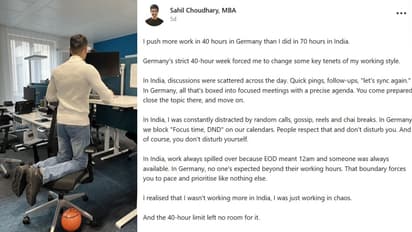
An Indian professional living in Germany said he achieved more meaningful work in a 40-hour week there than in 70-hour weeks in India. In LinkedIn post, Sahil Choudhary highlighted structured meetings, fewer distractions, clear focus time, and strong work-life boundaries in Germany. His views sparked online debate about productivity, hustle culture
An Indian man living in Germany has started a wide online discussion after saying that he completed more meaningful work in a standard 40-hour week there than he did during nearly 70-hour weeks in India. He argued that the difference was not about effort, but about structure and work culture. Sahil Choudhary shared his views in a detailed post on LinkedIn. In his message, he explained how moving to Germany changed his understanding of productivity, time management, and focus at work.
Comparing work experiences in two countries
Choudhary described how Germany’s strict 40-hour workweek forced him to rethink how he approached daily tasks. He said the clear limit on working hours encouraged better planning and prioritisation.
According to him, when he worked in India, he often spent very long hours at the office. However, he felt that much of that time was lost due to scattered communication and frequent interruptions.
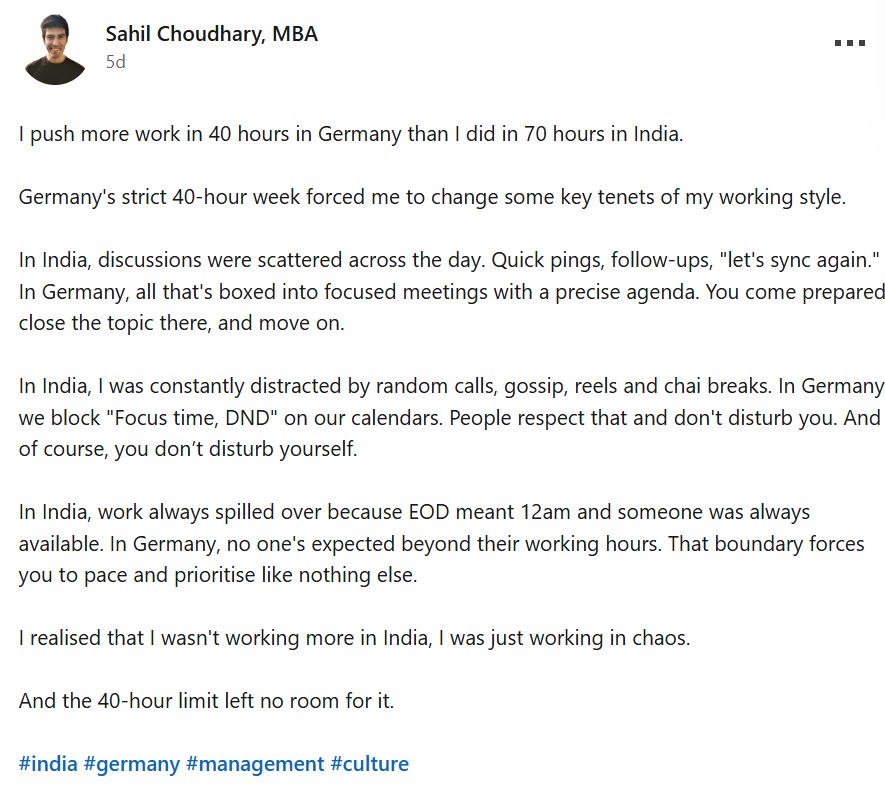
He explained that discussions in India often continued throughout the day. These included repeated follow-ups, quick messages, and multiple meetings or “sync-ups”. In contrast, he said conversations in Germany are usually planned and structured.
Structured meetings and clear agenda
Choudhary noted that meetings in Germany typically have a clear agenda. People are expected to come prepared. The goal is to solve the issue during the meeting itself.
He said this approach reduces unnecessary back-and-forth communication. Instead of revisiting the same topic many times, teams focus on resolving matters quickly and moving forward.
In his view, this system saves time and helps employees concentrate on actual work.
Focus time and fewer distractions
Another major difference he highlighted was the level of distractions.
Choudhary admitted that while working in India, he experienced frequent interruptions. These included random phone calls, office gossip, social media use, and extended tea breaks.
He suggested that such interruptions often broke concentration and reduced efficiency.
In Germany, he observed that employees actively block “focus time” or “Do Not Disturb” hours on their calendars. He said that, importantly, colleagues respect these boundaries.
This allows workers to focus deeply on tasks without constant interruptions.
Clear work-life boundaries
Choudhary also discussed work-life balance. He said that in India, work often continued beyond official hours because someone was always available.
According to him, the end of the working day rarely meant that work truly ended.
In Germany, however, employees are generally not expected to work beyond their scheduled hours. This encourages better time planning during the day. Workers must prioritise tasks carefully and avoid unnecessary delays.
He said this structure helped him become more disciplined and efficient.
Realisation about productivity
Summing up his experience, Choudhary wrote that he realised he had not necessarily been working harder in India. Instead, he felt he was working in a chaotic environment.
He added that the fixed 40-hour limit in Germany left little space for poor time management. Because of the clear boundaries, work had to be completed within the available time.
His post suggested that structure, not long hours, played a key role in productivity.
Strong online reactions
The post received significant attention. Many users joined the discussion in the comments section.
Several people agreed with his views. They said that modern workplaces often confuse constant availability with real productivity.
Some users argued that being always responsive to calls and messages breaks concentration. They said this makes it difficult to do deep, focused work.
Others said that the issue was not about talent, but about how time is managed.
Some commenters reflected on common workplace habits in India. They mentioned distractions, informal interruptions, and unclear boundaries between personal and professional time.
They suggested that respecting colleagues’ focus time could improve output without increasing working hours.
However, a few users pointed out that workplace culture varies widely across companies and industries. They said the comparison might not apply to every office in India or Germany.
The post by Sahil Choudhary has sparked a broader debate about productivity, work culture, and the value of structured time. While opinions differ, the discussion highlights an important question: do longer working hours always mean better results, or does clear structure lead to more effective work?
The conversation continues online, showing that work-life balance and productivity remain important topics for many professionals.
Stay updated with the Breaking News Today and Latest News from across India and around the world. Get real-time updates, in-depth analysis, and comprehensive coverage of India News, World News, Indian Defence News, Kerala News, and Karnataka News. From politics to current affairs, follow every major story as it unfolds. IMD cities weather forecastsRain Cyclone Asianet News Official App