Indian Army Seeks Infrared Target Rocket To Boost Air Defence Missile Training Against Drones, Cruise Missiles
Synopsis
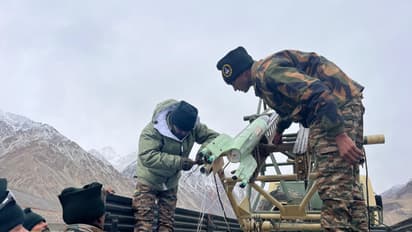
The Indian Army has issued RFI to domestic and global defence manufacturers, seeking details on an Intermediate Target System Rocket, a ground-launched aerial target designed to simulate realistic threats for training troops equipped with infrared-guided surface-to-air missiles.
New Delhi: The Indian Army has issued a request for information (RFI) to domestic and global defence manufacturers, seeking details on an Intermediate Target System Rocket, a ground-launched aerial target designed to simulate realistic threats for training troops equipped with infrared-guided surface-to-air missiles.
The move signals the army’s effort to close a critical gap in its air defence training infrastructure, where live-fire exercises against credible, manoeuvrable targets remain limited.
The RFI lays out a demanding set of technical and operational requirements. The target rocket must be capable of simulating manned aircraft, cruise missiles, and unmanned aerial vehicles (UAVs) – the three principal aerial threats that air defence units across theatres are trained to engage.
This breadth of simulation requirement reflects the evolving threat environment India’s military faces, particularly given increased drone activity documented along both the western and northern frontiers in recent years.
Performance requirements
The specifications set a minimum flight speed of 180 metres per second, a flight endurance of at least 30 seconds, and a slant range of more than 6 kilometres. These parameters intended to replicate the approach profile of fast-moving aerial threats at distances where shoulder-fired or vehicle-mounted infrared missiles are typically engaged.
The system must also be operable from altitudes of 4,200 metres or above, a requirement that directly addresses the army’s operational deployments along the Himalayan terrain, including in Ladakh, Sikkim, and Arunachal Pradesh.
To serve as a credible surrogate for real targets, the rocket must generate a strong infrared signature detectable by in-service missiles. The launcher must be slew-able in both bearing and elevation.
Tactical mobility is central to the design brief. The entire system – launcher, rockets, and ancillary equipment – must be transportable on standard 2.5-tonne military vehicles or equivalent platforms, and launch preparation must be completed within 15 minutes.
The army also requires the system to function in adverse weather, including light rain, fog, and cloud cover, across a wide temperature and humidity range.
Indigenization and procurement process
In keeping with the government’s ‘Make in India’ policy for defence, the RFI mandates a minimum indigenous content of 50 per cent.
Broader context
India’s air defence modernization has accelerated sharply in the wake of the 2020 Galwan Valley clash with China and the sustained military standoff along the Line of Actual Control.
The army has in recent years inducted additional Very Short Range Air Defence (VSHORAD) systems and man-portable air defence systems (MANPADS), and is pursuing a broader upgrade of its layered air defence network.
The Indian Air Force already operates target drones for pilot and missile crew training, but the army’s ground-based air defence units have long lacked a dedicated, cost-effective, infantry-portable target system tailored to their organic missile inventory.
The intermediate target system rocket, if successfully developed and fielded, would address that gap without requiring the elaborate logistics and airspace clearances associated with drone targets.
Stay updated with the Breaking News Today and Latest News from across India and around the world. Get real-time updates, in-depth analysis, and comprehensive coverage of India News, World News, Indian Defence News, Kerala News, and Karnataka News. From politics to current affairs, follow every major story as it unfolds. IMD cities weather forecastsRain Cyclone Asianet News Official App