India Untold: When Sarojini Naidu Teased, Nicknamed Mahatma Gandhi ‘Mickey Mouse’
Synopsis
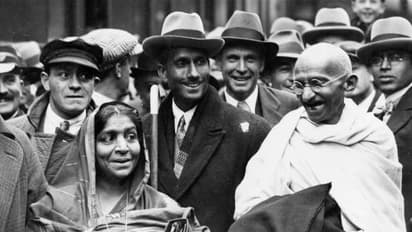
Sarojini Naidu called Gandhi the ‘Apostle of Peace’, the ‘Mystic Spinner’, and when she sought to reconcile factions within the Congress, he named her ‘Peace- Maker’. Then came her most mischievous title for him: ‘Mickey Mouse’ and the ’Little Man’.
It was July 1914. Europe stood on the brink of destruction as the First World War erupted across the continent. In London, amid the growing anxiety of a world sliding into conflict, a meeting took place that would shape decades of India’s freedom struggle — the first encounter between Sarojini Naidu and Mahatma Gandhi.
Sarojini had missed Gandhi when his ship first docked in London. Determined not to let the opportunity slip again, she made her way the next morning to Kensington, to the modest lodgings where he was staying. She climbed the steep staircase of what she later described as an “old, unfashionable house,” and peered through an open door.
There he was; “a little man with a shaven head, seated on the floor.”
Spread around him, she recalled, was “a battered tin of parched ground-nut and tasteless biscuits of dried plantain flour.” The scene amused her immensely. She burst out laughing.
That laughter marked the beginning of one of the most remarkable political friendships in modern Indian history.
Gandhi looked up and responded in kind. As Sarojini later described it, ‘He lifted his eyes and laughed back at me saying, “Ah, you must be Mrs Naidu! Who else dare be so irreverent. Come in,” he said, “and share my meal.”
“No, thanks.” I replied, sniffing, “What an abominable mess it is.”’
Gandhi was in London to support Britain’s war effort. As Germany and Austria-Hungary squared off against Russia, France and Britain, he believed Britain was facing an existential crisis. In his view, India should not exploit the moment.
He said, ‘England’s difficulty should not be turned into India’s opportunity’.
Instead, he believed Indian support could strengthen demands for self-government once the war ended.
In his autobiography, My Experiments with Truth, Gandhi mentioned this first meeting. He had arrived in London to organise an ambulance unit for Britain. He was also aware of the Lyceum, a women’s club Sarojini belonged to, which was sewing clothes for soldiers.
At their first meeting, Sarojini handed him cloth pieces cut to pattern and instructed him to stitch them according to the directions provided. Soon after, at Gandhi’s suggestion, she began rallying Indian residents in England to support the war effort.
Sarojini teased him, debated him, challenged him. She stood by him fiercely, but never unquestioningly.
Their correspondence, spanning three decades, is a chronicle of India’s march to freedom. Beginning in 1915, Gandhi addressed her as a dear sister; she wrote to him as a dear friend she looked up to in every way.
In the mid-1920s, he addressed her as ‘Mirabai’. She, travelling across continents, once signed off ‘from the Wandering Singer to the Spinner-Stay-At-Home’. She called him the ‘Apostle of Peace’, the ‘Mystic Spinner’, and when she sought to reconcile factions within the Congress, he named her ‘Peace- Maker’.
Then came her most mischievous title for him: ‘Mickey Mouse’ and the ’Little Man’.
Just before Gandhi left for Bihar in July 1946 amid communal riots, she called him ‘beloved pilgrim’.
She could revere him deeply and still laugh at him.
She famously refused to emulate his austere lifestyle completely: ‘Good heavens, all that grass and goat milk? Never, never, never.’
Even Vijaya Lakshmi Pandit, in her memoir The Scope of Happiness, remembered Sarojini’s irreverent affection: ‘The one person who was really able to help Gandhiji to relax and enjoy a joke was Sarojini Naidu. She was herself a unique human being with a fount of amusing stories and could say the most outrageous things without giving offence. It was she who nicknamed Gandhiji “Mickey Mouse” when he was at the height of his fame and he enjoyed this as much as anyone and asked all sorts of questions about Mickey Mouse, whom he had never seen on screen.’
From Laughter to Leadership
What drew Sarojini to Gandhi was not merely charisma — it was his “single-mindedness, his good faith and large-heartedness.” As she deepened her involvement in the Congress, she became one of his closest political associates.
In March 1930, when Gandhi launched the Salt Satyagraha — defying the British monopoly on salt — he ignited the Civil Disobedience Movement. Soon arrested, he left the movement without its central figure.
On 5 May, leadership passed to Sarojini.
With thousands of volunteers, she attempted to enter the Dharasana Salt Works near Dandi. The gates were closed, the factory barricaded — but the moral force of the protest shook the empire.
Gandhi’s repeated fasts took a toll on his frail health. Often, Sarojini remained by his side, praying silently for his life.
On 20 September 1932, she stood with him as he fasted against the British ‘communal award’ granting separate electorates for the lower castes.
Again, on 10 February 1943, Gandhi began another fast, ending on 2 March. Rumours swirled about his failing health. Sarojini later recalled that by the seventh day, he seemed gone.
‘It was as though a light had gone out of the world.’
And yet, she marvelled at his resilience, calling him ‘the marvellous little Mickey Mouse who has nibbled his way back to life from the lightly spread and knotted nets of death.’
Final Goodbye
Sarojini endured repeated imprisonments for the nationalist cause. Her longest incarceration came after the Quit India Resolution of 8 August 1942. She was jailed in the Aga Khan Palace in Poona alongside Gandhi and Kasturba.
There, tragedy struck. Kasturba died after a prolonged fever. Sarojini herself, suffering from malaria, was released in March 1943.
Five years later, in 1948, just months after India’s independence, Gandhi was assassinated.
In her broadcast on 1 February 1948, Sarojini’s grief resonated across the nation: ‘My father, do not rest.’
It was not merely mourning. It was a call — that his ideals must live on.
Stay updated with the Breaking News Today and Latest News from across India and around the world. Get real-time updates, in-depth analysis, and comprehensive coverage of India News, World News, Indian Defence News, Kerala News, and Karnataka News. From politics to current affairs, follow every major story as it unfolds. IMD cities weather forecastsRain Cyclone Asianet News Official App