India Untold: The Forgotten INA Icon Who Stood Tall At Red Fort And His Connection With Shah Rukh Khan
Synopsis
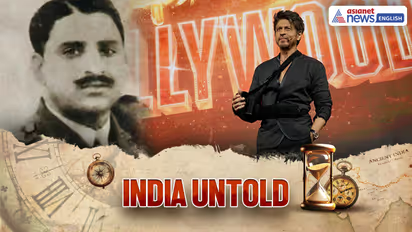
According to multiple accounts, Shah Nawaz was like a father figure to Shah Rukh Khan’s mother, Lateef Fatima. In the late 1940s, when Fatima and her family suffered a road accident in Delhi, it was Shah Nawaz who rushed them to hospital.
"Chaalis korodon ki awaaz — Sehgal, Dhillon, Shah Nawaz.” This thunderous chant echoed through Lahore’s historic Minto Park in December 1945. It was not for towering generals, but for three mid-rank officers of the Indian National Army (INA)—Prem Kumar Sehgal, Shah Nawaz Khan, and Gurbaksh Singh Dhillon—whose courage lit the spark of defiance against colonial power.
Just a month earlier, the trio had been dragged into the infamous Red Fort Trials. Accused under Section 121 of the Indian Penal Code of “joining with rebels in an act of rebellion or with enemies in acts of hostility makes a man a traitor,” they stood accused of betraying the Crown by leaving the British Indian Army to fight for India’s freedom.
Despite a fiery defence by Congressman Bhulabhai Desai, the court convicted all three—branding them guilty of treason, and Dhillon additionally of abetment to murder. On January 3, 1946, the verdict was delivered; dismissal from service, loss of pay and honours, and transportation. Yet, what the British hoped would be a humiliation turned into a nationwide cry of solidarity. These men were no longer “traitors”, they became symbols of India’s uncompromising will for independence.
But behind the larger-than-life figure of Shah Nawaz Khan lies another fascinating thread to Bollywood’s King Khan.
Shah Nawaz and the King Khan Family
According to multiple accounts, Shah Nawaz was like a father figure to Shah Rukh Khan’s mother, Lateef Fatima. In the late 1940s, when Fatima and her family suffered a road accident in Delhi, it was Shah Nawaz who rushed them to hospital.
Their bond deepened over time, and some sources suggest that he even adopted her. Fatima’s marriage to freedom fighter Meer Taj Mohammed Khan was solemnised in Shah Nawaz’s own bungalow.
From Rawalpindi to Red Fort
Born in Rawalpindi district in 1914, Shah Nawaz inherited military discipline from his father, Tikka Khan, and joined the British Indian Army in 1935. When World War II erupted, he fought in Singapore only to be taken prisoner alongside 40,000 Indians when Japan captured the territory.
In Singapore, he encountered Netaji Subhash Chandra Bose, who inspired him to join the INA. Fierce in courage and unwavering in spirit, Shah Nawaz quickly rose to command the Second Division. By 1944, Netaji entrusted him with leading the INA’s charge in Mandalay, and later in Kohima. His eventual capture in Burma brought him back to Indian soil—not as a soldier, but as a “traitor” on trial.
After the trials, Shah Nawaz Khan shifted his battle from the battlefield to the political arena. In 1952, he won his first Lok Sabha seat from Meerut and went on to serve as Deputy Minister in ministries spanning Railways, Agriculture, Labour, and Steel.
His most defining role, however, came in 1956 as the head of the Shah Nawaz Committee, tasked with investigating the mysterious death of Netaji Subhash Chandra Bose. After sifting through testimony in India and Japan, the committee concluded that Netaji perished in a plane crash.
A Hero Remembered
When Shah Nawaz Khan passed away in 1983, the man once branded a “traitor” was buried with full state honours near Lal Qila—the very Red Fort where he once stood in chains.
Stay updated with the Breaking News Today and Latest News from across India and around the world. Get real-time updates, in-depth analysis, and comprehensive coverage of India News, World News, Indian Defence News, Kerala News, and Karnataka News. From politics to current affairs, follow every major story as it unfolds. IMD cities weather forecastsRain Cyclone Asianet News Official App