India halted Operation Sindoor on own terms, ready for long war: Singh
Synopsis
Defence Minister Rajnath Singh said India halted Operation Sindoor on its own terms and was ready for a long war. He called Pakistan the 'epicentre of International Terrorism' and praised PM Modi's 'zero tolerance policy' against terror.
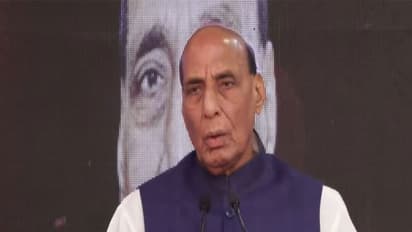
Defence Minister Rajnath Singh on Thursday affirmed that India voluntarily put a halt to Operation Sindoor on its own terms and was ready for a long war against Pakistan. Addressing the ANI National Security Summit 2.0, Rajnath Singh called Pakistan the epicentre of International Terrorism and called for uprooting the ideological and political roots of terrorism. Hailing Prime Minister Narendra Modi's leadership, the Defence Minister lauded the "zero tolerance policy." He also noted that India did not fall for the "bluff" of a nuclear attack.
'Halted Operation Sindoor on Our Own Terms'
Recalling Operation Sindoor, which came as India's response to the deadly Pahalgam terror attack last year, the Union Minister said, "It's been almost a year since Operation Sindoor, and our Operation Sindoor is also a symbol of this new world order. It was a turning point that sent a message to the entire world that India is no longer the one that adheres to the old way of thinking, where terrorist attacks occur on our soil, we merely issue diplomatic statements. And under Prime Minister Modi's leadership, our government has maintained that no terrorist activity will be tolerated under any circumstances."
He added that the Indian armed forces have expanded their capabilities since then and are robust in times of sudden need. "During Operation Sindoor, we precisely targeted those who had attacked us. And I want to clarify here again that we didn't stop this operation because our capabilities had diminished. We stopped it voluntarily, on our own terms, and if necessary, we were fully prepared for a long war. And we also had surge capacity, the ability to expand our capabilities in times of sudden need. Not only did we have it, but we still have it, and it's even more robust than before. Therefore, I don't think there's any need to say anything more," he said.
'Pakistan Epicentre of International Terrorism'
Slamming Pakistan, Defence Minister Singh noted three dimensions of terrorism: operational, ideological, and political. He called for destroying the political patronage of terrorism in the neighbouring country. He said, "Terrorism is not just an anti-national act, it has multi-dimensions, and terrorism can only be dealt with if we tackle it in all its three dimensions--operational, ideological, and political. The true IP address of terrorism is its ideological and political roots, where it thrives. The ideological nourishment and political patronage of terrorism is the nectar in Ravana's navel, which, after cutting off one head, regenerates another. I believe it is essential to dry up this navel that gives life to terrorism."
"We have always seen that countries like Pakistan have consistently supported terrorism, and this is why both India and Pakistan gained independence at the same time, but today, India is known worldwide for its Information Technology, while Pakistan is considered the epicentre of other IT, i.e., International Terrorism. Our military industrial complex has proven that it is not only for the period of peace, but it is also prepared for rapid supply during wartime. We were even threatened with a nuclear attack, but we did not fall for that bluff," the Defence Minister added.
Operation Sindoor: A Look Back
As India mourned the 26 lives lost in the Pahalgam attack, what followed was decisive action by the Indian armed forces in the form of Operation Sindoor. Indian armed forces struck terror bases in Pakistan and Pakistan-occupied Jammu and Kashmir (PoJK). In Operation Sindoor, launched on May 7, 2025, India successfully destroyed nine major terror launchpads in Pakistan and Pakistan-occupied Jammu and Kashmir (PoJK), targeting Lashkar-e-Taiba, Jaish-e-Mohammed, and Hizbul Mujahideen facilities. Indian armed forces killed over 100 terrorists in action. Pakistan responded with drone attacks and shelling, which led to a four-day conflict between the two neighbouring countries. India showed formidable defence and conducted retaliatory strikes, destroying Radar installations in Lahore and Radar facilities near Gurjanwala. Inflicted by heavy damage, Pakistan's Director General of Military Operations (DGMO) called the Indian DGMO and a ceasefire was agreed on May 10. (ANI)
Stay updated with the Breaking News Today and Latest News from across India and around the world. Get real-time updates, in-depth analysis, and comprehensive coverage of India News, World News, Indian Defence News, Kerala News, and Karnataka News. From politics to current affairs, follow every major story as it unfolds. IMD cities weather forecastsRain Cyclone Asianet News Official App