India’s EU Deal Is a Message to Washington
Synopsis
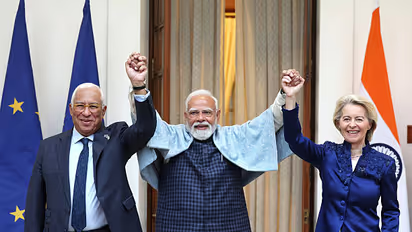
India’s newly signed trade agreement with the European Union is being celebrated as an economic breakthrough. This deal is India’s quiet message to Washington: We are no longer negotiating from dependence.
India’s newly signed trade agreement with the European Union is being celebrated as an economic breakthrough. It is that, but it is also something more consequential. This deal is India’s quiet message to Washington: We are no longer negotiating from dependence.
What makes this moment even more striking is that this agreement has been nearly twenty years in the making. Talks between India and the EU began in the mid-2000s and stalled repeatedly over tariffs, standards, and political sensitivities. What changed the tempo was geopolitics. As trade discussions with the United States grew turbulent, unpredictable, and increasingly politicized, both New Delhi and Brussels rediscovered urgency. The long, patient negotiation suddenly accelerated. Europe became not just a partner, but a strategic alternative.
For decades, India’s trade posture has been shaped by asymmetry. The United States has been its largest single-country export destination, its most powerful market, and often its toughest negotiator. When Washington tightened screws on visas, tariffs, or compliance, India had limited room to maneuver. The EU deal changes that equation.
This is not a cosmetic pact. It is a sweeping economic architecture linking two markets of nearly two billion people. Tariffs on the overwhelming majority of goods will fall to zero over time. Indian exports from textiles and pharmaceuticals to engineering goods gain preferential access to a 27-nation bloc. In return, India opens sensitive sectors, including automobiles, wines and spirits, and a wide range of services. Digital trade rules, dispute-settlement mechanisms, and supply-chain safeguards bring predictability to a world that has grown allergic to it.
The commercial upside is substantial. But the strategic upside is transformative.
For the first time in a generation, India can credibly say to its partners: we have options. Europe is no longer just a market. It is a second anchor. That alone reshapes the psychology of every future negotiation, especially with the United States.
In Washington, India has often been on the defensive, reacting to tariff threats, visa curbs, or shifting trade doctrines. With Europe now structurally open, New Delhi gains leverage. It can redirect marginal capacity, new investments, and export growth toward the EU corridor if U.S. access becomes hostage to politics. It can point to European concessions on services, digital trade, and customs facilitation and ask: what does America put on the table?
This is not about turning away from the United States. The U.S. remains India’s largest single-country export destination and a central pillar of its trade ecosystem. American demand still powers large swathes of India’s IT services, manufacturing exports, and diaspora-linked commerce. In real terms, the U.S. is still India’s prime customer.
But the EU deal gives India something it has long lacked: insulation.
It is a hedge against volatility in U.S. trade policy. It reduces concentration risk. It signals to global investors that India is not bound to a single corridor of growth. And it allows New Delhi to negotiate with Washington from a position of balance rather than anxiety.
Think of it as portfolio strategy for a rising power. Europe becomes the second anchor. America remains the largest holding. India does not liquidate one because it acquired the other. It is no longer exposed to a single point of failure.
The deeper brilliance of this moment is structural. India is building a two-front trade strategy. If Washington hardens, Europe absorbs. If Europe tightens regulatory screws, America becomes the counterweight. In both directions, India emerges as the swing supplier in a world desperate for trusted alternatives to China.
This is why the India–EU deal is not merely about tariffs and quotas. It is about posture. It tells the world that India is done pleading for access. It is now designing its own geometry of power.
And in Washington, that message will be heard.
(Disclaimer: The opinions expressed are solely those of the author and do not reflect the views or stance of the organization. The organization assumes no responsibility for the content shared.)
Stay updated with the Breaking News Today and Latest News from across India and around the world. Get real-time updates, in-depth analysis, and comprehensive coverage of India News, World News, Indian Defence News, Kerala News, and Karnataka News. From politics to current affairs, follow every major story as it unfolds. IMD cities weather forecastsRain Cyclone Asianet News Official App