HP to get Rs 600 cr yearly from Kishau project without investment
Synopsis
Industries Minister Harshwardhan Chauhan said HP will not invest in the Kishau Multipurpose Project but will earn Rs 600 crore annually from its power component, calling the 6-state agreement a major win for the state's financial interests.
Kishau project: HP to earn Rs 600 crore annually without investment
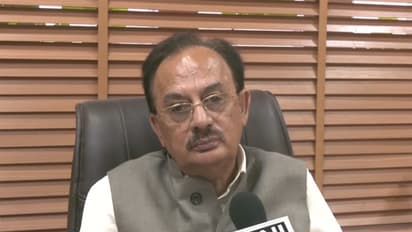
The Industries Minister of Himachal Pradesh, Harshwardhan Chauhan, on Wednesday said the state government had protected the state's financial interests in the long-pending Kishau Multipurpose Project and ensured that Himachal Pradesh would not have to make any financial contribution towards the project, while it is expected to earn around Rs 600 crore annually from the power component.
Chauhan was speaking to ANI in Shimla a day after Himachal Pradesh, Uttarakhand, Uttar Pradesh, Haryana, Rajasthan and Delhi signed an agreement for the Kishau project in the presence of Union Home Minister Amit Shah. The project is proposed on the Tons river, a tributary of the Yamuna, along the Himachal-Uttarakhand border. The Centre has said it will bear 90 per cent of the cost of the water component.
Calling the agreement a welcome development, Chauhan said the Himachal government had particularly focused on protecting the state's interests during negotiations. “The signing of the agreement among the six states is a welcome step. The Chief Minister has protected the interests of Himachal Pradesh very effectively. Himachal Pradesh will not have to spend even a single rupee on this project and the state will receive around Rs 600 crore annually,” he said.
The minister said the project had remained pending for around 25-30 years because of differences over its terms, cost-sharing and other conditions. According to the Centre, the water component will be financed with 90 per cent central assistance and the remaining 10 per cent shared by the participating states.
Chauhan said the earlier arrangement envisaged Himachal Pradesh and Uttarakhand contributing towards the power-generation component, even though several downstream states would benefit from the water. “The Chief Minister strongly pressed the point that if the Government of India was bearing the cost of the water component, why should Himachal Pradesh and Uttarakhand bear the cost of the power component? The Centre accepted this demand. Himachal Pradesh will not have to invest any money in the project,” he said.
He said the financial arrangement would allow Himachal Pradesh to derive revenue from the project without making the proposed investment. Recent reports have also put the expected annual power-related income for Himachal at around Rs 600 crore.
Rehabilitation of displaced families a major issue
Chauhan, whose Sirmaur constituency is among the areas that could be affected by the project, said rehabilitation and resettlement of affected families would be a major issue. “The dam is coming up on the Tons river, which is a tributary of the Yamuna. One side is Uttarakhand and the Himachal Pradesh side falls in my constituency. Around 3,000 people are expected to be displaced and several villages will be affected,” he said.
He said the affected families should receive a comprehensive rehabilitation package covering monetary compensation, land and employment. “We expect the relief and rehabilitation package to be very good so that the affected people do not suffer losses. Whether it is in terms of money, land or employment, the government and the Chief Minister will have to ensure that all aspects of rehabilitation are properly addressed,” Chauhan said.
The Himachal government has earlier said the state's interests were safeguarded in the fresh arrangement, while affected families would be compensated under applicable land-acquisition provisions.
Responding to the political debate over who should get credit for the Kishau agreement, Chauhan said the Centre could claim the resolution of a long-pending inter-state issue, but maintained that the Himachal government had secured important concessions for the state. “If the Government of India wants to call it its achievement, that is a separate matter. But Himachal Pradesh has protected its interests. Our conditions were accepted and implemented. Himachal will not put in even a single rupee and will receive around Rs 600 crore annually,” he said.
The six-state agreement was signed on September 15 after years of negotiations. The project is intended to support water supply, irrigation and hydropower generation across the Yamuna basin.
Minister questions Forest Dept's role in river mining
On the issue of dredging and extraction of material from river basins in Himachal Pradesh, Chauhan openly questioned the role of the Forest Department and said there could be no ambiguity over the jurisdiction of the Mining Department. He said complaints had been received about riverbed dredging and mining-related activities being undertaken without proper consultation with the Mining Department.
“Dredging or mining is not the work of the Forest Department. Mining is the work of the Mining Department. I am receiving complaints and hearing about a number of irregularities. The regulations are not being given the importance they should be,” Chauhan said.
He said the issue had also come up in the Assembly, where BJP members had raised questions and created a commotion over the matter. “There are many things that have been raised in the Assembly. I will not disclose everything because it is not appropriate for me to do so at this stage. But I am also receiving complaints and hearing that many irregularities are taking place,” he said.
Chauhan specifically questioned how responsibility could be fixed on Mining Department officials if activities were being undertaken by another department. “The powers of mining are defined under the mining rules. The designated Mining Officer has the authority in these matters. If somewhere the Forest Department is doing something illegal, how can the Mining Officer be held responsible for it? How can he issue extension forms when an area has already been auctioned and given to somebody else for a particular value?” he asked.
He said the government needed to bring clarity regarding the roles of various departments involved in riverbed extraction and dredging. “We are trying to bring clarity to all these issues. There is a need for a proper policy so that there is no conflict between departments and the specialised department is allowed to perform the work for which it is responsible,” he said.
The minister also questioned whether the state was receiving the revenue it should from mining activities. “The complaints that are coming to me suggest that the regulations are not being properly implemented and the revenue that should come to the state is not coming as expected,” he said.
Explaining the existing mechanism, Chauhan said the mining policy provides for government revenue linked to production and the terms of the auction. He said if an area was auctioned for a particular value, questions could arise if subsequent extensions or extraction activities were undertaken without following the prescribed procedure.
“If an area has been auctioned, how can an extension be issued when the area has already been given to someone else? At what value and under what authority is it being done? These are issues on which we are seeking clarity,” he said.
He indicated that the government was examining whether a separate and clearly defined policy was needed to regulate dredging and riverbed extraction while preventing jurisdictional disputes between the Forest and Mining departments.
'Unfortunate': Minister opposes charges on UPI transactions
On the reported proposal to impose charges on certain UPI transactions, Chauhan termed the move unfortunate and said it could discourage the country's transition towards digital payments. “It is very unfortunate. The policy of the country was to encourage digital and cashless transactions, and people adopted it. Now, after people have developed this habit, imposing a tax or charge on these transactions will put a burden on the common man,” he said.
He said imposing a charge, particularly on higher-value digital transactions, could encourage people to return to cash payments. “You are imposing a charge after people have adopted the habit. The government should withdraw such a tax so that the habit of digital transactions continues. Otherwise, people may again move towards cash,” Chauhan said.
He also questioned the relevance of a proposed threshold of Rs 2,000, arguing that ordinary consumer purchases can easily exceed that amount. “They say transactions above Rs 2,000 will attract a charge and those below Rs 2,000 will not. But what is there today that costs less than Rs 2,000? If you go to a restaurant or buy something, a bill of Rs 2,000-3,000 is common,” he said.
On Jai Ram Thakur's 50-seat claim, Chauhan says voters will decide
Reacting to former Chief Minister Jai Ram Thakur's reported claim that the BJP would return with 50 seats in the next Assembly election, Chauhan said such claims would ultimately be decided by voters. “These are Mungeri Lal ke haseen sapne. The people will decide when the elections come. The people decide how many seats a party gets, who forms the government and who sits in the Opposition. These are just airy claims,” he said.
Chauhan said the BJP had made similar “Mission Repeat” claims ahead of the 2022 Assembly election. He also alleged that the previous BJP government had used its position and government machinery during the election period, saying the people of Himachal Pradesh would ultimately decide the political outcome.
On the Opposition's criticism that the Congress government had failed to fulfil its election guarantees, Chauhan said the government still had around one-and-a-quarter years remaining in its tenure. “We still have around one-and-a-quarter years of our term. Whatever guarantees remain, we will fulfil them,” he said.
He also hit back at criticism of the Congress government, saying the BJP itself faced internal differences. The minister said that the final assessment of the government's performance would be made by the people when the Assembly elections are held.
(ANI)
(Except for the headline, this story has not been edited by Asianet Newsable English staff and is published from a syndicated feed.)Stay updated with the Breaking News Today and Latest News from across India and around the world. Get real-time updates, in-depth analysis, and comprehensive coverage of India News, World News, Indian Defence News, Kerala News, and Karnataka News. From politics to current affairs, follow every major story as it unfolds. IMD cities weather forecastsRain Cyclone Asianet News Official App