Gaganyaan is foundation for larger space ambitions: Astronaut Angad Pratap
Synopsis
Group Captain Angad Pratap said Gaganyaan is a major milestone that will lay the foundation for India's larger human spaceflight ambitions, including the Bharatiya Antariksha Station, and make India the fourth country with this capability.
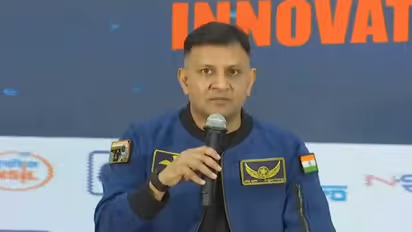
Group Captain and astronaut Angad Pratap on Wednesday said Gaganyaan will lay the foundation for India's larger human spaceflight ambitions, including the Bharatiya Antariksha Station, stressing that the country's ultimate aim should be to make space accessible to everyone and push the boundaries of knowledge for humanity.
Speaking at the Space Expo session 'The Next Chapter of Space: A Conversation on Exploration, Science and Innovation', Pratap said Gaganyaan is about developing India's independent capability to send humans into space and described it as a major technological milestone.
Gaganyaan: A Major Technological Milestone
“Gaganyaan is about acquiring the capability to launch a human to space domestically, here in India. It's a huge capability, and I am very, very eagerly waiting for that day to happen. Because it is a very critical piece of what I would call apex technology, which has 16 to 20 very niche sets of technologies under it. So once you reach that milestone, it is a huge milestone for any country in the world, and we are going to be the fourth country in the world to do that, all by ourselves,” he said.
Beyond Gaganyaan: The Bharatiya Antariksha Station
However, he said India's human spaceflight ambitions should not be limited to Gaganyaan, pointing to the Bharatiya Antariksha Station as an important part of the country's long-term plans. “Notwithstanding that, I wouldn't really restrict myself to Gaganyaan, because in India people currently associate human spaceflight only with Gaganyaan. The Bharatiya Antariksha Station is still in the shadows. So Gaganyaan is nothing but human spaceflight,” Pratap said.
Expanding Knowledge Beyond Earth
He said human spaceflight would allow scientists to expand knowledge beyond what can be learnt by observing phenomena on Earth. “And for those from a physics background, you know about the physics cube. All of the learning we have had, whether in the biological domain or the engineering domain, we have learned primarily by observing things here on Earth. There is much, much more to learn out there, beyond Earth, for which you have to send your scientists. You have to send humans of all specialisations -- who are probably sitting right here -- all the way up there,” he added.
Pratap said Gaganyaan should therefore be viewed as a foundation for much larger human spaceflight programmes. “So Gaganyaan may sound like just one single capability or a technology demonstrator where we just send one person, for one orbit maybe, and bring them back. But that will lay the foundation for much bigger things that I have already talked about, and Tom has already talked about,” he said.
Public-Private Collaboration Essential
He also stressed the need for greater collaboration between the government and private sectors in India's space programme. “We need to make space accessible to everyone. A lot of technology will cross over between the private sector and the government sector -- it's a symbiotic relationship, and both will gain from each other. But the ultimate aim is to push the boundaries of knowledge for humanity as a whole,” he added.
International Perspective: Sunita Williams on Future Space Stations
The session featured Sunita Williams, retired US Navy officer and NASA astronaut and Tom Shelley, Vice President, Crew Partnerships, VAST Space, who discussed the future of space exploration, science, innovation and commercial space stations.
NASA astronaut Sunita Williams said India is “ready for the challenge” of building future space stations, while stressing that advanced technologies, autonomous systems and international cooperation will be critical as human spaceflight moves beyond the International Space Station (ISS).
Williams said the next generation of space stations offers an opportunity to develop systems that can reduce dependence on Earth, including onboard databases, reliable 3D printing and autonomous scientific analysis. Reflecting on her experience aboard the ISS, Williams said astronauts cannot simply rely on a database or search engine in space in the same way people on Earth can. (ANI)
(Except for the headline, this story has not been edited by Asianet Newsable English staff and is published from a syndicated feed.)Stay updated with the Breaking News Today and Latest News from across India and around the world. Get real-time updates, in-depth analysis, and comprehensive coverage of India News, World News, Indian Defence News, Kerala News, and Karnataka News. From politics to current affairs, follow every major story as it unfolds. IMD cities weather forecastsRain Cyclone Asianet News Official App