Farakka Treaty: Bihar CM seeks protection of state's water rights
Synopsis
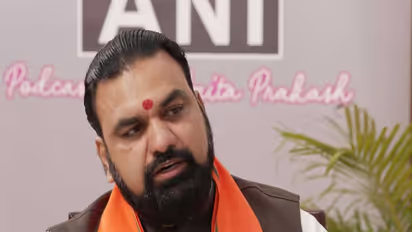
Bihar CM Samrat Choudhary has demanded the state's interests be protected in Farakka Water Treaty talks. He stated Bihar's right to water for drinking, agriculture, and industry must be ensured before providing water to Bangladesh.
Bihar's Stance on Farakka Treaty
Bihar Chief Minister Samrat Choudhary has said that the state’s interests should be protected in any negotiations on the Farakka Water Treaty, which expires in December this year. In an interview with ANI, Samrat Choudhary said the state has lean flow of water in certain period of the year but there is requirment to provide 1,500 cumec of water from the Ganga to Bangladesh and if the state needs for water to meet drinking water needs or for agriculture or industry, it should be able to do so anytime.
He said Bangladesh is a neighbour and if water is to be given under a treaty, it should be given. “My request is that if people of the state need water for drinking needs, if it is needed for agriculture, for supporting industry, it should have the right to take it any time. There is no problem in giving water but the interests of the state should be protected,” he added.
"We urge the Prime Minister that our interests be protected and we urged this to the Foreign Minister as well," he added.
Impact of Farakka and Shifting River Focus
The Bihar Chief Minister also talked about plans for a corridor along Ganga, saying that there has been widening of Ganga expanse because of siltation due to Farakka Barrage and said there has been a lot of widening in Buxar, Patna, Begusarai and Bhagalpur. He said the reclaimed land can be used for industry and other purposes.
Choudhary said Bihar had earlier focused more on the Kosi and Gandak rivers because of the greater threat from those rivers and noted that water level rose in Ganga this year. “We were working more on Koshi and Gandak because we were more afraid of that place. But this time, after 10 years, the level of water in the Ganga has gone to the highest level. The record of 10 years has broken,” Choudhary said.
The 30-year India-Bangladesh Ganga Water Treaty was signed in 1996 and is set to expire in December 2026. JD(U) leader Sanjay Jha had said earlier that Bihar had suffered for 30 years because of the Farakka Barrage Treaty and said the agreement should not be renewed when it expires in December this year.
JD(U) Leader Calls for Non-Renewal of Treaty
"There are two aspects to this. First, when this 30-year treaty was signed in 1996, I do not believe there was any serious consideration given to Bihar's interests by the government in power at the time... Personally, I feel the entire state's interests were sacrificed in this treaty... Previously, the water flowing into the Ganga used to be stored within the river's channel. Now, with that storage capacity lost, the water causes floods in the surrounding areas instead of remaining within the riverbed. The entire stretch of the Ganga is affected by this issue caused by the Farakka Barrage," Jha told ANI.
He said the storage capacity of the Ganga had reduced due to the Farakka Barrage, causing water to spread into surrounding areas during floods instead of remaining within the river channel.
"The second aspect concerns the treaty's provisions for the 'lean season '; there is an agreement to release 1,500 cumec of water from the Ganga to Bangladesh. However, when the Ganga enters Bihar at Buxar during the lean season, the flow is only 400 cumec. This implies that 1,100 cumec of water is being drawn from Bihar's internal river systems to meet this obligation. Consequently, when we need water for irrigation or drinking, that water is diverted to Bangladesh under the treaty... I feel the time has come to decide against renewing the lease when it expires in 30 years," he added.
Bihar-Jharkhand Sone River Agreement
Samrat Choudhary lauded the MoU signed earlier this year between Bihar and Jharkhand on the sharing of Sone River water The MoU was signed on August 31 this year in the presence of Union Home Minister Amit Shah.
Amit Shah had said hat the agreement regarding the sharing of the Sone River's waters is an excellent example of the 'Team Bharat' vision and cooperative federalism. He said that while all states possess their own distinct identities, if they move forward as 'Team Bharat' within the national context, there is no problem which cannot be resolved.
The Union Home Minister also said that the agreement to resolve the nearly 25-year-old water dispute between Bihar and Jharkhand exemplifies that any problem can be solved through dialogue conducted with the spirit of cooperative federalism. He said that issues concerning vast geographical areas, farmers, rural regions, and drinking water supplies in both states have been permanently resolved. (ANI)
(Except for the headline, this story has not been edited by Asianet Newsable English staff and is published from a syndicated feed.)Stay updated with the Breaking News Today and Latest News from across India and around the world. Get real-time updates, in-depth analysis, and comprehensive coverage of India News, World News, Indian Defence News, Kerala News, and Karnataka News. From politics to current affairs, follow every major story as it unfolds. IMD cities weather forecastsRain Cyclone Asianet News Official App